
REVIEW · TROGIR, CIOVO & THE KASTELA COAST
Trogir walking tour with a local guide
Trogir in 90 minutes feels like time travel. This small-group walk knits together Trogir Old Town, Cathedral of St. Lawrence, and the harbor edge, with a local guide explaining what you are looking at as you go. You get art, civic life, and sea views, all in a pace that keeps you oriented without turning it into a museum marathon.
I love how the guide slows you down for the details, especially Radovan’s Portal, so the cathedral feels specific instead of generic. I also like the way the tour blends big monuments with real everyday spaces, like John Paul II Square, where locals treat history like background music.
One possible drawback: with an approximate 1 hour 30 minutes length, you will get highlights and context, not long interior time at every stop. If you plan to linger for lots of photos inside churches, build in extra time on your own.
In This Review
- Key Highlights You Will Actually Feel on This Tour
- Why This 90-Minute Trogir Walk Works
- Price and Logistics: What You Get for $18.14
- Getting Oriented Near Ul. Gradska vrata 5
- Stop 1: Cathedral of St. Lawrence, Built Across Five Centuries
- Stop 1b: Radovan’s Portal, the Sculptural Hit
- Stop 2: John Paul II Square, a History Break You Can Enjoy
- Stop 3: Trogir Town Hall and Its Venetian Exterior Staircase
- Stop 4: St. Sebastian Church and the Clock Tower
- Stop 5: Town Loggia, Where Citizens Met
- Stop 6: Palace Cipiko and the Romanesque-to-Venetian Shift
- The Garagnin-Fonfogna Palaces, the North Gate Area
- The Kairos Bas-Relief: A Small Stop With a Big Meaning
- Church of Our Lady of Mount Carmel: Fishermen and Craftsmen
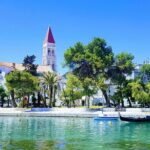
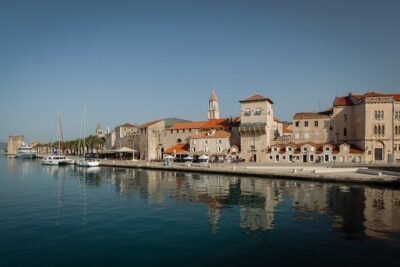
- Stop 7: The Riva Promenade, Trogir’s Palm-Fringed Sea Walk
- Finish: Kamerlengo Castle and Waterfront Power
- What Makes the Local Guide Part of the Value
- Pace, Timing, and a Realistic Expectation
- Who This Trogir Tour Is Best For
- Should You Book This Trogir Walking Tour With a Local Guide?
Key Highlights You Will Actually Feel on This Tour
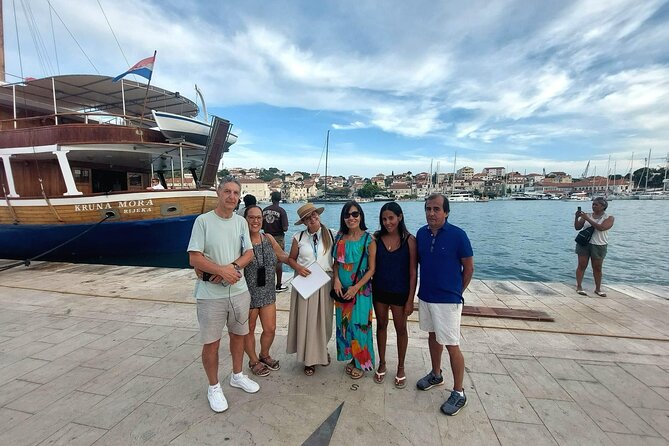
- Small group, local guide energy: a maximum of 15 people helps the pace stay conversational.
- The Cathedral of St. Lawrence is the anchor: construction started in 1213 and stretched for five centuries.
- Radovan’s Portal is an instant wow: a first-half-13th-century masterpiece by Master Radovan.
- Civic Trogir in the open air: you pause at John Paul II Square, then move through town hall, loggia, and church spaces.
- Waterfront views that make the walk pay off: the Riva promenade leads your eyes to Čiovo and finishes at Kamerlengo Castle.
- Personal storytelling is part of the deal: guides share family and life in the region, which makes the history stick.
More of the coast running west from Trogir
- Blue cave, Mama Mia and Hvar, 5 island speedboat tour from Trogir★ 5.0 · 2,861 reviews
- From Trogir: Three Islands Half-Day Speedboat Tour★ 4.8 · 804 reviews
- From Trogir or Split: Full-Day Blue Cave & Hvar Island Tour★ 4.7 · 413 reviews
- Half Day Speedboat Tour to Three Islands from Trogir★ 5.0 · 401 reviews
Why This 90-Minute Trogir Walk Works
Trogir is compact, but it is also easy to get turned around in its stone streets. This tour is built to solve that problem fast. In about 1.5 hours, you cover the core sights in the order that makes sense geographically, so you stop wandering and start connecting dots.
What makes it especially good value is that the route hits two kinds of sightseeing. First, you get the major landmarks tied to centuries of building, from Romanesque to Gothic. Second, you get the “how people lived” spaces, squares, loggias, and churches connected to specific communities like fishermen and craftsmen.
The result is a tour that feels like a guided orientation. You leave with a mental map and enough context to notice things you would otherwise miss.
Price and Logistics: What You Get for $18.14
At $18.14 per person, this is one of those tours that can fit into almost any budget. The duration matters here: 90 minutes is long enough to explain the why behind the walls, but short enough to pair with beach time, a waterfront lunch, or a second wander through the Old Town.
A few practical notes help you plan smoothly:
- English language option is available.
- You receive a mobile ticket.
- Group size tops out at 15 travelers, which usually keeps questions possible.
- It is generally scheduled so you can join without needing special skills.
Also, the tour is typically booked ahead. If you are visiting in peak season, I would not treat this as a last-minute maybe. Lock it in early so you can build the rest of your day around it.
Getting Oriented Near Ul. Gradska vrata 5
Your meeting point is Ul. Gradska vrata 5, 21220, Trogir. That matters because it puts you close to the entry area where the Old Town begins to feel like a maze of lanes.
The ending point is Obala bana Berislavića, 21218, Trogir, which keeps you near the waterfront side of the town. That is a smart finish, because once you know your bearings you can naturally drift toward the sea instead of doubling back.
Bring comfortable shoes. Trogir’s streets are not always flat, and you will be walking a continuous loop through Old Town plus the promenade.
Stop 1: Cathedral of St. Lawrence, Built Across Five Centuries

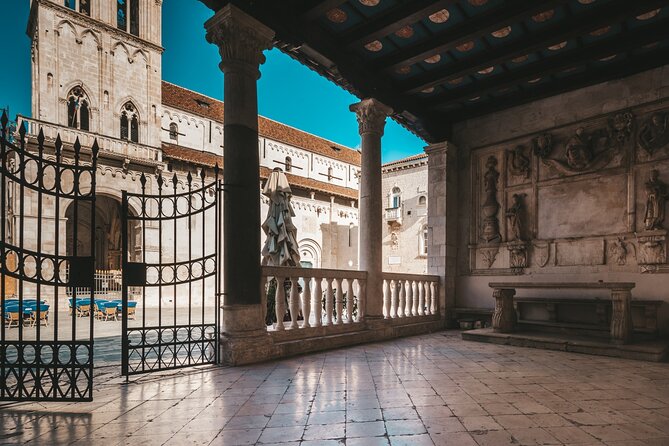
The tour’s core monument is the Cathedral of St. Lawrence. Construction began in 1213 and stretched for five centuries, and you can feel that layering in how the building looks. It has three naves, and it blends Romanesque and Gothic styles, so you are not looking at one single “snapshot” of medieval art. You are seeing time accumulate in stone.
Even if you only glance quickly, the big body of the cathedral gives you a sense of how important Trogir was as a node on the Adriatic. Then the guide brings it down to details.
One of the best payoff moments is the bell tower. From up there, the views are described as panoramic, including the island of Čiovo, the mainland, and the Adriatic Sea. If you time your climb well and the day is clear, this is the kind of view that makes you understand why towns here were built where they were.
More Trogir covered at walking pace
- Trogir: City Highlights Guided Walking Tour
★ 4.9 · 199 reviews - Trogir: Old Town Guided Walking Tour
★ 4.6 · 76 reviews - Split Old Town Walking Tour
★ 5.0 · 25 reviews - Private Trogir walking tour with LOCAL guide
★ 4.8 · 23 reviews - Discover Trogir: Guided Walking Tour of a Medieval Gem
★ 5.0 · 13 reviews
Stop 1b: Radovan’s Portal, the Sculptural Hit
Right at the cathedral is Radovan’s Portal, the main entrance sculpted by Master Radovan, a craftsman from medieval Trogir. This is dated to the first half of the 13th century, and it is the kind of artwork that rewards even a short look.
What I like about how the guide frames it is that you are not just told it is impressive. You learn how to see it. Once you understand the role of a master sculptor and the medieval “team” behind portals like this, the carvings feel less random and more purposeful.
This stop is one reason the tour is worth doing early in your stay. After you see this portal and learn what it signals about craft and patronage, the rest of the Old Town’s buildings start speaking a similar language.
Stop 2: John Paul II Square, a History Break You Can Enjoy
Then you shift gears to John Paul II Square (Trg Ivana Pavla II). This is described as one of the most beautiful historic piazzas in Trogir, framed by major buildings and taken over by café life on sunny days.
The practical genius here is that the square functions like a mental reset. You get a pause, you can sit for a moment, and you can let the morning’s architecture sink in before you move back into the stone maze.
If the weather is cooperative, this is where you can do a small, low-stress thing, like grabbing an ice cream or a coffee and simply watching. You are still “on tour,” but you are doing it like locals: in the open air, with time to look.
Stop 3: Trogir Town Hall and Its Venetian Exterior Staircase

Next up is the Town Hall, built in the 15th century. The highlight here is the stone building with an elegant courtyard decorated with coats of arms, plus a striking feature that the guide points out: the exterior staircase as an example of Venetian architecture in Trogir.
This is one of those stops where a good guide makes the difference. A staircase sounds like a minor detail until someone explains why it looks like it does, what style it signals, and how Venetian influence traveled and stuck. Then suddenly you notice other “Venice in Croatia” hints across the town.
It also helps you understand how civic power looked in stone. This was not just decorative. Town halls and staircases were built for ceremonies, movement, and public presence.
Stop 4: St. Sebastian Church and the Clock Tower

St. Sebastian’s Church and Clock Tower comes next, built in 1476 by the citizens of Trogir. The reason is vivid: people were grateful to be delivered from the plague, so the church is tied to survival and community gratitude.
The architect named here is Niccolò di Giovanni Fiorentino, also known as Nicolas of Florence. When you hear that name come up again later, it helps connect the dots across different buildings. It is a neat way to show that styles are not random. Designers and craftsmen left footprints.
The clock tower aspect matters even if you only see it briefly. It is a reminder that in towns like this, timekeeping was not abstract. The day ran around signals, bells, and public landmarks you could spot from multiple directions.
Stop 5: Town Loggia, Where Citizens Met
Just next to the civic core is the Town Loggia, dating back to the 13th century. This is a covered space where citizens once gathered to discuss issues of the day. On certain days, the local court would also meet there to proclaim laws and proceed with court cases.
I like this stop because it turns the “pretty buildings” into something more human. You start imagining voices in the same spot where you now stand, and you understand that loggias are not only decorative arches. They are communication hubs.
If you are someone who likes history that explains how people functioned day to day, this is the kind of detail that makes the tour feel like more than sightseeing.
Stop 6: Palace Cipiko and the Romanesque-to-Venetian Shift
Then you reach Palace Cipiko, also called the Great Cipiko Palace. It is described as a group of Romanesque buildings that later took on a Venetian Renaissance look between the 15th and the 17th centuries, after extensive remodeling.
This is a key lesson in how Trogir changed over time. Instead of looking at one building frozen in one style, you see the town revise itself. The guide also notes that Niccolò di Giovanni Fiorentino worked on this project, and mentions he carved the south portal.
If you want a quick “aha,” this is it. The south portal and the mixture of styles are like a visual biography of the town.
The Garagnin-Fonfogna Palaces, the North Gate Area
As you step into the Old Town through the North Gate, you pass an area of palaces tied to the Venetian family Garagnin-Fonfogna. The museum sits within those palaces, and the timing of this stop matters. You are entering the Old Town, so it feels like the story starts right at the boundary.
Even if you do not go inside, it helps to know that this is the kind of structure families occupied and reshaped. Palaces like this are not only about wealth, they are about setting the tone for the street life around them.
The Kairos Bas-Relief: A Small Stop With a Big Meaning
On the route, you also come across a bas-relief that tells a story through imagery. It shows a young man standing on tiptoe, arms outstretched, holding a pair of scales. He has a tuft of hair falling over his forehead, but his crown is bald, and the guide explains that the figure represents Kairos, the right moment.
The message is practical even if you do not think of sculpture as advice. When the right moment comes, do not be afraid to seize it, because it will not wait forever. If you like art that gives you a mental takeaway, this is a clever pause that keeps the tour from becoming only about dates and styles.
Church of Our Lady of Mount Carmel: Fishermen and Craftsmen
Next is the Church of Our Lady of Mount Carmel, founded in the Middle Ages. The guide ties it to the community it served, historically a church of Trogir’s fishermen, craftsmen, and laborers.
Location-wise, it is just off the waterfront promenade in the western part of the Old Town. That makes it a good transition stop, because it reconnects you with the sea without jumping straight into pure scenery.
There is also a specific seasonal detail worth flagging. If you are in Trogir on 16 July, the church evening procession with the statue of Our Lady is part of the tradition. Even if you are not there then, it’s a reminder that these are living religious spaces, not only photo backdrops.
Stop 7: The Riva Promenade, Trogir’s Palm-Fringed Sea Walk
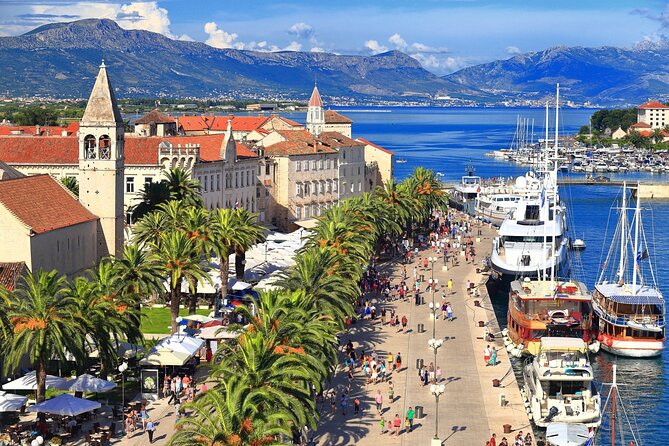
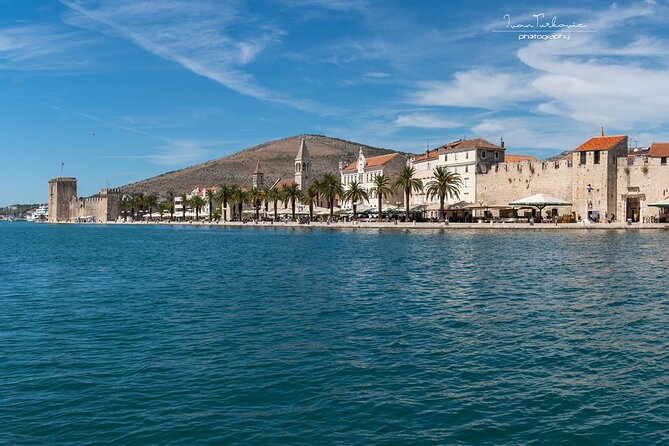
After the church, the route heads to Riva, which locals call Trogir’s palm-fringed promenade. The description here is very specific: wide, flat, and straight, running along the water edge.
This part is not random scenery. It is a chance to reset your eyes and let the town’s architecture breathe. From here, you get splendid views across the sea channel to Čiovo. It also gives you a different sense of Trogir’s shape, because you can spot where the Old Town sits on its tiny island corner.
If you are the type who needs a break mid-tour, this promenade segment is it.
Finish: Kamerlengo Castle and Waterfront Power
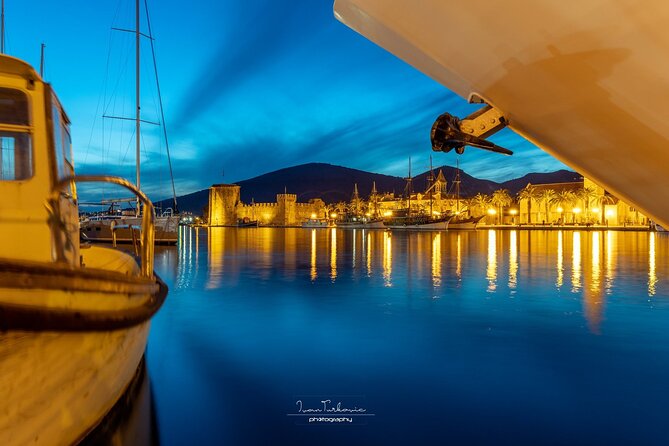
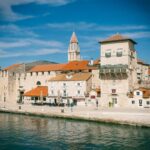
At the end of the promenade is Kamerlengo Castle, an early 15th-century fortress at the corner where the Old Town sits on its tiny island. It is positioned so you can understand its defensive logic, close to the water and visible from where people would approach.
Right nearby, the route points out a local football pitch and a small playground, plus stalls connected to tour operators. That mix is part of the charm. Even with castles and cathedrals, the area stays tied to daily life.
This ending works because it is a full circle feeling. You started near the Old Town boundary and moved through civic and religious landmarks, and now you end at the water and the fortification edge.
What Makes the Local Guide Part of the Value
The most praised aspect of this tour is not just the buildings, it is the way the guide explains them. People consistently mention that guides bring history to life with calm, easy pacing and strong local insight.
You will likely hear personal stories, often family connected, because a local guide can connect the dots between today’s streets and the longer story underneath them. That matters because it turns memorizing facts into understanding patterns, like why Venetian influence shows up in staircases and portals, or how plague survival ended up in church-building.
Also, with a group size capped at 15, you should be able to ask small questions without being swallowed by a crowd.
Pace, Timing, and a Realistic Expectation
The tour length is approximately 1 hour 30 minutes, and that is the right frame to use when you book. Some stops are intentionally quick highlights, designed to cover key sights without slowing to a crawl.
If you want “tour plus extra time in every church,” you may need to do a second visit on your own later. If you want a clear overview that helps you prioritize, you will be happy here. It is the kind of guided start that makes your self-guided wandering afterward far more satisfying.
You should also note that this experience requires good weather. If conditions are poor, you will be offered a different date or a full refund, so plan flexibly.
Who This Trogir Tour Is Best For
This works well for:
- First-timers in Trogir Old Town who want a fast, meaningful orientation.
- Travelers who like architecture but also want human context, like plague gratitude or how fishermen built their community spaces.
- People who prefer a small-group tour with time to ask questions.
It might not be ideal if you only want long inside-the-building visits or if you are hoping for a detailed stop at every single interior chapel. This is built around flow and highlights.
Should You Book This Trogir Walking Tour With a Local Guide?
I think you should book it if your priority is understanding the town quickly and seeing the right sights in the right order. For the price, $18.14, you are paying for guidance that turns a confusing maze of streets into a story with landmarks you can remember.
Skip it only if you already have a strong grasp of Trogir’s cathedral, Venetian influences, and civic architecture, and you plan to read and wander on your own all day. Otherwise, this is a smart way to get your bearings fast, then spend the rest of your time enjoying cafés in John Paul II Square and the views from the Riva promenade.
Walk It: More of Trogir at Ground Level
West Along the Kastela Coast


Freshly written up around Trogir
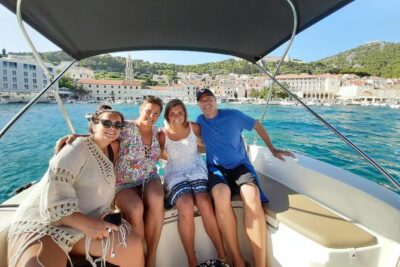
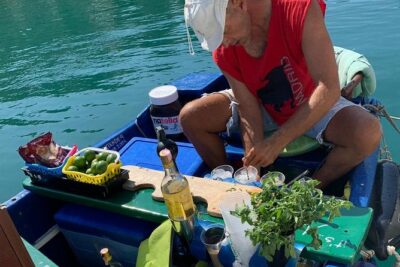
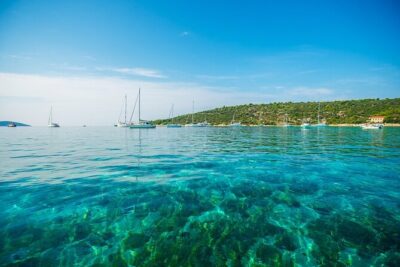
Trogir, Ciovo & the Kastela Coast, top to bottom.
 ★ 4.6Split/Trogir: Blue Cave, Mamma Mia, Hvar and 5 Island TourFrom $1096,320 reviews
 ★ 5.0Blue cave, Mama Mia and Hvar, 5 island speedboat tour from TrogirFrom $1112,861 reviews
 ★ 5.0Krka Waterfalls Day Tour with Boat Ride from Split and TrogirFrom $322,134 reviews
 ★ 5.0Krka Waterfalls tour with Trogir Walking tour and Krka panoramic boat cruiseFrom $481,659 reviews
 ★ 5.0Krka National Park Tour with tour Guide & Wine tasting from Split & TrogirFrom $501,625 reviews
 ★ 4.5Hvar, Brač & Pakleni islands cruise with lunch & drinks from Split & TrogirFrom $951,452 reviews
 ★ 4.7Split/Trogir: Krka National Park Day Trip with Wine TastingFrom $49925 reviews
 ★ 4.8From Trogir: Three Islands Half-Day Speedboat TourFrom $67804 reviews
Browse the lists this tour appears in