
REVIEW · ZADAR OLD TOWN & SEA ORGAN TOURS
Zadar Guided Tour with Virtual Reality Experience
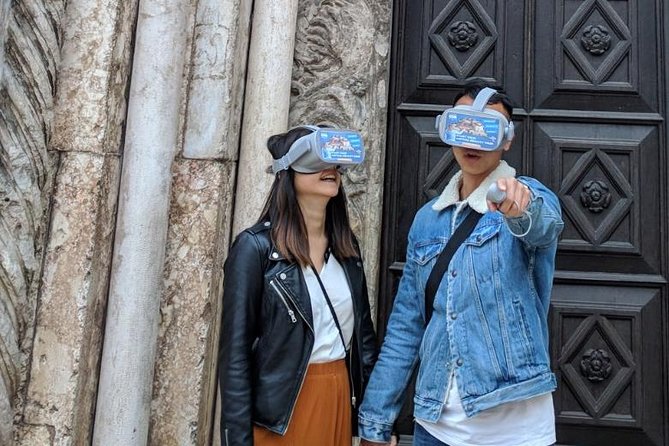
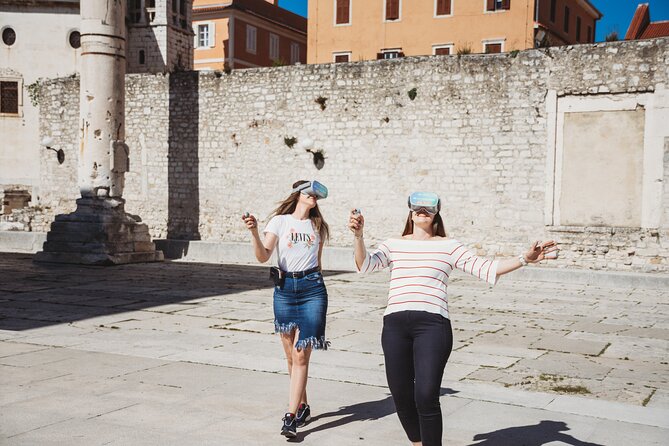
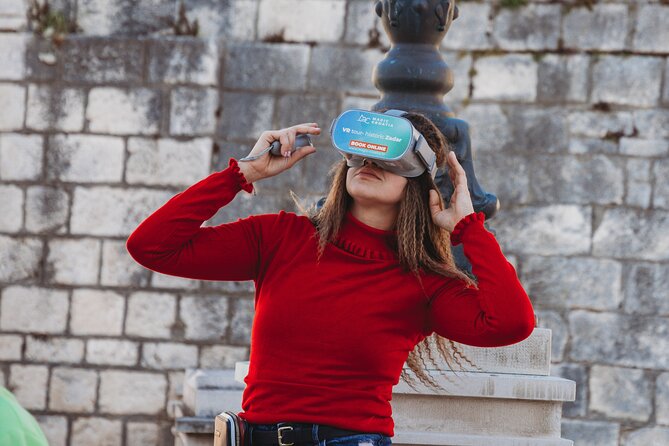
Zadar feels different when your guide hands you VR. This 2 hour walking tour uses VR headsets to show places you usually cannot enter and to reconstruct vanished moments in Zadar’s past, led by an English guide. I especially like that it gives you physical stops in the Old Town while the VR does the heavy lifting of time travel. One note to keep expectations realistic: the VR can feel basic at a few stops, sometimes like a simple panorama, and the visual quality may not match modern games.
You will start at Magic Croatia – Travel Agency on Poljana Pape Aleksandra III 7 and end at the Sea Organ on the promenade. The pace is steady, with short visits at each location (mostly around 10 minutes, one a bit longer), and the sites come with free admission tickets. The group stays small, capped at 25 people, which makes questions easier and keeps the whole thing from turning into a sprint.
This is a good fit if you like history explained clearly and you want something more active than a standard city stroll. You can expect a walking route in Zadar’s historic center, with near public transportation for getting there and service animals allowed. Most participants can join, but you will be standing and moving between stops, including times when you look down or tilt your head while using VR.
In This Review
- Key highlights I think you will care about
- Two Hours in Zadar That Actually Adds Up
- From Magic Croatia to the Sea Organ: How the Route Plays
- VR Headsets in the City: What to Expect When You Look Around
- Church of St. Krsevan (Chrysogonus): Seeing a Romanesque Interior You Cannot Usually Enter
- St. Simon’s Church: The Gothic Reliquary That Makes the Room Feel Different
- Five Wells and the Layers of Zadar’s Walls
- The Forum: Roman Scale, VR Air Views, and a Center-Stage Moment
- St. Anastasia’s Bell Tower Scene: WWII Bombing, Seen From Above
- Cathedral of St. Anastasia: Dalmatia’s Largest Cathedral and Closed Rooms You Can See in VR
- Paseo Marítimo: The Former Market, the Missing Post Office, and Planes Over the City
- Sea Organ and the Greeting to the Sun: Finishing With Then and Now
- Price and Value: Why $36.04 Can Be a Good Deal
- Who This Tour Fits Best
- Should You Book It?
- FAQ
- How long is the Zadar guided tour with virtual reality?
- What does the tour cost?
- What is included in the experience?
- What language is the tour offered in?
- Where do we meet for the tour?
- Where does the tour end?
- What time does the tour start?
- Is there a group size limit?
- Are the attraction tickets included?
- Can I cancel, and are service animals allowed?
Key highlights I think you will care about
- VR headsets included for every main time-travel scene, not just one demo
- A guided route with English support and clear narration at the sites
- Access via VR to spots that are normally closed (like monastery areas and cathedral rooms)
- WWII reconstruction in multiple places, not just one dramatic stop
- Old Town connections from Roman to medieval to Venetian to modern Zadar, all in one walk
- Ends at the Sea Organ, so you finish on the seafront instead of backtracking
Other Zadar outings we thought were worth a look
- Zadar: Plitvice Lakes Guided Day Tour with Tickets★ 4.9 · 3,148 reviews
- Zadar: Kornati Boat Trip with Lunch and Swim Stops★ 4.5 · 1,498 reviews
- Zadar: Plitvice Lakes with Boat Ride and Zadar Old Town Tour★ 4.9 · 1,368 reviews
- From Zadar: Plitvice Lakes with Boat Ride & Zadar Old town tour★ 5.0 · 1,129 reviews
Two Hours in Zadar That Actually Adds Up

This tour works because it compresses a lot of Zadar into a format that stays readable. You get a sequence of landmarks, and the VR scenes help stitch them together, so the story does not feel like a list of monuments.
The timing is practical: most stops land around 10 minutes, which keeps the walk from dragging. It also means you are not waiting around for long periods while you try to line up VR moments, listen to narration, and then move on.
From Magic Croatia to the Sea Organ: How the Route Plays

You meet at Magic Croatia – Travel Agency at Poljana Pape Aleksandra III 7, with a 10:00 am start. You finish at the Sea Organ on Obala kralja Petra Krešimira IV, which is an easy way to turn the tour into a half-day plan on the promenade afterward.
This ending matters more than it sounds. Zadar’s waterfront areas are where you can naturally slow down, and the Sea Organ is the kind of place where the tour’s theme of time and place feels complete. If you like to keep your plans light, this “walk out to the sea” layout is a strong choice.
VR Headsets in the City: What to Expect When You Look Around
VR here is not a single cinematic show. Instead, your VR headset acts like a tool that changes what you notice at each stop, from adding reconstructed interiors to showing how damage shaped the city.
That said, take the VR quality as variable. Some scenes may be more like a dated simulation or a clean panorama view, and at least one VR segment can feel a little strange, especially when you look down with no obvious floor beneath you. If you are prone to motion oddness, start with a slower head tilt and keep your body steady before you let your eyes roam.
Church of St. Krsevan (Chrysogonus): Seeing a Romanesque Interior You Cannot Usually Enter
Stop one is the Church of St. Krševan, linked to Chrysogonus, a male Benedictine monastery church built in 1175. Outside, it is described as one of the most beautiful Romanesque churches you will see, well preserved, and the key twist is that it is typically closed and often missed by casual sightseeing.
VR changes the rules. You will use the headset to visit the monastery courtyard and to see the interior, giving you a sense of space you usually cannot get on foot. Practically, this is a great opener because it sets expectations: you are not just looking at stone, you are also learning how the building worked.
Tip: Keep your camera away here if you want the best experience, because you will want your attention on the reconstructed view rather than repeating the same photo angles.
- Zadar: Plitvice Lakes Full-Day Guided Tour with a Boat Ride
★ 4.7 · 807 reviews - From Zadar: Kornati National Park and Telascica Boat Trip
★ 3.8 · 788 reviews - Zadar: 3 Islands Luxury Boat Tour with Aperol Spritz
★ 4.9 · 774 reviews - Zadar: Kornati and Telašćica Cruise with Ticket Included
★ 4.2 · 759 reviews - Zadar: Original Island-Hopping Speedboat Tour
★ 5.0 · 654 reviews
St. Simon’s Church: The Gothic Reliquary That Makes the Room Feel Different
Next comes St. Simon’s Church, focused on the interior of the church of St. Simeon. The star is the biggest city treasure, a silver pleated Gothic chest built for the relics of St. Simeon, a patron saint still loved and recognized today.
This stop is short, about 10 minutes, so the experience is more about orientation than lingering. You will get a clear explanation of what the reliquary represents and why it carries civic pride, which helps you look past the surface and notice the details in the materials and form.
Five Wells and the Layers of Zadar’s Walls
At Five Wells, the tour shifts from buildings to the city’s defense lines and gateways. You will learn about construction tied to the Roman gates that served as entrances to the antique city of Zadar.
Then the narrative steps forward through time: you will see where the entrance to the medieval city sits, and you will also spot the construction of the Venetian walls. The payoff here is understanding why Zadar feels “stacked” with different eras in close proximity. It is not random. It is built on centuries of control, trade, and defense.
This is one of those stops where taking a couple of minutes to look at the edges and transitions helps. When you know what you are viewing, those stone lines stop being just scenery and start being a map you can read.
The Forum: Roman Scale, VR Air Views, and a Center-Stage Moment
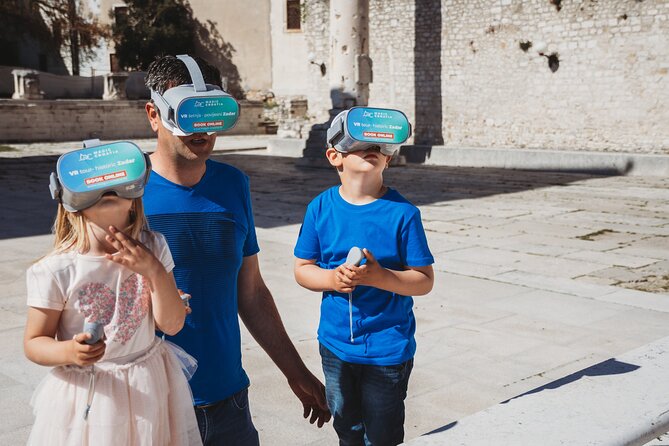
The Forum stop is one of the tour’s core experiences. You will visit the remains of the Roman Forum in Zadar’s Old Town, described as the biggest Forum built in Croatia, constructed from the 1st to 3rd century, and now visible largely as ruins.
VR adds a big missing piece: you will see the Forum from above, like from a hot-air balloon. An audio guide provides interesting facts during the VR portion, which helps you connect the aerial shapes to what you later see at ground level.
Then you step into the Forum setting, standing in the very center surrounded by recreated buildings and statues. Even if you are not a VR superfan, this is a smart use of technology because it gives you a sense of scale. After that, you will face a temple dedicated to Jupiter, Juno, and Minerva dating from the 1st century BC, and you will hear a story about ancient religious rituals.
One of the most satisfying parts here is the contrast you get when the VR ends. You are looking at structures that have held on for about 2000 years in some form, which makes the ruins feel more tangible.
Practical note: Because VR quality can vary by scene, focus on the narration and the spatial layout. If a segment feels more basic, the Forum’s real-world ruins still carry weight.
St. Anastasia’s Bell Tower Scene: WWII Bombing, Seen From Above
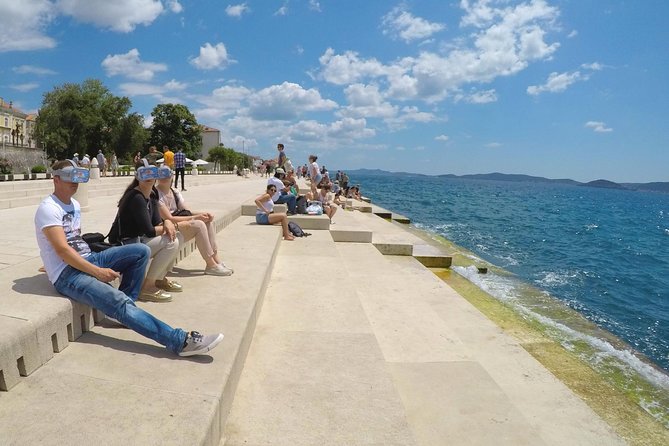
Next you get a stark visual chapter focused on WWII. In the Bell Tower segment, you look at Zadar’s Old Town as if you are standing at the top of the St. Anastasia’s bell tower.
The VR portion shows air attack and bombing, with buildings burning and collapsing as airplanes drop bombs. When the visuals end, you see a map showing heavily damaged areas of the city that do not exist anymore.
This stop can feel heavy, but it is also a useful education. Zadar’s seafront and Roman stones look calm now, so seeing the damage in a reconstructed way explains why certain areas and landmarks changed or vanished.
Cathedral of St. Anastasia: Dalmatia’s Largest Cathedral and Closed Rooms You Can See in VR
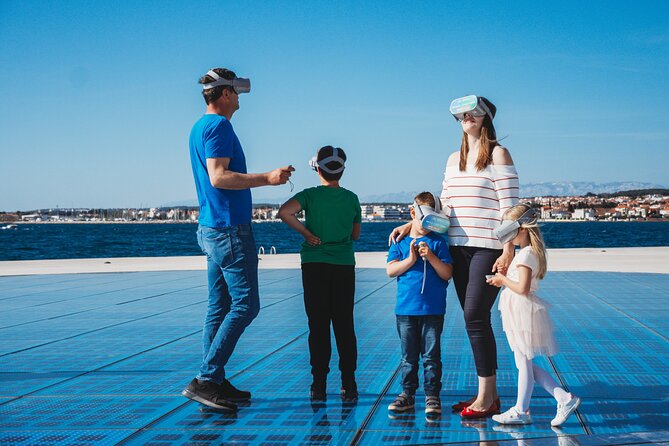
St. Anastasia’s Cathedral was built in the 12th and 13th century and is the largest cathedral in the Dalmatia region. St. Anastasia is one of the city’s protectors, and her relics are housed inside.
VR here is not about watching from far away. You will be able to visit the cathedral with the headset and hear the story of St. Anastasia, plus take a look inside the baptistery and sacristy, places that are closed for public. That matters because it adds access without you needing special permissions.
This is a good stop for people who like religious art, architecture details, and understanding how saints and local tradition shape a place. It also balances the WWII material by giving you something grounded in craftsmanship and ongoing faith.
Paseo Marítimo: The Former Market, the Missing Post Office, and Planes Over the City
On the Paseo Marítimo, you walk the area tied to the former city market. You will learn that people used to sell fish, vegetables, fruits, and other products here, and that today’s open market sits on the opposite side of the city because the old one was destroyed during WWII bombings.
The VR adds the missing city layer. You will see residential buildings and a post office that does not exist anymore, plus planes dropping bombs on the city. Even though you are standing in the present-day promenade, the VR reframes what used to be there.
This is also where the tour’s concept really clicks. The walking route shows you what survived, and the VR shows you what changed. The result is a clearer mental map of Zadar’s breakpoints.
Sea Organ and the Greeting to the Sun: Finishing With Then and Now
The final stop is the Sea Organ, part of the seafront promenade where the Greeting to the Sun and Sea Organ installation sits, built in 2005. You will get VR that shows how this location looked in the 13th century.
Then you get another scene from above, again with the hot-air balloon perspective, showing Crusaders attacking Zadar from the sea. You will hear the background story tied to the idea that Zadar was a Catholic city at that time.
Finishing here makes sense. By the time you reach the Sea Organ, you have already seen Roman structures, medieval layers, wartime destruction, and cathedral tradition. Ending at a modern landmark built in 2005 gives you a sense of continuity, how the city keeps creating new meanings on the same shoreline.
Price and Value: Why $36.04 Can Be a Good Deal
At $36.04 per person for about 2 hours, the value depends on what you want from your day.
You are paying for three things that are hard to replicate separately on your own:
- A guided walk that connects sites across time periods.
- VR headsets included for multiple scenes, including access to spaces that are normally closed.
- A route that keeps you moving efficiently, ending where many people want to be anyway, at the sea promenade.
Also, the tour’s stops list admission ticket free for each location, which helps you avoid surprise costs while still seeing a lot of key landmarks.
If you are the type who likes learning and you enjoy visual reconstructions, the price can feel fair. If you expect top-tier, cutting-edge VR production at every stop, you might find the experience uneven, because some segments can look basic or dated.
Who This Tour Fits Best
This is a strong choice if you:
- want an easy way to understand Zadar in a short window
- like seeing normally closed interiors in a low-effort way
- are okay with a mix of real-world ruins and VR reconstructions
It also tends to work well for families with teens and people who like interactive tech, since VR breaks up the walking. If you are traveling solo, the small group size and guide support can make it feel less lonely.
If you have limited tolerance for VR that feels older in style, consider that the quality varies by scene. You can still enjoy the walking part and the landmark explanations, but the VR may not be perfectly “wow” at every stop.
Should You Book It?
I would book this tour if you want a guided Zadar experience that uses VR for practical reasons, not just novelty. The best moments are when VR helps you see interior spaces that are typically closed, and when it clarifies how WWII and earlier centuries shaped what you see today.
I would think twice if you are very picky about visual quality. The VR can be basic in places, and one or two scenes may feel like a simple panoramic look rather than a detailed, modern simulation.
If you can accept that the VR experience varies, you will likely enjoy the overall structure and the fact that you finish at the Sea Organ with your head full of a clearer Zadar story.
FAQ
How long is the Zadar guided tour with virtual reality?
The tour lasts about 2 hours.
What does the tour cost?
The price is $36.04 per person.
What is included in the experience?
Virtual reality headsets are included, and you have a guide available during the walking tour.
What language is the tour offered in?
English is offered, and tours are available in multiple languages.
Where do we meet for the tour?
The start point is Magic Croatia – Travel Agency, Poljana Pape Aleksandra III 7, 23000, Zadar, Croatia.
Where does the tour end?
The tour ends at the Sea Organ on the sea promenade, Obala kralja Petra Krešimira IV, 23000, Zadar, Croatia.
What time does the tour start?
The start time is 10:00 am.
Is there a group size limit?
Yes, the maximum number of travelers is 25.
Are the attraction tickets included?
Admission tickets are listed as free at the tour stops.
Can I cancel, and are service animals allowed?
Free cancellation is available up to 24 hours in advance for a full refund. Service animals are allowed, and the meeting area is near public transportation.
Zadar, A Few More Outings




Freshly written up around Zadar
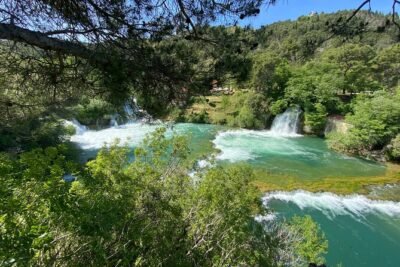
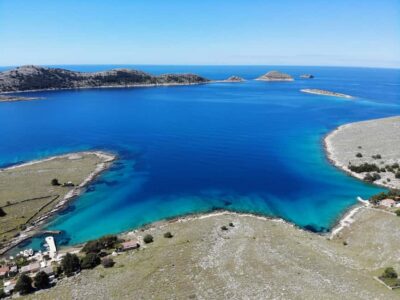
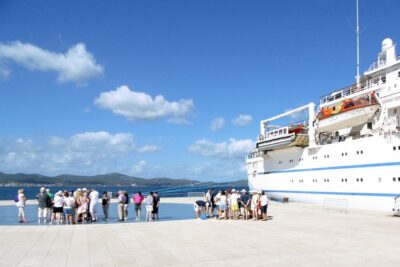
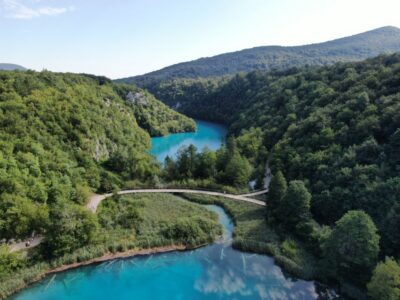
Zadar Old Town & Sea Organ Tours, top to bottom.
 ★ 4.9Zadar: Plitvice Lakes Guided Day Tour with TicketsFrom $883,148 reviews
 ★ 4.8Zrmanja River: Half-Day Guided Kayaking Tour Near ZadarFrom $641,817 reviews
 ★ 4.5Zadar: Kornati Boat Trip with Lunch and Swim StopsFrom $641,498 reviews
 ★ 4.9Zadar: Plitvice Lakes with Boat Ride and Zadar Old Town TourFrom $531,368 reviews
 ★ 4.9From Zadar: Island-Hopping Speedboat Tour with DrinksFrom $381,247 reviews
 ★ 4.1Zadar: Kornati and Telašćica Full-Day Boat Trip with LunchFrom $511,193 reviews
 ★ 4.7Zadar: Plitvice Lakes Full-Day Guided Tour with a Boat RideFrom $58807 reviews
 ★ 3.8From Zadar: Kornati National Park and Telascica Boat TripFrom $64788 reviews
Browse the lists this tour appears in