
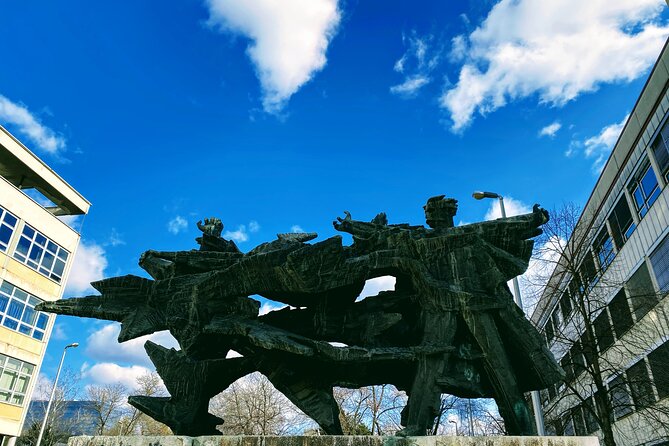
REVIEW · CITY TOURS
Back to Yugoslavia Private City Tour in Old-Timer Yugo Car
A Yugo car makes history feel real. This private Zagreb communism sightseeing tour mixes architecture, public spaces, and street-level stories, all while you roll around in an original 35 year old Yugo with a licensed local guide. I especially love how the guide ties the Yugoslav era to everyday life, and how the car ride turns a history tour into something you actually feel in your body, not just read about.
You do need to go in with the right mindset. Some of the route is outdoors, and the experience works best in good weather, so plan for a bit of walking and standing in open air. If you want only highlights with zero political context, this might feel a little more focused than you expect, but that also depends on what you ask the guide.
One more thing that makes this tour practical: it’s private and you get to shape the pace. You start at Vatroslav Lisinski concert hall and finish back there, or at a spot you choose within about 3 km of the main square, which is handy after a tour that ends in the center.
In This Review
- Key highlights that make this tour worth your time
- A Yugo ride changes how you see Yugoslav Zagreb
- Meeting at Lisinski, then letting your tour fit your interests
- Gorica open air market and the abandoned dishes factory stop
- Travno and the Mammoth apartment building in your line of sight
- Zagreb Fair and Kockica, the Dice building shaped by power
- The Sava River levee walk and Hendrix Bridge views
- The concert hall for Eurovision 1990 and the Lady from Zagreb pass-by
- Dražen Petrović Museum and Cibona tower, sport history meets city form
- What makes the guide work so well on this kind of tour
- Price and value for a $102.41 private 2.5-hour experience
- When this tour is a great fit
- A realistic drawback to keep in mind
- Should you book the Back to Yugoslavia tour in a Yugo?
- FAQ
- Where does the tour start and end?
- How long is the tour?
- What is the price per person?
- Is the tour private?
- What language is the tour offered in?
- What’s included in the tour?
- Does the tour depend on weather?
- Are mobile tickets used?
- Is there free cancellation?
Key highlights that make this tour worth your time
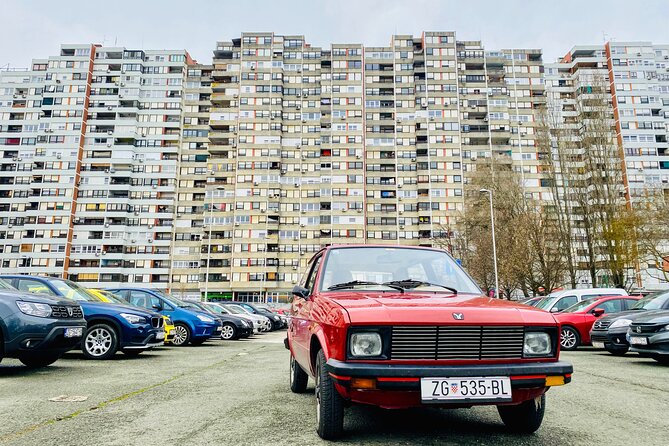
- Private, bespoke pace so you can spend longer on what interests you (and skip what doesn’t)
- Original 35 year old Yugo car for a classic, photo-friendly ride through communist-era Zagreb
- Licensed local guide who connects Yugoslav history to real neighborhoods and daily life
- Architecture hits including the Mammoth in Travno and Zagreb’s famous communist-era buildings
- Sava River levee walk with a stop at the well-known Hendrix bridge area
- Memorial stop for Dražen Petrović near Cibona tower and the basketball legacy
More city-scale tours around Zagreb
- Zagreb: Small Group Walking Tour City Center and WW2 Tunnels★ 4.9 · 895 reviews
- Zagreb: City and WWII Tunnels Walking Tour★ 4.9 · 845 reviews
- Hop On Hop Off Panoramic bus – Zagreb City Tour★ 3.7 · 769 reviews
- Zagreb: Guided City Tour with WWII Tunnels★ 4.9 · 155 reviews
A Yugo ride changes how you see Yugoslav Zagreb
Zagreb can be wonderfully easy to explore on foot, but this tour takes you one step further by putting you inside the story. Rolling through the city in an original Yugo does more than provide character, it forces slower, more observant travel. You tend to notice where buildings sit, how neighborhoods connect, and why certain “big statements” were built where they were.
I like that the focus stays human. Instead of only talking about leaders and dates, you get explanations about the kind of life people lived, what these spaces were for, and how ideology showed up in steel, concrete, and city planning. That is where the experience feels different from a standard “photos and facts” sightseeing loop.
The other big win is that it is private. When you only have your group, the guide can adjust how much background you want, and you are not stuck listening to a one-size-fits-all script. For many people, that matters just as much as the car.
Meeting at Lisinski, then letting your tour fit your interests
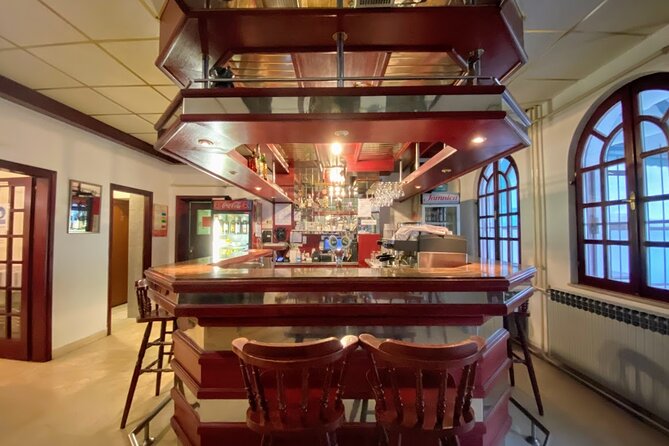
The tour starts at Vatroslav Lisinski concert hall near the main square area. That is an easy launch point because you are already in the central part of Zagreb, and it keeps the logistics simple. You also finish back at Lisinski, or your guide can drop you near where you want to continue, as long as it is within the city limits around the main square area.
Because it is private, you get a built-in advantage. If you are curious about the communist-era housing blocks, you can ask for more time on those streets. If your interest leans more toward everyday life and public spaces, you can steer the conversation toward markets, river areas, and how people used major venues.
I also like that the tour is offered in English, with a mobile ticket. You do not need to decode complicated instructions, and you can focus on the experience rather than the admin.
Gorica open air market and the abandoned dishes factory stop
One of the more intriguing opening segments is the stop around the open air market and the abandoned dishes factory called Gorica. Even if you do not know the backstory, this kind of location gives context fast. Markets are where daily needs meet politics in a very practical way: food, schedules, access, and the rhythm of local life.
Adding an abandoned industrial site to a city tour is also smart. It reminds you that big systems, including planned economies, leave physical leftovers when times change. The “factory” piece adds texture, and it helps you understand that history is not only monuments, it is also what remains, repurposed, or left behind.
Time-wise, you should expect a short stop rather than a deep on-site inspection. Still, it is a useful tone setter. It frames the tour as something about lived space, not only government buildings.
Travno and the Mammoth apartment building in your line of sight
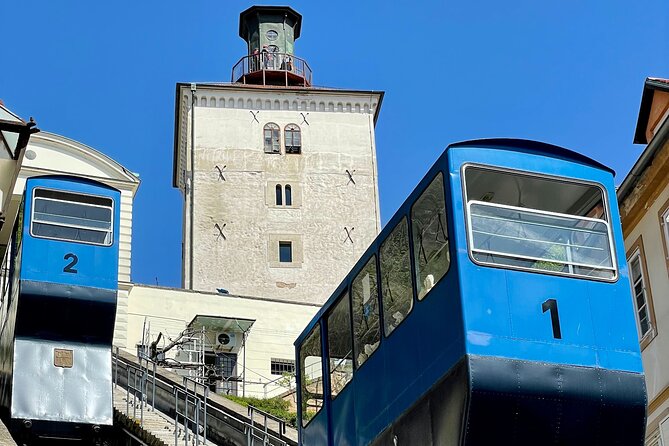
Next comes Travno, with a quick stop in front of The Mammoth, described as the largest apartment building in Zagreb. This is the kind of place where the scale does the talking. When you see large housing blocks in person, the ideology stops being abstract. You start thinking about how people were expected to live, how communities formed, and what “planned living” looked like at street level.
The best part here is that you can connect it to other things you see later on the route. Once you understand how housing was built and what it signaled, other communist-era structures become easier to interpret. The guide’s job is to translate the architecture into daily meaning, and this stop is a strong start for that.
A possible drawback: if you hate photo stops or you prefer nonstop movement, this is still a sightseeing pause. On the plus side, it is brief, and the perspective you get is worth it.
- Plitvice Lakes with Ticket & Rastoke Guided Tour from Zagreb
★ 5.0 · 966 reviews - Zagreb: Small Group Walking Tour City Center and WW2 Tunnels
★ 4.9 · 895 reviews - Zagreb: Skip-the-Ticket-Line Museum of Broken Relationships
★ 4.5 · 847 reviews - Zagreb: City and WWII Tunnels Walking Tour
★ 4.9 · 845 reviews - Plitvice and Rastoke day trip from Zagreb w/ticket (guar. dep.)
★ 5.0 · 804 reviews
Zagreb Fair and Kockica, the Dice building shaped by power
After Travno, you head toward Zagreb Fair, the main Zagreb venue for different fairs and trade shows. Even in a quick stop, it is a reminder that political eras do not only build housing and monuments. They also shape where commerce, public gatherings, and large events happen, because those are stages for public life.
Then comes Kockica, with the building known as The Dice. It was built to house the Central Committee of Croatian Communists. This is one of those moments where you can really see how power gets translated into architecture. The structure is not just an office, it’s a statement of who matters and where decision-making lives.
This is also a stop where listening matters. You will get more value if you let the guide explain what the building’s role was, and how it fit into Zagreb’s urban plan. If you only look at it as a photo backdrop, you will miss the best part.
The Sava River levee walk and Hendrix Bridge views
You then move toward the Sava River and walk along the levee area. You get a break from pure building-focused sightseeing and a change of pace that helps the whole tour click. River edges show how cities expand and how people move through open space.
A notable landmark here is the famous Hendrix bridge. Even if you do not know every detail, it is the kind of bridge that acts like a city marker. It helps you ground the story in something recognizable and keeps the tour from feeling like it is trapped in one theme.
One practical note: a river walk can be breezy and it is outdoors. So on warm days, bring water and wear comfortable shoes. On cooler days, a light layer is smart. If weather is poor, the “good weather required” note matters, because the tour may be rescheduled or refunded.
The concert hall for Eurovision 1990 and the Lady from Zagreb pass-by

Later in the route, you stop at the concert hall area known for hosting the Eurovision Song Contest in 1990. This is a clever pivot from communist-era architecture to cultural identity. Big public events show what a city wants to project, and they also show what kind of audience Zagreb attracted at that time.
You also pass by The Lady from Zagreb, another recognizable attraction on the route. Pass-by stops can feel quick, but they work when they are used as anchors. You start connecting the dots between different eras: the political space, the cultural stage, and the public art elements that reflect what people noticed and valued.
If you like tours that move fast and keep a steady rhythm, this part is satisfying. If you prefer longer stops, you can ask your guide to spend an extra minute explaining what you are seeing, especially if it helps you understand how the city changed.
Dražen Petrović Museum and Cibona tower, sport history meets city form
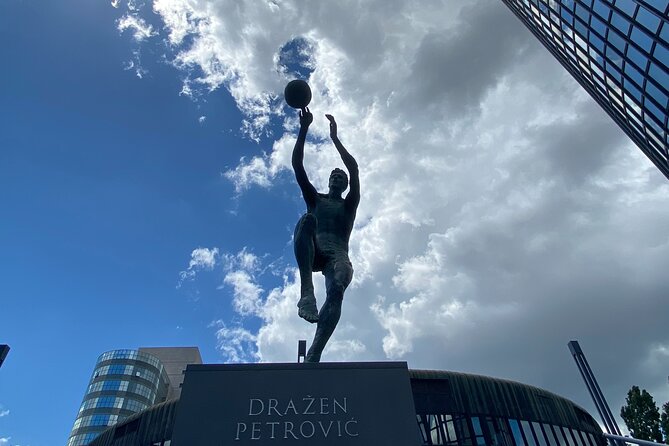
The final highlighted stop is the Drazen Petrovic Museum – Memorial Center. You see a statue of Dražen Petrović, known as a basketball player, plus the nearby Cibona tower area. This ending matters because it broadens the tour beyond politics and architecture into identity and achievement.
Sports figures often act like unofficial ambassadors. They become symbols people rally behind, and that symbolism can be as important as official monuments. Pairing the statue and the memorial setting with a major tower view helps you feel how Zagreb organizes identity in public space.
It is also a good capstone after the communist-era buildings earlier. You end with a different kind of cultural narrative. The message becomes more balanced: yes, the Yugoslav past shapes Zagreb, but the city also expresses itself through memory, sport, and public life.
What makes the guide work so well on this kind of tour
The strongest version of this experience depends on the guide. This tour uses an experienced licensed local guide, and one review specifically mentioned a guide named Theo, with the kind of excitement you want in a private tour.
A good guide does two jobs at once. First, they keep the factual thread straight so you understand what you are seeing. Second, they turn it into everyday sense, so the stops do not become disconnected. That is exactly what you want when the topic is Yugoslavia and communist-era Zagreb, because it can easily turn into either heavy politics or random photo points.
If you want the experience to feel tailored, come with at least one curiosity. Examples that match the route: How did housing policy shape neighborhoods? Why were certain buildings built where they were? What did public venues represent? Ask, then let the guide steer the conversation. In a private setting, that is where you get real value.
Price and value for a $102.41 private 2.5-hour experience
At $102.41 per person for about 2 hours 30 minutes, this is not a cheap “grab a guide and go” walking tour. But it is also not overpriced for what you receive, because the cost covers several things that are hard to replicate on your own.
You get private transportation and a ride in an original 35 year old Yugo, plus snacks, plus an experienced licensed local guide and detailed explanations. In other words, you are paying for curated movement across the city, not just spoken commentary. If you will otherwise spend time figuring out how to see far-apart sites efficiently, the car and route planning can feel like savings in effort.
This price can also make more sense when you are two people or more in your group, since the tour is private and only your group participates. If you are a solo traveler, it can still be worth it if you enjoy guided interpretation and want the classic car element, not just the sites.
For best value, treat it as a “special interest” tour. If Yugoslav history and the way politics shaped the city interests you, you are likely to feel your money at work. If you are mainly chasing generic views, you might prefer a different tour style.
When this tour is a great fit
This works best for people who enjoy city history with real-world context. If you like architecture, public spaces, and stories about how ordinary life was shaped by the era, you will likely get a lot out of it. The private format is a plus if you want to ask questions and get explanations in your own direction.
It also fits well if you are nostalgic or personally connected to the Yugoslav period. One review described feeling both recognition and surprise, and that combination is exactly what this tour seems built for. Even without personal ties, the mix of housing, river space, and cultural venues can still land emotionally.
If you are traveling with someone who prefers faster sightseeing but you want depth, the guide’s flexibility can help. You can focus on the stops that suit both tastes, then keep the pace comfortable.
A realistic drawback to keep in mind
The biggest consideration is weather and outdoor time. Since the tour depends on going around and includes levee walking and open-air stops, poor conditions can disrupt the experience. There is also the subject matter: Zagreb’s Yugoslav and communist past is not just background. It is the main lens, so go in prepared to talk about that era, not avoid it.
Also, because it is a focused route, it is not the right pick if you want a totally broad “top sights” checklist. You will see important places, but the selection is thematic. That is part of the charm, but it can also be a mismatch.
Should you book the Back to Yugoslavia tour in a Yugo?
I’d book it if you want Zagreb through the specific lens of Yugoslav history and communist-era urban design, and if you enjoy guides who can translate buildings into lived meaning. The classic Yugo car ride and the private structure make it feel like a conversation, not a bus ride with a script.
Skip it if you want a purely light, casual highlights tour, or if outdoor walking in the weather worries you. If you are flexible on timing and you like asking questions, it is a strong way to see Zagreb beyond postcards, with just enough humor and street-level context to make it memorable.
FAQ
Where does the tour start and end?
The tour starts at Vatroslav Lisinski concert hall, Trg Stjepana Radića 4, Zagreb. It ends either back in front of the Lisinski concert hall or at a guest chosen location within the city limits (about 3 km around the main square).
How long is the tour?
The duration is approximately 2 hours 30 minutes.
What is the price per person?
The price is $102.41 per person.
Is the tour private?
Yes. It is a private tour/activity, so only your group participates.
What language is the tour offered in?
The tour is offered in English.
What’s included in the tour?
Included are snacks, private transportation, an experienced licensed local guide, and a ride in an original 35 year old classic Yugo. You also get detailed information about Zagreb’s history and everyday life.
Does the tour depend on weather?
Yes. This experience requires good weather. If it is canceled due to poor weather, you’ll be offered a different date or a full refund.
Are mobile tickets used?
Yes, it includes a mobile ticket.
Is there free cancellation?
Yes. You can cancel up to 24 hours in advance for a full refund.
City-Scale Tours in Zagreb

Freshly written up around Zagreb
City Tours, top to bottom.
 ★ 4.8Dubrovnik: City Walls Early Morning or Sunset Walking TourFrom $291,523 reviews
 ★ 4.9Split: City Highlights Electric Tuk-Tuk TourFrom $501,317 reviews
 ★ 5.0Dubrovnik: Ancient City Walls & Wars Walking TourFrom $301,270 reviews
 ★ 5.0Dubrovnik Combo: Old Town & Ancient City WallsFrom $521,019 reviews
 ★ 4.9Zagreb: Small Group Walking Tour City Center and WW2 TunnelsFrom $23895 reviews
 ★ 4.9Zagreb: City and WWII Tunnels Walking TourFrom $23845 reviews
 ★ 3.7Hop On Hop Off Panoramic bus – Zagreb City TourFrom $25769 reviews
 ★ 4.8Dubrovnik: Old Town & City Walls Guided Tours ComboFrom $50697 reviews
Browse the lists this tour appears in