REVIEW · CROATIA
Experience Split With Local Professional Historian – Small Group
Split makes sense when you walk it. This 2-hour small-group experience is led by local historian Boris, and I love the way 3D reconstructions and pictures make Diocletian’s Palace feel real, not academic. You’ll also get that strong local angle on everyday life in Split. One consideration, it’s a compact route and it stays mostly outdoors, so bring comfy shoes and be ready for the weather.
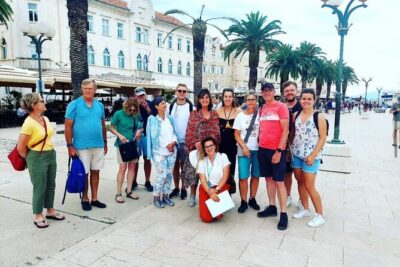
I also like the pace here. With a maximum of 12 people, you can actually ask questions and have the guide slow down when you want details. Our walk includes photo help, so if you care about getting good angles inside and around the palace walls, you’re not just left to figure it out yourself.
You start at Golden Gate and end at People’s Square (Pjaca). Along the way you connect the big Roman landmarks to the medieval and modern city that grew around them, including the harbor promenade and the squares locals use every day.
In This Review
- Key highlights worth showing up for
- Entering Split at Golden Gate, the city’s strongest first clue
- Gregory of Nin and how Split remembers its characters
- From the Palace front line to hidden uses: the Diocletian’s Palace walk
- Peristyle, cellars, and Triclinium: understanding how power worked
- Jupiter’s Temple, St. Domnius, and the shift from Roman religion to Christian life
- Riva Harbor, Fruit Square, and Pjaca: seeing Split after the Romans
- Group size, time on your feet, and asking Boris questions
- Price and value: what $38.62 buys when entry is free
- Practical tips before you meet at Golden Gate
- Who this tour fits best in Split
- Should you book this small-group Split historian walk?
- FAQ
- What is the duration of the experience?
- How much does the tour cost?
- What language is the tour offered in?
- How large is the group?
- Where does the tour start and end?
- Are admission tickets included?
- What is included in the tour besides the guide?
- What should I bring or plan for since the tour is outdoors?
- Is free cancellation available?
Key highlights worth showing up for
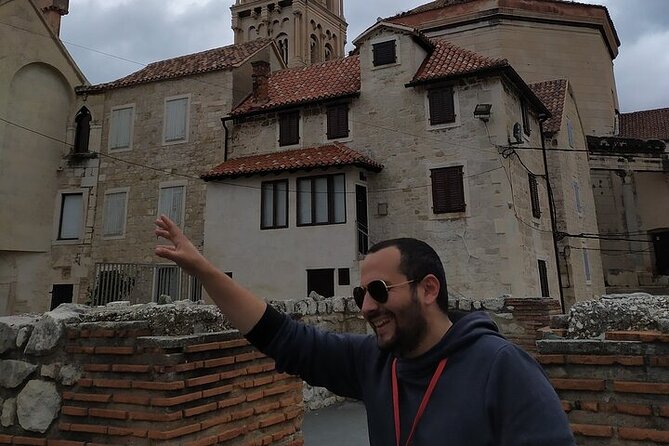
- Licensed historian guide (Boris) who teaches with a classroom-style clarity and personal local context
- 3D reconstruction images and a display book that help you visualize palace spaces you’re standing near
- Golden Gate to Diocletian’s Palace core orientation that makes Split’s old town easier to explore after
- Peristyle and the Triclinium area explained through how the palace functioned, not just what it looks like
- Photo support during the walk, with guidance on angles and where to stand
- Small group size (max 12) so the tour feels human and interactive
Still weighing it up? These Split trips also came through our review desk.
- Split: Krka Waterfalls Trip with Boat Cruise and Swimming★ 4.8 · 10,519 reviews
- From Split: Krka Waterfalls, Food & Wine Tasting Tour★ 5.0 · 9,326 reviews
- Blue cave, Mamma Mia and Hvar, 5 islands speedboat tour★ 5.0 · 7,150 reviews
- From Split: Krka Waterfalls, Food & Wine Tasting Tour★ 4.9 · 6,598 reviews
Entering Split at Golden Gate, the city’s strongest first clue
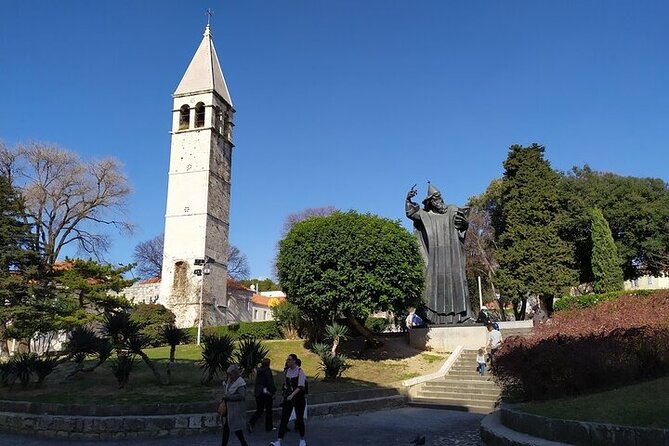
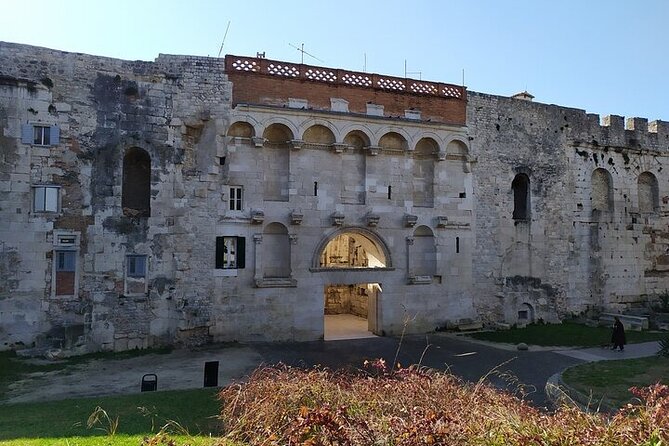
Golden Gate is a smart place to begin, because it gives you the right mental map fast. It’s the northern gate of Diocletian’s Palace, and it sits opposite one of Split’s best-known statues, Gregory of Nin. Even before you get deep into the palace, you start seeing how the old Roman walls frame the everyday city outside them.
What I like about this start is how it frames the palace as a living system. Your guide explains why this gate mattered, not in a vague way, but as a practical piece of the city’s layout. It’s also quick to handle, with a short stop that keeps the tour moving without turning into a lecture marathon.
If you’re worried about feeling lost, don’t. This opening sets you up to recognize later landmarks as part of the same story, rather than random stone points on a map.
Gregory of Nin and how Split remembers its characters
Right after Golden Gate, you’ll stand at the Gregory of Nin statue. This is one of those moments where history stops being just dates and becomes a person. Your guide shares stories and facts about Gregory of Nin, the high monument dedicated to him, and the sculptor behind it.
Even if you’ve never heard of Gregory of Nin, the payoff is clarity. The statue is placed in a way that makes sense once you understand the palace setting around it. You’ll also start noticing how Split’s identity layers over time, Roman structures giving way to later cultural memory.
If you like your history with personality, this stop is a nice break from palace walls. It also gives you an anchor point for photos because it’s a well-known figure in a very visible spot.
From the Palace front line to hidden uses: the Diocletian’s Palace walk
This tour’s heart is Diocletian’s Palace. You enter the story from the Golden Gate side and then work through the most important parts and the “why that place mattered” details.
You’ll hear about Diocletian as an emperor and connect that to what the palace was designed to do. Then you move through key spaces and see how the structure shifted as Split moved from Roman rule into a medieval city life. That transition is a huge part of why the palace feels so different from other ancient ruins. It didn’t become a museum and disappear. It stayed in use, and the city grew right into it.
Here’s what you should expect as the walk gets more specific:
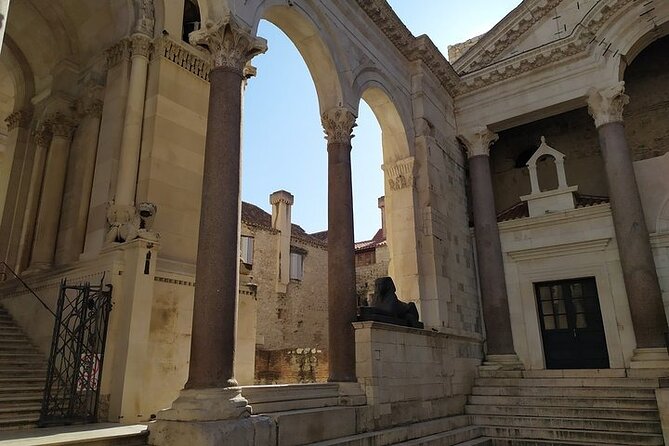
- Peristyle, the central palace space, is explained as both a connector and a divider between the Emperor and everyone else.
- Diocletian’s Cellars, in the palace substructure, are treated as a place with real historical usage and present-day importance.
- The guide checks in around nearby spaces like the Triclinium, so you learn what Roman dining and organization looked like at the top level.
This is where the tour’s teaching tools matter. The guide uses a book with pictures and 3D reconstruction images to help you visualize the palace layout from your position on the ground. If you’ve ever stood in a ruin and wondered what you’re supposed to imagine, that’s exactly the problem this tour is built to solve.
Peristyle, cellars, and Triclinium: understanding how power worked
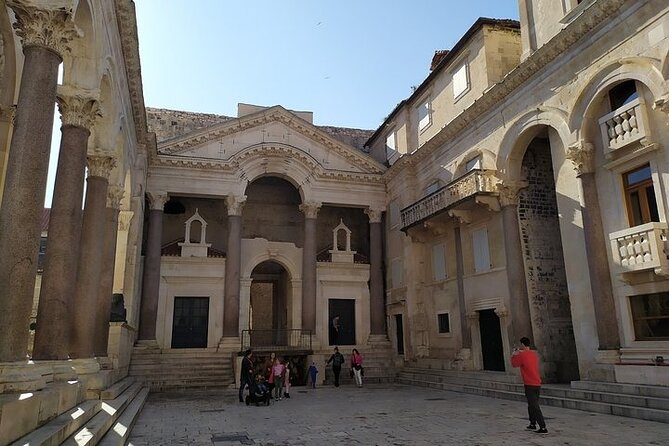
Standing in the Peristyle is a key moment. It’s not just a pretty courtyard. Your guide explains its function and importance as the palace center, where movement and access were shaped. You’re basically learning how the palace managed distance between the ruler’s world and everyone else.
Then you transition into the central part of the cellars area. This is one of those spots where it’s easy to miss the point if you just glance around. On this walk, you get the usage during different historical periods and why it shaped Split’s development. It helps you understand the palace not as a single Roman snapshot, but as a structure that kept being repurposed.
The tour also includes time to check Triclinium and talk about Emperor dining habits and Roman eating culture in general. Even though you’re outdoors and not stepping into a fully restored interior, the explanation gives you the logic behind the space. It’s the kind of detail that makes subsequent sightseeing click.
- Split: Krka Waterfalls Trip with Boat Cruise and Swimming
★ 4.8 · 10,519 reviews - From Split: Krka Waterfalls, Food & Wine Tasting Tour
★ 5.0 · 9,326 reviews - Blue cave, Mamma Mia and Hvar, 5 islands speedboat tour
★ 5.0 · 7,150 reviews - From Split: Krka Waterfalls, Food & Wine Tasting Tour
★ 4.9 · 6,598 reviews - Split/Trogir: Blue Cave, Mamma Mia, Hvar and 5 Island Tour
★ 4.6 · 6,320 reviews
Jupiter’s Temple, St. Domnius, and the shift from Roman religion to Christian life
The route keeps moving through the palace’s religious footprint. You’ll view Temple of Jupiter from outside and learn why Roman temples to honor gods were so central in daily life and state culture. It’s brief, but focused, and it sets up what comes next.
After that, you visit Cathedral of Saint Domnius for an outside look. You’ll be pointed to significant parts and told which elements are worth remembering if you decide to visit the interior on your own later. This is helpful because it saves you from wandering in with blank eyes.
One of the best connections in this part of the walk is how Christianity changed the use and meaning of palace spaces. You’ll hear about transitions around Peristyle and how expansion of Christianity affected buildings and daily life as time moved forward. That story is one of the reasons Diocletian’s Palace feels more like a foundation for a living city than a sealed-off monument.
You also stop at the Vestibulum connected to Diocletian’s private chambers. This pre-entrance is explained in terms of its importance and function, so you can read the palace layout more like a designed experience, not just walls and arches.
Riva Harbor, Fruit Square, and Pjaca: seeing Split after the Romans
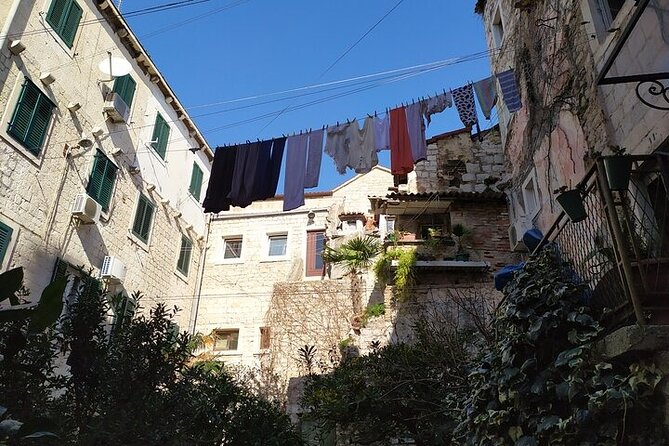
After the palace core, the tour shifts to the city’s human scale. Riva Harbor is the main promenade, and your guide explains how it was built over centuries and why it became central for locals. This part matters because it shows you what the palace eventually gave birth to: a city street life you can actually enjoy now.
Next is Fruit’s Square (Trg Brace Radic). It sounds small and charming, and that’s the point. You’ll learn why it’s called Fruit Square and hear about an important monument in the middle, along with what surrounds it. These are the stops that make Split feel like a place with routines, not just ruins to photograph.
Finally, you reach People’s Square, also called Pjaca. This square is described as the city’s center of happenings from medieval times to today. Your guide explains the story behind the square and the surrounding buildings, including something like the old city hall area. It’s a satisfying wrap-up because you end at a place that’s useful after the tour, not just a final point on a route.
Before you finish completely, you’ll get suggestions for other places to see in Split that weren’t part of the walk. That’s a big value add. It turns your “intro” tour into a starting plan for the rest of your days.
Group size, time on your feet, and asking Boris questions
This is built for small-group pacing. The maximum group size is 12, which is why the guide can learn names and keep the conversation flowing. In real terms, that means you don’t spend the whole time just trying to hear over other people. If you have a question, there’s room for it.
The tour is listed at about 2 hours. In practice, it can run closer to 2.5 hours when the group asks more questions or wants extra context. That’s usually a good sign here, because the format supports back-and-forth teaching.
The guide, Boris, is a licensed local professional historian with a master’s degree in history, and his teaching style comes through. People also mention he’s patient with questions, and I can see why. This isn’t a rushed monologue. It’s more like a structured walkthrough where you get the big picture, then the details you care about.
Also, since the guide can help with photos, it’s worth paying attention to where he points you. Small changes in angle and distance make a big difference in the palace spaces and the squares.
Price and value: what $38.62 buys when entry is free
At $38.62 per person, you’re paying for more than walking shoes and a map. You’re paying for a licensed historian, a structured route, and the guided visual tools, including 3D reconstruction images in a display book.
Your stops on this walk are described as free admissions, and the tour does not include admission tickets. In practical terms, that means you’re not hit with surprise entry fees for major segments of the route. You’re paying mainly for the guide’s ability to interpret what you see.
So the value equation is pretty straightforward:
- If you want orientation and explanations that make Diocletian’s Palace understandable, this is good value.
- If you just want to stroll the outside of the palace with no guidance, you could likely self-tour. But you’d miss the visual reconstructions and the functional explanations that tie spaces together.
For most first-time visitors, I think the price makes sense because Split’s old core is dense. A short guided hit can save you hours of guesswork once you’re back on your own.
Practical tips before you meet at Golden Gate
Here’s how to make the most of the experience on the ground.
First, start at Golden Gate, Dioklecijanova 7, 21000 Split. The walk ends at People’s Square (Pjaca), 21000 Grad, Split. If you plan your day tightly, it helps to know you finish near the main square center.
Second, plan for weather. This experience requires good weather. Since the walk is outdoors for multiple stops, rain or poor conditions can affect comfort. If conditions aren’t great, you may be offered a different date or a full refund.
Third, wear comfortable shoes. The route is compact, but it’s still a walking experience across historic surfaces around the palace and city center.
Finally, bring your camera. The guide can help with photos, and you’ll be standing at multiple classic photo angles around Golden Gate, the statue area, and the palace center spaces.
Who this tour fits best in Split
This tour is especially good if you’re:
- Visiting Split for the first time and want the old town to make sense fast
- Interested in Roman and post-Roman transitions, not just one era
- The kind of person who likes explanations and photos that connect to what you’re seeing
- Traveling with kids or teens, because the guide uses a teaching approach and keeps things interactive based on how people describe the experience
If you’re already deep into architectural study and want lots of inside access, you might find the outside-focused nature less satisfying. But for most people, it’s an excellent way to get the big picture and then explore on your own with confidence.
Should you book this small-group Split historian walk?
I’d book it if your goal is to understand Diocletian’s Palace in a practical way and turn the old city into something you can navigate. The biggest wins for me are the 3D reconstruction visuals and Boris’s teacher-like way of connecting spaces to how life worked, in Roman times and after.
I’d hesitate only if you dislike walking in the open, or if you strongly prefer long museum-style stays. This is a structured walking tour, and it expects you to follow along on foot.
If your time in Split is limited, this is one of the smartest “start here” choices you can make. It ends in Pjaca, so you’re set up for your next stops immediately.
FAQ
What is the duration of the experience?
It runs for about 2 hours.
How much does the tour cost?
The price is $38.62 per person.
What language is the tour offered in?
The tour is offered in English.
How large is the group?
The maximum group size is 12 travelers.
Where does the tour start and end?
It starts at Golden Gate (Dioklecijanova 7, 21000 Split) and ends at People’s Square (Pjaca) in Split.
Are admission tickets included?
No admission tickets are included.
What is included in the tour besides the guide?
You get 3D reconstruction images and pictures via a display book, plus the local professional licensed guide with a master’s degree in history.
What should I bring or plan for since the tour is outdoors?
This experience requires good weather, and it is a walking tour through outdoor areas, so comfortable shoes and weather-appropriate clothing help.
Is free cancellation available?
Yes, you can cancel for a full refund up to 24 hours before the experience start time.