

REVIEW · DUBROVNIK CITY WALLS & OLD TOWN WALKS
Explore Dubrovnik Old Town Walking Tour
Dubrovnik gets real on foot. In an hour, you walk the UNESCO core with a licensed guide, starting at Pile Gate and moving along the main spine, Stradun, with stories about Ragusa’s survival after earthquakes, wars, and the breakup of Yugoslavia. You also get a sense of how Dubrovnik kept remaking itself, street by street.
I love how the tour hits the big monuments without you having to figure out the route yourself. I also like the focus on small side streets and corners that feel calmer than the main crush.
The only drawback is that it’s about 1 hour of walking, so if you want long, slow museum time or lots of extra stops, you’ll need to pair this with free time afterward.
In This Review
- Key highlights you will actually use
- Entering Dubrovnik’s walled heart, in just one hour
- Price and what you get for $26.38 per person
- Meeting at Brsalje ul. 2, then finishing near Ul. Pred Dvorom
- Pile Gate: the main entrance that tells you how power works
- Stradun: Dubrovnik’s main street, plus Franciscan and Onofrio
- Prijeko Street: narrow lanes that change the vibe
- Luza Square and Sponza Palace: where the civic story sits
- Back on Stradun for the cathedral zone
- Ragusa’s comeback story: from catastrophe to identity
- You might pick up Game of Thrones pointers without losing the history
- What the guides do that makes this an orientation win
- How fit do you need to be, really?
- Getting the most out of your first day after the walk
- Should you book this Dubrovnik Old Town walking tour?
- FAQ
- Where does the tour start and where do I end?
- What time does the tour start?
- How long is the walking tour?
- How much does the tour cost?
- How many people are in the group?
- What is included in the ticket price?
- What is not included?
- Is it a mobile ticket?
- What happens if the weather is bad?
- What is the cancellation policy?
Key highlights you will actually use
- Pile Gate start gives you the perfect sense of arrival inside the walls, right where the drawbridge story begins
- Stradun stop time is efficient, with the Franciscan monastery and Onofrio’s fountain along the main drag
- Prijeko Street shows the quieter Dubrovnik mood, with narrow lanes that are easy to miss alone
- Luza Square connects the power buildings, including Sponza Palace and St Blaise church area
- You circle back on Stradun to orient you toward the cathedral zone for later exploration
Different routes over the walls and through the old streets
- Dubrovnik: Old Town Walking Tour★ 4.8 · 5,174 reviews
- Dubrovnik Discovery Old Town Walking Tour★ 5.0 · 4,458 reviews
- Dubrovnik Old Town History Walking Tour★ 5.0 · 1,684 reviews
- Dubrovnik: City Walls Early Morning or Sunset Walking Tour★ 4.8 · 1,523 reviews
Entering Dubrovnik’s walled heart, in just one hour

Dubrovnik Old Town is beautiful, but it can also be a little overwhelming. You have crowds, walls, signs everywhere, and you feel like you should already know where to go. This walk helps you get your bearings fast, because it’s built around the town’s most recognizable moments inside the medieval walls.
The timing is short on purpose. About an hour gives you a clean overview so you can plan the rest of your day with less guesswork. For a first visit, that matters, because Dubrovnik rewards repeat passes, not scattershot wandering.
You also get the kind of explanation that turns stone into a story. You do not just see places, you hear how Ragusa, Dubrovnik’s older identity, rebuilt itself again and again.
Price and what you get for $26.38 per person
$26.38 might sound like a lot for a walk, until you break it down. You are paying for a professional licensed guide plus local taxes, and the stop plan includes admission tickets at the key monuments you visit.
What I like about this value is the focus. In roughly an hour, you cover multiple landmark areas such as Pile Gate, Stradun’s central features, Luza Square with Sponza Palace, and the cathedral zone. If you try to do this solo, the hard part is not the walking, it’s knowing what to look at and why it matters.
Also, the group size is capped at 20 people. That is small enough for questions and pacing, without feeling like you are stuck in a bus line inside the walls.
Meeting at Brsalje ul. 2, then finishing near Ul. Pred Dvorom

The tour starts at Brsalje ul. 2, 20000 Dubrovnik, and you end at Ul. Pred Dvorom 4, 20000. It runs at 10:00 am, and it is about one hour long.
Using the exact addresses helps more than you would think. Old Town is tightly packed, and it is easy to circle the same few blocks while trying to match a mental map to the real one. I’d recommend arriving a few minutes early, so you can start relaxed instead of hunting the meeting point right when you are supposed to begin.
You also get a mobile ticket. That is handy because it saves time, especially when you are hopping between sites later.
Pile Gate: the main entrance that tells you how power works
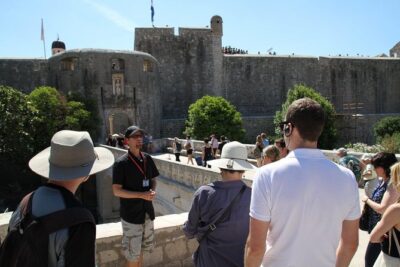
You start at Pile Gate, Dubrovnik’s main doorway into the Old Town. It is the kind of place where you feel the walls in your bones, because it is the threshold between modern streets and medieval defense.
This stop is about 10 minutes, which is just enough time to notice details and still move on. You will also hear the significance of the drawbridge and why controlling the entrance mattered so much to a maritime republic like Ragusa.
Practical tip: stand where you can see the gate opening and take a second to look back toward the approach road. That simple habit helps you remember the layout, so later you can navigate the walls like you planned it.
More Dubrovnik covered at walking pace
- Dubrovnik: Game of Thrones Walking Tour
★ 5.0 · 1,732 reviews - Dubrovnik: Ancient City Walls & Wars Walking Tour
★ 5.0 · 1,270 reviews - Dubrovnik: Game of Thrones Walking Tour
★ 4.9 · 981 reviews - ‘Game of Thrones’ Walking Tour in Dubrovnik
★ 4.5 · 945 reviews - Dubrovnik: Old Town Walking Tour
★ 4.9 · 792 reviews
Stradun: Dubrovnik’s main street, plus Franciscan and Onofrio

Next comes Stradun, the famous central street that acts like the spine of the Old Town. This is the longest segment, about 20 minutes, and it is where the tour gives you landmarks that are easy to spot later when you return on your own.
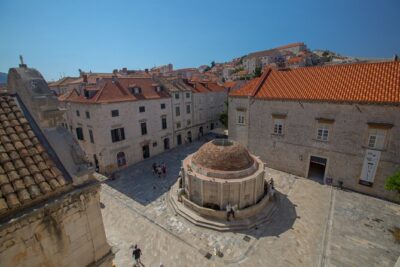
On Stradun, you pass the Franciscan monastery area and Onofrio’s fountain. The fountain is the sort of feature you might ignore if you are focused only on photos, but on a guided walk it becomes a reference point. You learn how these places fit into daily life, not just a postcard view.
One good thing about the Stradun focus is orientation. If you know where the fountain is and how the monastery fronts the street, the rest of your wandering gets calmer. You are not guessing.
Prijeko Street: narrow lanes that change the vibe

Then you shift to Prijeko Street, and you feel the difference immediately. The streets narrow, the light changes, and the tour slows down just enough to let you notice the texture of Old Town life.
This stop is about 10 minutes. It is short, but it’s valuable because it shows you how neighborhoods connect back to the main route. It also helps you spot the practical shortcuts, the lanes that make your later sightseeing runs smoother.
If you like photos, this is a good place to stop for a couple without blocking other people. A quick look up, a quick look down, then keep moving keeps the street experience pleasant for everyone.
Luza Square and Sponza Palace: where the civic story sits

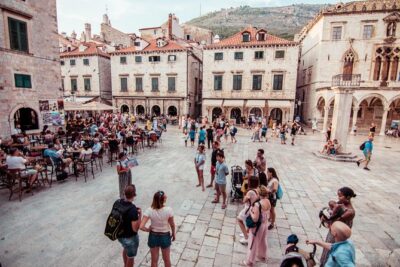
At Luza Square, the tour shifts from street atmosphere to civic power. You spend about 10 minutes here, and the focus lands on Sponza Palace and the St Blaise church area.
This is where you start understanding Dubrovnik not as a single era, but as a system that kept functioning through disasters. Ragusa was a trading power, and its buildings reflect that mix of commerce, law, and public identity. Even if you are not a history nerd, this kind of context makes the architecture easier to read.
A practical point: Luza Square can feel open compared to the narrow streets. That makes it a good place to catch your breath. It is also a helpful stop if you are planning your later route, because you can use this square as a landmark grid point.
Back on Stradun for the cathedral zone

The tour loops back to Stradun for another 10 minutes, this time centered on the Cathedral of Dubrovnik area. This is not a long visit, but it is an intentional orientation move.
If you later decide to spend time at the cathedral, you’ll already know where you are. You’ll also understand how the cathedral zone fits into the story the guide is building across stops, rather than treating it as another separate sight.
This final Stradun segment also gives you a sense of scale. After seeing gate, squares, and side streets, the cathedral area feels like the last big anchor point. It helps you map the town in your head.
Ragusa’s comeback story: from catastrophe to identity
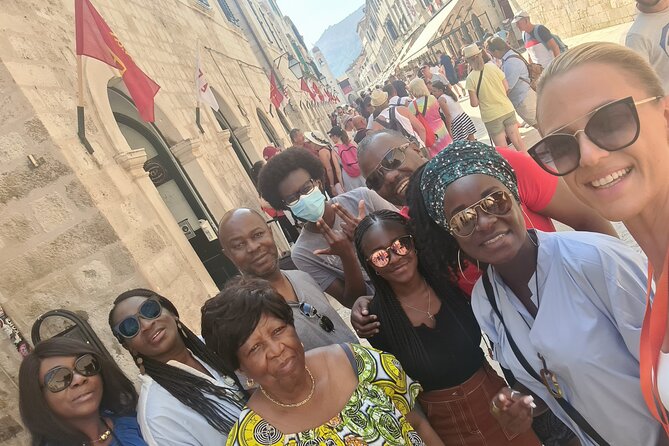
One of the best parts of this walk is the through-line. The guide weaves how UNESCO-listed Dubrovnik was reborn after catastrophe, from earthquakes and wars to the fall of Yugoslavia.
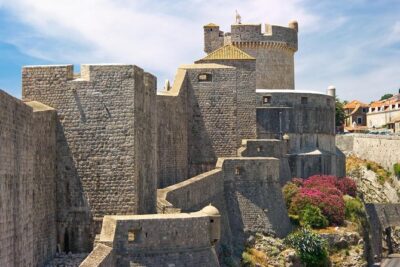
That framing changes how you see the walls. You stop treating them as just scenery and start treating them as evidence. Dubrovnik’s survival is not a single dramatic event. It is an ongoing process, and you feel that in the way the Old Town looks both historic and repaired over time.
I also like the emphasis on both ancient history and modern culture. Dubrovnik is not only old stone. It is a working city that still lives under the shadow of what it went through, and the tour hints at that with stories tied to today.
You might pick up Game of Thrones pointers without losing the history
Dubrovnik has a well-known pop culture presence, and some guides add that kind of extra layer. You may get Game of Thrones pointers as you walk, not as the main event, but as a way to connect streets and views to scenes.
The key is how it is handled. The tour still keeps the historical focus front and center, so you do not end up doing a theme walk with no real context. Instead, those pop culture moments can be a memory hook that makes the real stories easier to recall later.
If you want that extra layer, ask a question or two early. Guides often have a good sense of what will resonate, and a short exchange can make the walk feel more personal.
What the guides do that makes this an orientation win
What consistently makes this kind of walking tour work is not just facts. It is the way a guide organizes your attention.
Here, the pace gives you time to absorb landmarks in sequence: Pile Gate, Stradun’s main features, the turn into Prijeko Street, the jump to Luza Square, and then the cathedral zone. That step-by-step structure is why this works as an orientation tour. You come away with a mental map, not just a list of sights.
The group size limit also helps. With up to 20 people, you are usually close enough to hear details and ask questions. And because the tour is a walking format, you are not trapped behind glass or separated from the city by ropes.
How fit do you need to be, really?
This tour calls for moderate physical fitness. It is not described as strenuous, but you are walking for about an hour through compact historic streets.
I recommend wearing comfortable shoes with grip. Dubrovnik’s stone can be slick, especially after any damp weather. Bring water too, because food and drinks are not included.
If you have trouble with long walks or frequent standing, you might find you want more breaks. In that case, consider going slower during your free time afterward, or pair this with a shorter plan the rest of the day.
Getting the most out of your first day after the walk
Think of this tour as your setup. After the guided hour, you should be able to choose where to return for deeper time.
Here’s what I’d do next, based on the stops you cover:
- Use Luza Square and Stradun as your main anchors.
- Plan a longer visit around the cathedral zone if it interests you.
- Save Prijeko Street lanes for late morning or late afternoon, when the light changes and the vibe softens.
Because the tour ends at Ul. Pred Dvorom 4, you can also use that as your natural transition into the rest of the Old Town. You are dropped off close enough to keep exploring without feeling like you have to cross the entire walls circuit again.
Should you book this Dubrovnik Old Town walking tour?
Book it if you want a fast, well-structured introduction to Dubrovnik inside the medieval walls. The short duration plus multiple landmark stops makes it an efficient way to build a map in your head, especially if it’s your first day in town.
Skip it, or at least manage expectations, if you want a long, slow tour with lots of time for interiors and unhurried wandering. This is a guided overview. You will get the highlights, but you’ll still want follow-up time on your own.
If you are curious about Ragusa’s comeback story and you like hearing how the present connects to the past, this is a solid choice. For $26.38, you are buying time, direction, and context in one walk, which is exactly what most people need in Dubrovnik.
FAQ
Where does the tour start and where do I end?
It starts at Brsalje ul. 2, 20000, Dubrovnik, Croatia, and it ends at Ul. Pred Dvorom 4, 20000, Dubrovnik, Croatia.
What time does the tour start?
The start time listed is 10:00 am.
How long is the walking tour?
The duration is about 1 hour.
How much does the tour cost?
The price is $26.38 per person.
How many people are in the group?
The tour has a maximum of 20 travelers.
What is included in the ticket price?
Included are local taxes and a professional licensed guide, and the listed monument stops include admission tickets.
What is not included?
Food and drinks are not included, and there is no hotel pickup and drop-off.
Is it a mobile ticket?
Yes, the tour uses a mobile ticket.
What happens if the weather is bad?
The experience requires good weather. If it is canceled due to poor weather, you will be offered a different date or a full refund.
What is the cancellation policy?
Free cancellation is available. You can cancel up to 24 hours in advance for a full refund. If you cancel less than 24 hours before the start time, the amount paid is not refunded.
Walk It: More of Dubrovnik at Ground Level


Still on the Walls? Keep Reading
Freshly written up around Dubrovnik




Dubrovnik City Walls & Old Town Walks, top to bottom.
 ★ 4.8Dubrovnik: Old Town Walking TourFrom $235,174 reviews
 ★ 5.0Dubrovnik Discovery Old Town Walking TourFrom $244,458 reviews
 ★ 5.0Dubrovnik Old Town History Walking TourFrom $241,684 reviews
 ★ 4.8Dubrovnik: City Walls Early Morning or Sunset Walking TourFrom $291,523 reviews
 ★ 5.0Dubrovnik: Ancient City Walls & Wars Walking TourFrom $301,270 reviews
 ★ 5.0Dubrovnik Combo: Old Town & Ancient City WallsFrom $521,019 reviews
★ 4.9Dubrovnik: Old Town Walking TourFrom $23792 reviews
★ 5.0Dubrovnik Combo: Old Town & Ancient City WallsFrom $521,019 reviews
★ 4.9Dubrovnik: Old Town Walking TourFrom $23792 reviews
 ★ 4.8Dubrovnik: Old Town & City Walls Guided Tours ComboFrom $50697 reviews
Browse the lists this tour appears in