
REVIEW · PRIVATE
Private Walks & Storytelling – the best small group tour in Split
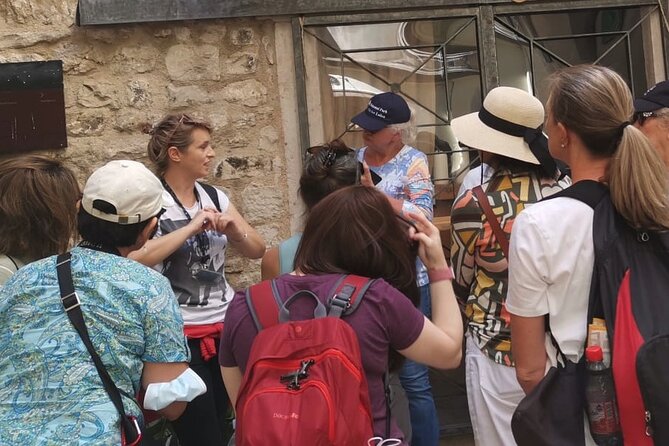
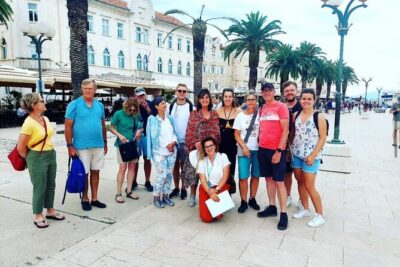
Split gets personal when you hear its stories. This private walk is built for storytelling and real, street-level context, guided by a licensed interpreter who knows Split from the inside. You move at a human pace, tying what you see in Diocletian’s Palace to the way people live now, with local details you usually miss.
Two things I especially like: the small group size (up to 10) makes it easy to ask questions, and the tour stays focused on what you care about, since it’s customizable. One consideration: a couple of the major religious sites on the route have entry fees not included, so you may want a little extra budget.
In This Review
- Key points worth knowing
- Riva Harbor, the slow start that sets the tone
- Diocletian’s Palace substructures, history under your feet
- Peristyle and Saint Domnius, imperial square to bell tower
- Temple of Jupiter, then the medieval transformation
- Pusti me da prodjem street and Narodni trg, where Split expands
- Nadalina chocolate stop, a sweet way to learn food culture
- Golden Gate to Grgur Ninski, finishing with wishes in the right place
- Price and logistics, what $238.34 per group really buys
- The guide experience, where Mirjana-style storytelling makes it feel personal
- Who should book this Split walk?
- Tips to enjoy it smoothly (and not lose time)
- Should you book Private Walks & Storytelling in Split?
- FAQ
- How long is the Split private walking tour?
- How many people are in a group?
- Is the tour offered in English?
- Where do we meet, and where can the tour end?
- Are entry tickets included for every stop?
- What happens if the weather is poor?
- What is the cancellation timeframe for a full refund?
Key points worth knowing
- Small group, private feel: up to 10 people, which keeps the pace conversational.
- Licensed, born-and-raised guide support: local insights plus formal historical interpretation.
- Diocletian’s Palace from street level down to the substructures: you see more than the postcard views.
- Customizable route focus: you get steering toward what interests your group most.
- Food and flavor moments: coffee and a chocolate tasting stop with local production stories.
- You can shift where the tour ends: your guide can adjust the finishing point based on what you want.
Still weighing it up? These Split trips also came through our review desk.
- Split: Krka Waterfalls Trip with Boat Cruise and Swimming★ 4.8 · 10,519 reviews
- From Split: Krka Waterfalls, Food & Wine Tasting Tour★ 5.0 · 9,326 reviews
- Blue cave, Mamma Mia and Hvar, 5 islands speedboat tour★ 5.0 · 7,150 reviews
- From Split: Krka Waterfalls, Food & Wine Tasting Tour★ 4.9 · 6,598 reviews
Riva Harbor, the slow start that sets the tone
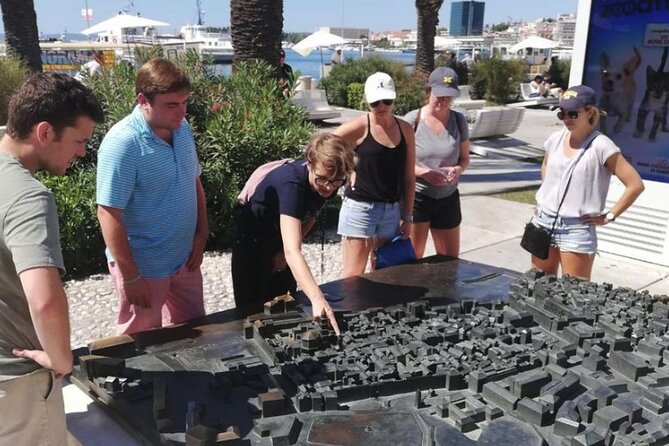
Most Split tours rush. This one starts where the city relaxes: Riva Harbor. You’ll get oriented fast, because this is where daily life happens, with people lingering by the sea, chatting, and doing the kind of “nothing special” things that actually define a place. It’s a smart first move, because it pulls you out of cruise-ship mode and into local rhythm right away.
From there, your guide leads you into the old town toward Diocletian’s Palace, explaining not just what the stones are, but how locals still live among them. You’ll hear stories that connect everyday sights to older layers of the city, like Roman architecture that didn’t get erased, it got reused. And yes, you’ll get a small bite along the way, which makes the walking feel lighter and keeps the tour grounded in the senses: sound, smell, sea air, and the pace of the streets.
Practical note: this is the kind of start that helps later stops make more sense, because you learn the “why” behind what you’re seeing.
Diocletian’s Palace substructures, history under your feet
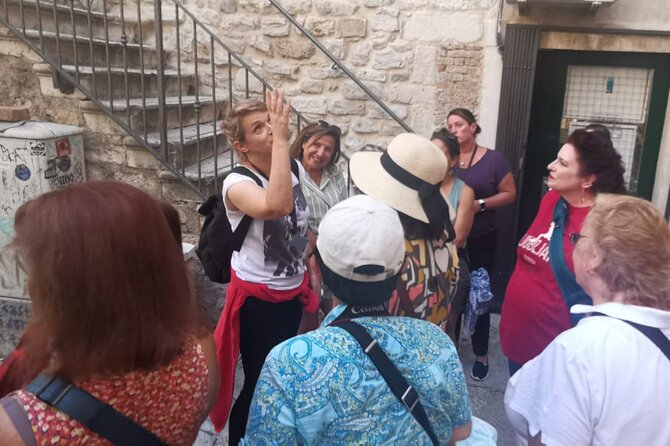
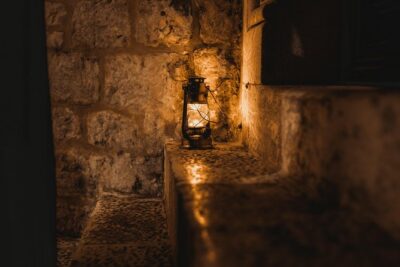
After the harbor, you step below street level into the Diocletian Palace substructures. This is where the tour earns its name as storytelling, because the setting changes how you perceive the city. The space feels close and thick with time, and your guide connects each area you see to the life that once happened here.
You’ll spend about 10 minutes in this underground section. That might sound short, but it works because the experience is designed as a chapter, not a lecture. You’re not trying to memorize everything. You’re learning how the Palace functioned, how the city began from inside these walls, and how the pulse of the place still echoes today.
If you’re the type who likes understanding the “system” behind a landmark, this is the moment that clicks. You also get a nice break from the brightest parts of the old town, so your legs and your brain both get a breather.
Peristyle and Saint Domnius, imperial square to bell tower
Next comes the Peristyle of Diocletian’s Palace, the open-air imperial square. This is a big visual payoff after the narrow lanes, and your guide uses that contrast to tell stories about traditional and modern Split side by side. The word pomalo comes up for a reason. It’s not just a vibe, it’s a way of understanding how the city moves through time. Take it easy, enjoy the layers, don’t rush the meaning.
From Peristyle, you’ll reach Cathedral of Saint Domnius and focus on a landmark most people notice immediately: the tall bell tower. What’s easy to miss is the cathedral’s role as one of the oldest religious sites in the world. You’ll get a brief but meaningful look at the cathedral within the palace complex, about 10 minutes.
One thing to plan for: entry to the cathedral is not included. It’s still worth seeing, but don’t assume every stop on this walk is ticket-free.
Temple of Jupiter, then the medieval transformation

Walk back into the palace substructures area and head toward the Temple of Jupiter. Your guide frames it through political religion, linking Diocletian with Jupiter, the Roman sky and thunder god. This stop is about perspective, because it helps you see the Palace as both a physical fortress and an ideological statement.
During the Middle Ages, the Temple shifted use and became a baptistery dedicated to St. John the Baptist. That transformation is exactly the kind of thing that makes Split feel alive. You’re not just looking at ruins, you’re watching how structures get reused and reinterpreted when the world changes.
This stop is about 10 minutes, and the Temple entry is not included. So if you want to avoid any surprise costs, keep a small buffer in your budget for those sites.
- Split: Krka Waterfalls Trip with Boat Cruise and Swimming
★ 4.8 · 10,519 reviews - From Split: Krka Waterfalls, Food & Wine Tasting Tour
★ 5.0 · 9,326 reviews - Blue cave, Mamma Mia and Hvar, 5 islands speedboat tour
★ 5.0 · 7,150 reviews - From Split: Krka Waterfalls, Food & Wine Tasting Tour
★ 4.9 · 6,598 reviews - Split/Trogir: Blue Cave, Mamma Mia, Hvar and 5 Island Tour
★ 4.6 · 6,320 reviews
Pusti me da prodjem street and Narodni trg, where Split expands
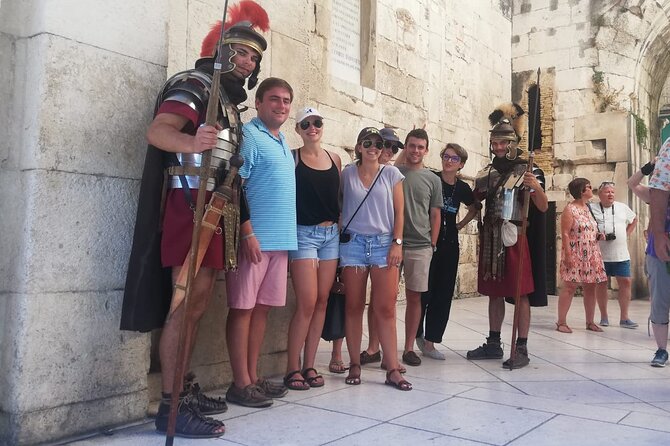
Between the ancient and medieval layers, you get a short scenic walk through Let Me Pass (Pusti me da prodjem) Street. It’s only about 2 minutes, but it’s a great palate cleanser between “major monuments.” Your guide explains why locals give it that nickname, pointing you toward how people think about the city at street scale, not just empire scale.
Then you move to Narodni Trg, an area that reflects the city’s growth after the original walls could no longer contain life. Here, Split spreads westward, and the architecture shows influence from different parts of Europe, stacked over time. Your guide ties that mixed look to a simple idea: Split doesn’t replace history, it builds beside it.
This part is mostly free, and it’s one of the spots that helps the tour feel rounded. You’ll finish this section with a better sense of where the Palace ends and the city proper takes over.
Nadalina chocolate stop, a sweet way to learn food culture
Halfway through and near the end, you get a stop that’s both practical and memorable: Nadalina chocolate. About 8 minutes here, with local chocolate samples and stories about food production. It’s a rare thing in an old-town walking tour, a reminder that cultural history isn’t only marble and towers, it’s also what people eat and how they make it.
This stop is admission included, meaning you don’t have to deal with any extra ticket friction. And the structure helps your pacing. By now your feet will be warm, your brain will be full of Roman and medieval references, and a chocolate tasting gives you a clean mental reset.
If you like tours that treat food as part of culture, not as a random add-on, this is the kind of moment you’ll remember later when you’re back in your apartment comparing what you tried.
Golden Gate to Grgur Ninski, finishing with wishes in the right place
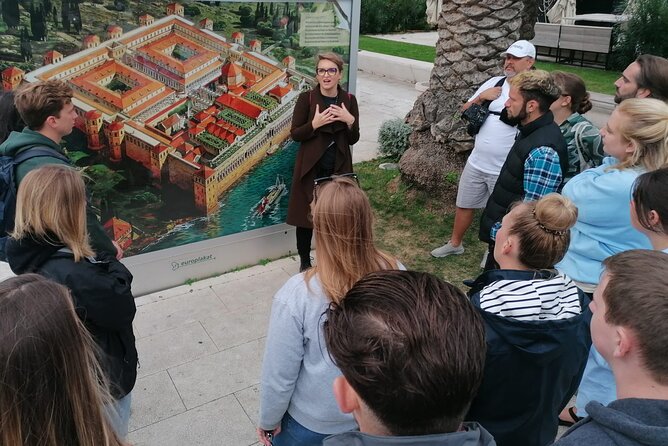
Your walk then reaches the Golden Gate (Porta Aurea), one of the four main Roman gates into Diocletian’s Palace. Your guide explains why it matters, pointing toward the road to the north and the larger Roman province story. You’ll also hear about antique military strategy within the Palace complex, and you’ll get a sense for how movement and defense were planned into the space.
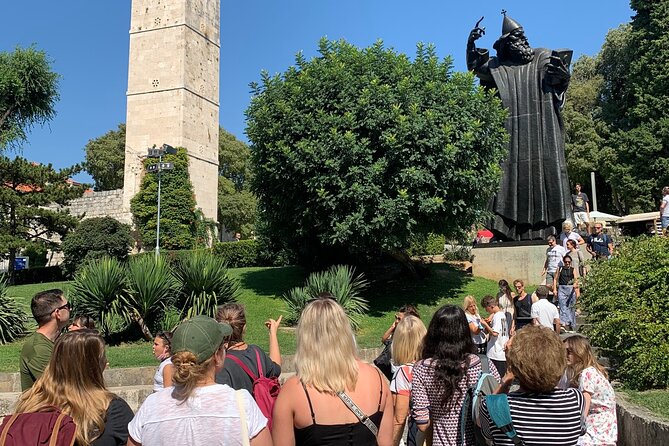
After the gate, you end at the Grgur Ninski statue area. This finish is clever, because it layers time again: you’re looking at antique wall fabric next to more modern art and daily life. The tour also includes a local tradition tied to the sculpture, where you make a wish. It’s brief, about 15 minutes at the end, but it gives the tour a satisfying emotional close.
This final stop has ticket included and it feels like a symbolic exit from the past into the present, without pretending the city ever fully separates those two.
Price and logistics, what $238.34 per group really buys
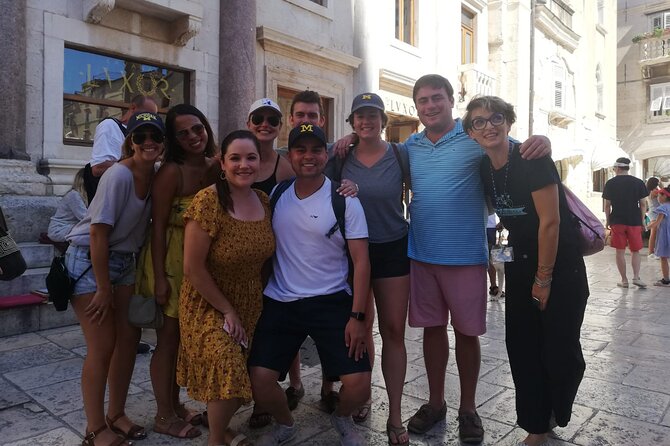
The price is $238.34 per group, up to 10 people. That matters because this isn’t priced like a classic single-person guided tour. It’s closer to a private experience with a small-group cap, so the value changes based on how you travel.
If you book with the full group size, the cost works out to roughly $24 per person at the maximum. If it’s just two or four people, the per-person number climbs fast, but you still get the advantages of a guided, customizable walk and a locally grown storytelling approach.
Timing is also part of the value story. The tour runs around 1 hour to 1 hour 40 minutes, long enough to cover the Palace interior layers and a modern city stop, but short enough that you can still enjoy the rest of your day. It’s also popular, with many people booking about 52 days in advance, so if you have firm plans, don’t wait until the last minute.
Entry fees are mixed. Some stops include admission, and some explicitly do not. So when you plan your day, budget for the Cathedral of Saint Domnius and the Temple of Jupiter since those are listed as not included.
Also, you get a mobile ticket, and the tour is offered in English.
The guide experience, where Mirjana-style storytelling makes it feel personal
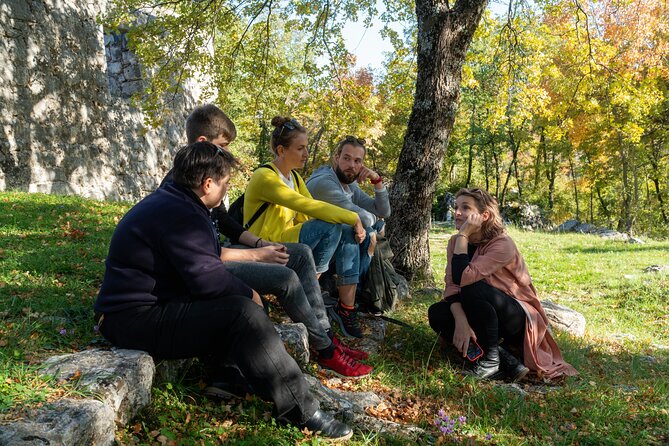
The best small tours feel like conversations that guide your feet. This one is built that way. Your guide is a licensed tourist guide, storyteller, and certified history interpreter, and the local expert is born and raised in Split. That combination matters, because it’s not only facts. It’s the human translation of those facts into what the streets are doing right now.
The guide personality you can expect centers on responsiveness and pacing for different ages. I love that this style doesn’t assume everyone wants the same amount of detail. In practice, guides like Mirjana are known for keeping teenagers and adults engaged at the same time, tailoring the tone and keeping the stories moving.
You’ll also get real-world practical help. Some guides provide extra support around on-the-ground issues like meeting timing confusion, and you’ll usually come away with food and coffee recommendations you can use the rest of your stay. That’s part of why local people do tours like this differently: the goal isn’t just to show you sights, it’s to help you live your day in Split with less guessing.
Who should book this Split walk?
This tour fits best if you want:
- A Split intro that explains the city through stories, not just dates.
- A Diocletian’s Palace focused experience that includes both surface highlights and underground space.
- A guide who can adjust the pace and emphasis for a mixed group, including teens.
- A day plan that includes short landmark breaks plus something to taste.
It’s also a good choice if you dislike long museum hours. This is walking, quick stops, and guided meaning. You still get the major names like the Cathedral of Saint Domnius and the Temple of Jupiter, but you won’t feel stuck in one place for ages.
If you only want ticket-inclusive attractions, double-check the two key sites that are not included. And if your plan is very strict, remember it’s weather dependent. Good weather helps this type of city walk.
Tips to enjoy it smoothly (and not lose time)
- Wear comfortable shoes. Old town walking is still walking, with uneven surfaces and lots of stops.
- Plan for a weather window. The tour requires good weather, and if it’s canceled due to poor conditions, you’ll be offered a different date or a full refund.
- Give your guide your priority at the start. Because it’s customizable, you’ll get more value if you say what you care about most, history, folklore, food, or modern city life.
- Use the ending flexibility. Your tour can end wherever you like. If you’re heading to dinner or a specific neighborhood, tell your guide at the beginning so they can adjust your finish point.
Should you book Private Walks & Storytelling in Split?
Book it if you want a small-group, locally guided walk that explains Split through stories you can actually use while you wander on your own afterward. The route hits the right balance: harbor life, palace structure, religious landmarks, and then a few streets that show how the city kept growing after the walls stopped being enough. Add a guided chocolate stop and it becomes more than a checklist.
Skip it or rethink if you’re only interested in places where all admissions are guaranteed to be included, since the Cathedral of Saint Domnius and the Temple of Jupiter are not listed as included. Also consider if you need a longer, deeper format. At about 1 to 1 hour 40 minutes, this is a strong sampler with sharp focus, not an all-day immersion.
If you’re trying to get your bearings and fall in love with Split at ground level, this is one of the better ways to do it.
FAQ
How long is the Split private walking tour?
The tour runs approximately 1 hour to 1 hour 40 minutes.
How many people are in a group?
The experience has a maximum of 10 travelers.
Is the tour offered in English?
Yes, it is offered in English.
Where do we meet, and where can the tour end?
You start at Brass Gate (Porta Aenea), Obala Hrvatskog narodnog preporoda 22. The tour ends at Ul. Stari pazar 9, but your guide can adjust the ending wherever you like if you tell them at the beginning.
Are entry tickets included for every stop?
No. Some stops list admission as included, and others list admission as not included. For example, admission is not included for the Cathedral of Saint Domnius and the Temple of Jupiter.
What happens if the weather is poor?
The tour requires good weather. If it is canceled due to poor weather, you will be offered a different date or a full refund.
What is the cancellation timeframe for a full refund?
You can cancel for a full refund if you cancel up to 24 hours in advance of the experience’s start time.
Freshly written up around Split

Private, top to bottom.
 ★ 4.7Dubrovnik: Blue & Green Caves Private Boat Tour with DrinksFrom $73814 reviews
 ★ 5.0Dubrovnik Private Speedboat Tour to Elaphite Islands with DrinksFrom $386660 reviews
 ★ 5.0SPLIT-PRIVATE Walking Tour of Diocletian’s Palace & Old TownFrom $240467 reviews
 ★ 5.0Tour The Game of Thrones – Private Walking TourFrom $185464 reviews
 ★ 4.0Private Krka Waterfalls tour with 30min Boat CruseFrom $301458 reviews
 ★ 5.0Dubrovnik: Private Boat Tours to Elaphite IslandsFrom $604437 reviews
 ★ 5.0Split by Private Electric Rickshaw – Palace & Hidden GemsFrom $48412 reviews
 ★ 5.0Private Blue cave, Mamma Mia and Hvar, 5 islands tour from SplitFrom $1,572387 reviews