
REVIEW · TROGIR, CIOVO & THE KASTELA COAST
Split and Trogir Half Day Tour from Split (with port pickup)
Roman walls meet Venetian streets in four hours. This Split and Trogir half-day packs two UNESCO towns into one smooth ride, with live onboard commentary and a pro guide to make the centuries click into place. I especially like the port pickup and drop into the city center, so you are not wasting your cruise day figuring things out.
Second, I like how the itinerary hits the big “why it matters” stops without turning it into museum overload. You also ride in comfort on an air-conditioned coach, which matters when the Dalmatian heat shows up. One possible drawback: you will do some walking, and entry fees are not included for several key sights, plus the tour ends back in Split with a walk to the ship.
In This Review
- Key things to know before you go
- Why this half-day Split and Trogir plan actually works
- Price and logistics: what you pay, what you do not
- Cruise-port meeting: the fastest way to avoid stress
- The coach ride: comfort plus live commentary
- Stop 1: Palazzo di Diocleziano, where Split begins
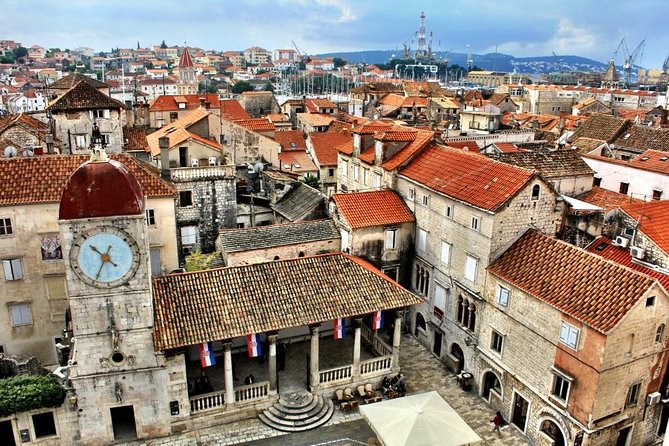
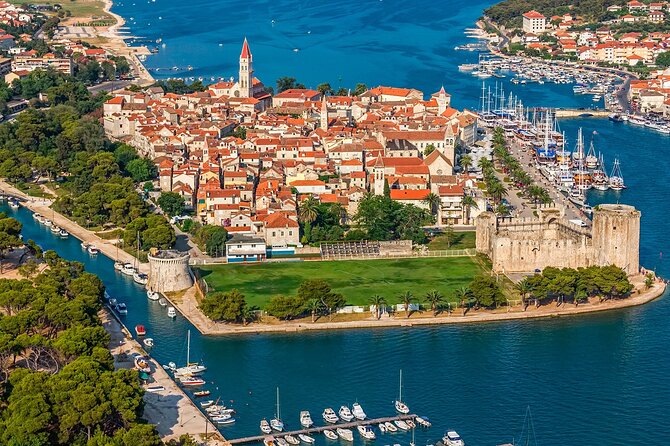
- Stop 2: Historic City of Trogir, a UNESCO time machine
- Stop 3: Cathedral of Saint Domnius, Roman roots under church walls
- Stop 4: Kula Karmelengo, a tower that turns into summer stages
- Stop 5: Prokurative, Venetian-inspired architecture in Split
- Stop 6: Saint Lawrence’s Cathedral, built over centuries
- Guides make the day: Tina, Sandra, Roko, Hrvoje, and Tia
- Walking level and weather: what to pack for a 4-hour sprint
- My value verdict: who should book this tour
- Should you book Split and Trogir from Split with port pickup?
- FAQ
- How long is the Split and Trogir half-day tour?
- Is the tour available in English?
- What is included in the price?
- Are entrance tickets included?
- Is food and drink included?
- Does the tour drop you back at the cruise ship?
- How do cruise passengers find the guide?
- What fitness level do I need?
- Is the tour small group size?
- What if my cruise ship is late or I miss the tour?
- What is the cancellation policy?
Key things to know before you go
- Port pickup is handled: the guide meets you at the cruise terminal with a Croatian Trails sign.
- You get two UNESCO towns: Split’s Roman core and Trogir’s layers from Greek to Venetian eras.
- Not all entrances are included: Diocletian’s Palace, St. Domnius, and Kula Karmelengo require separate tickets.
- Comfort on the move: an air-conditioned coach keeps transit painless.
- Group size is capped: maximum 50 travelers, so it should stay manageable.
- Expect a moderate walking pace: it fits a Level 2 style day for most people, but plan for stairs and cobblestones.
More of the coast running west from Split
- Split/Trogir: Blue Cave, Mamma Mia, Hvar and 5 Island Tour★ 4.6 · 6,320 reviews
- Krka Waterfalls Day Tour with Boat Ride from Split and Trogir★ 5.0 · 2,134 reviews
- Krka National Park Tour with tour Guide & Wine tasting from Split & Trogir★ 5.0 · 1,625 reviews
- Hvar, Brač & Pakleni islands cruise with lunch & drinks from Split & Trogir★ 4.5 · 1,452 reviews
Why this half-day Split and Trogir plan actually works
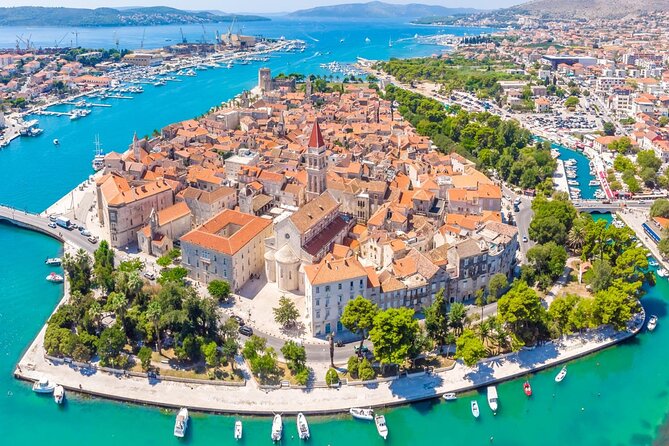
This tour is built for travelers who want “the essentials” fast, but still want context. You start with the Roman powerhouse of Diocletian’s world in Split, then you shift to Trogir, where churches and architecture show centuries stacking on top of each other.
The timing is the real win. In about four hours, you see the signature sights, hear how they connect, and still have breathing room in the towns so you can look up, take photos, and grab a snack.
Price and logistics: what you pay, what you do not
At $78.61 per person for roughly four hours, you are paying for guided interpretation, a professional guide, and port pickup plus air-conditioned transport. That is the value piece: you are not just driving past landmarks, you are getting the stories that make the buildings feel less random.
What is not included is important. Entry fees are not included for Palazzo di Diocleziano, Cathedral of Saint Domnius, and Kula Karmelengo. Other stops are listed as free (like parts of the historic city of Trogir and Prokurative, and St. Lawrence’s Cathedral), but you should still budget for at least those ticketed entrances.
Cruise-port meeting: the fastest way to avoid stress
If you are on a cruise ship, this one is designed around ship timing. You must share your ship name and docking and re-boarding times at booking, because the pickup start can shift based on when you disembark.
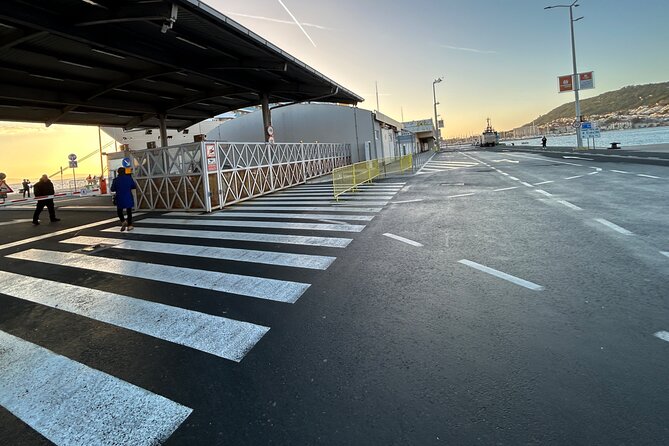
At the ship, you are looking for the guide holding a sign for Croatian Trails at the entrance area by the hop-on/hop-off red buses. The instructions are pretty direct for a reason: the terminal layout can trick you, and asking random directions can send you to the wrong fence line.
Also plan on the ending. The tour finishes back in Split’s city center, and there is about a 20-minute walk back to the ship’s terminal. If you want a lower-stress return, you can ask the guide for taxi help at the end.
The coach ride: comfort plus live commentary

The drive between Split and Trogir is handled by an air-conditioned coach. That sounds basic, but in July or August it can be the difference between enjoying the day and feeling cooked before you even start sightseeing.
While you ride, you get live commentary on board. It sets the stage so that when you arrive, you are not only seeing buildings, you are understanding why they were built and what changed when empires, trade routes, and rulers shifted.
- Split: Krka Waterfalls Trip with Boat Cruise and Swimming
★ 4.8 · 10,519 reviews - From Split: Krka Waterfalls, Food & Wine Tasting Tour
★ 5.0 · 9,326 reviews - Blue cave, Mamma Mia and Hvar, 5 islands speedboat tour
★ 5.0 · 7,150 reviews - From Split: Krka Waterfalls, Food & Wine Tasting Tour
★ 4.9 · 6,598 reviews - Split/Trogir: Blue Cave, Mamma Mia, Hvar and 5 Island Tour
★ 4.6 · 6,320 reviews
Stop 1: Palazzo di Diocleziano, where Split begins
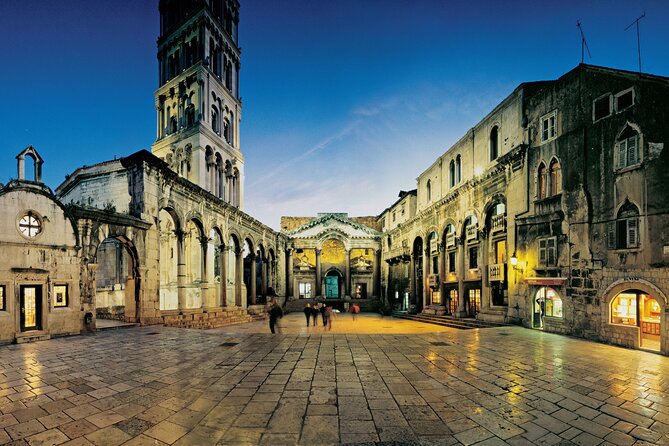
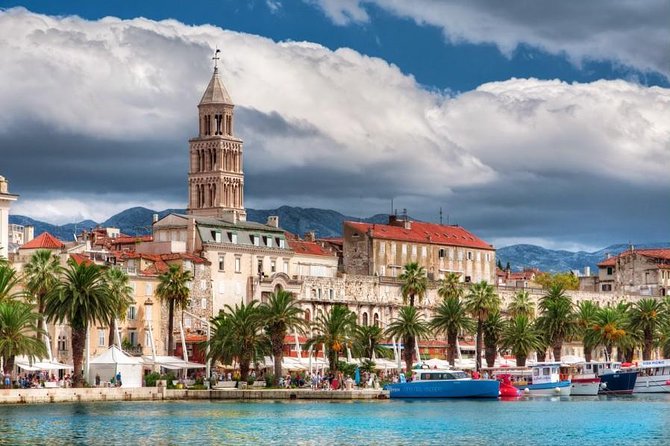
Your first major stop is the Palazzo di Diocleziano, the ancient palace built by Emperor Diocletian around the turn of the 4th century AD. Today, the palace structure forms about half of Split’s old town and city center, so you are not just touring ruins. You are stepping into a living layout that still shapes how Split feels.
This stop comes with a note that the admission ticket is not included. Practical advice: go in with the mindset that you are walking through a Roman plan that became a medieval and then modern city. Wear shoes you trust on stone.
You get about 20 minutes here, so the goal is orientation and highlights rather than a slow wander. If you love Roman engineering and street patterns, you’ll feel like you are getting the “skeleton” of Split.
Stop 2: Historic City of Trogir, a UNESCO time machine
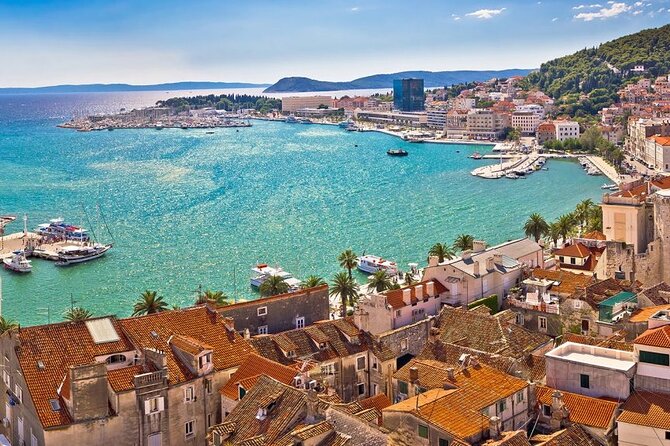
Next comes Trogir, a UNESCO World Heritage Site with a continuous urban tradition of about 2,300 years. The story starts with Greek colonists in the 3rd century BC, and then the town keeps layering through Romanesque churches and later Renaissance and Baroque influence from the Venetian period.
This is one of the most satisfying stops because it is visual. You can stand in one place and spot how different eras left different “styles” behind, especially around churches and the way the old town opens up to small squares.
The historic city portion is listed as free for admission, and you get about 1 hour. Use that time for what guided time cannot do: look closely at details, step into side streets, and plan a photo path that does not require backtracking.
Stop 3: Cathedral of Saint Domnius, Roman roots under church walls
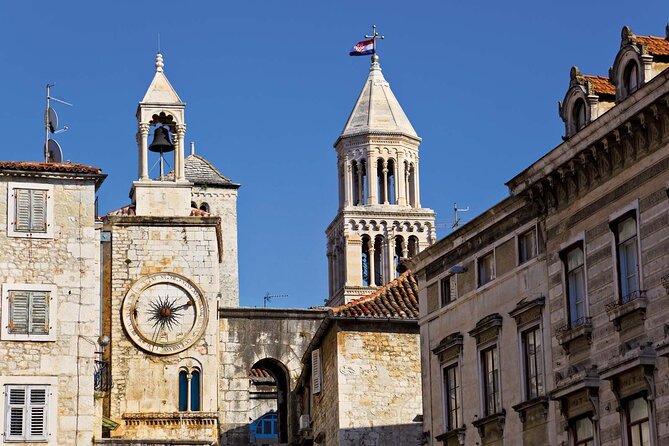
You then visit the Cathedral of Saint Domnius complex, which is more than one building. It includes a church and a bell tower, and the complex traces back to an Imperial Roman mausoleum.
The guide angle matters here: the church is dedicated to the Virgin Mary, while the bell tower is dedicated to Saint Domnius. That split dedication is the kind of detail that makes you notice what you are seeing, instead of just admiring it as “old stone.”
Admission for this stop is listed as not included, and your visit is about 20 minutes. Go in ready to look up. In places like this, the structure is the lesson, so you want your eyes trained on how the different parts were built and reused.
Stop 4: Kula Karmelengo, a tower that turns into summer stages
Kula Karmelengo is a castle/tower structure built in the mid-15th century and tied to earlier defensive building on the site. It was built by Marin Radoj as part of an expansion related to the Veriga Tower, and the name links to the title of an administrative official, the camerlengo.
What makes this stop feel practical is how it is used today. The information notes it is used as a location for performances during the summer months, so you are not only seeing a defensive relic, you are seeing a living reuse.
This stop has about 20 minutes and entry is not included. If you are short on energy, focus on the structure and surroundings rather than trying to read every inscription. Your guide can fill in the story quickly while you stand in the right spot.
Stop 5: Prokurative, Venetian-inspired architecture in Split
After Trogir’s medieval layers, Prokurative brings you into a different kind of “statement building.” Prokurative was built in the 19th century, supervised by General Marmont and initiated by Split’s mayor Antonio Bajamonti.
The design is inspired by Italian architecture and is noted for resembling St. Mark’s Square in Venice. The architect was from Venice and wanted a reminder of home, which explains why this part of Split feels like a cultural side-quest that pays off.
Your time here is short, about 15 minutes, and it is listed as free. Still, this is worth your attention because it shows how Split absorbed outside influences, not only what it inherited from Rome.
Stop 6: Saint Lawrence’s Cathedral, built over centuries
Your final stop is the Cathedral of St. Lawrence, a Roman Catholic triple-naved basilica built in Romanesque-Gothic. The construction lasted several centuries, which means the cathedral reflects the styles that followed each other in Dalmatia.
This is the kind of place where the “time” matters as much as the architecture. Because it took so long to build, you can often sense transitions in style, and that helps you understand how tastes and technical abilities changed over time.
Admission is listed as free, and you have about 15 minutes. If you want one last anchor for the day, let this be it. It is a strong closer that ties together the theme of layers and reuse that runs through both towns.
Guides make the day: Tina, Sandra, Roko, Hrvoje, and Tia
The guide is the difference between seeing buildings and understanding why they matter. The guides named for this tour include Tina, Sandra, Roko, Hrvoje, and Tia, and the common thread is how they connect facts to real places.
In the feedback, Tina and Sandra get singled out for clear, energized explanations and for caring how the group is doing during hot weather. Roko and Hrvoje are also praised for history storytelling that feels personal, not like a lecture.
Practical tip: bring questions. If you ask about the palace layout, the way Venetian influence shows up, or how bell towers and churches were assigned roles, you will usually get answers that make the next stop click faster.
Walking level and weather: what to pack for a 4-hour sprint
The tour is listed as requiring moderate physical fitness. Based on the pace, you should expect some cobblestones, stairs, and moving between sights. It is not a long hike, but it is not “sit at each stop either.”
The tour also operates in all weather conditions. That means you should come prepared for rain, and not just drizzle. A light rain layer and grippy shoes can make the difference between enjoying the churches and feeling annoyed.
My value verdict: who should book this tour
I think this is a smart booking for you if:
- You have a cruise port stop and need a plan that returns you to Split without drama.
- You want the big UNESCO highlights of both places without spending an entire day on trains or transfers.
- You prefer a guided route that gives context, but you still like checking out streets on your own during the open time.
I would hesitate if:
- You hate walking on uneven stone and can only do very minimal movement.
- You are trying to keep every cost fully predictable, because a few entrance tickets are not included.
Should you book Split and Trogir from Split with port pickup?
If your goal is a high-impact half-day with port pickup, air-conditioned comfort, and expert guidance, I would book it. It is designed around the rhythms of cruise timing and hits the signature sights that most people come to Croatia for.
Just go in with two expectations: you will trade some comfort and time for a sightseeing sprint, and you may need to pay separate tickets for major interiors. If that fits your travel style, this is a strong way to turn a short stop into something you remember.
FAQ
How long is the Split and Trogir half-day tour?
It runs for about 4 hours (approx.).
Is the tour available in English?
Yes. The tour is offered in English.
What is included in the price?
Included features are live commentary, a professional guide, port pickup, an air-conditioned vehicle, and taxes and handling charges.
Are entrance tickets included?
Not for everything. Admission tickets are not included for Palazzo di Diocleziano, the Cathedral of Saint Domnius, and Kula Karmelengo. Some listed stops are marked as free.
Is food and drink included?
No. Food and drinks are not included.
Does the tour drop you back at the cruise ship?
No. It includes pickup, but not a drop-off. The tour ends in Split city center, and you may need about a 20-minute walk back to the ship’s terminal.
How do cruise passengers find the guide?
The guide has a sign for Croatian Trails and meets you at the ship’s terminal entrance area next to the hop-on/hop-off red buses. The instructions note not to ask for directions because you may be sent to the wrong place.
What fitness level do I need?
The tour is listed as requiring moderate physical fitness.
Is the tour small group size?
Yes. The tour has a maximum of 50 travelers.
What if my cruise ship is late or I miss the tour?
The policy states that no refunds are issued if you miss the tour due to late or non-arrival of the cruise ship.
What is the cancellation policy?
You can cancel up to 24 hours in advance for a full refund.
West Along the Kastela Coast
Freshly written up around Split

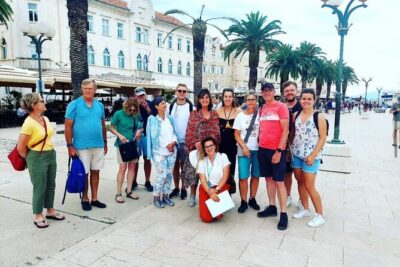
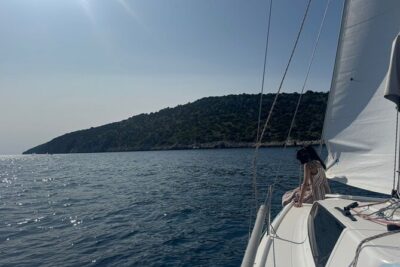
Trogir, Ciovo & the Kastela Coast, top to bottom.
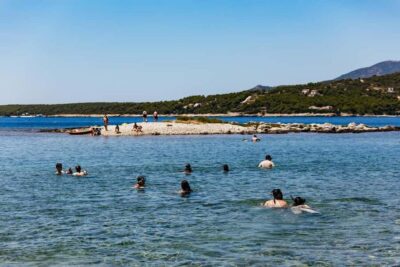 ★ 4.6Split/Trogir: Blue Cave, Mamma Mia, Hvar and 5 Island TourFrom $1096,320 reviews
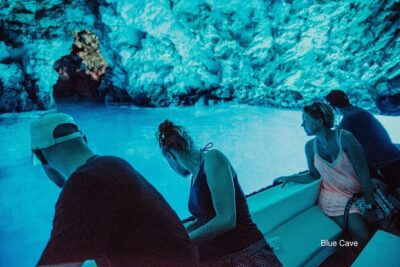 ★ 5.0Blue cave, Mama Mia and Hvar, 5 island speedboat tour from TrogirFrom $1112,861 reviews
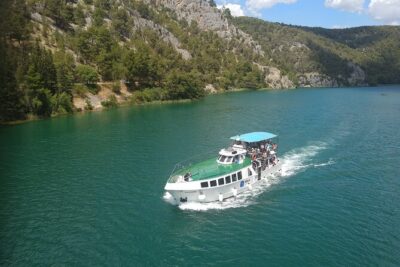 ★ 5.0Krka Waterfalls Day Tour with Boat Ride from Split and TrogirFrom $322,134 reviews
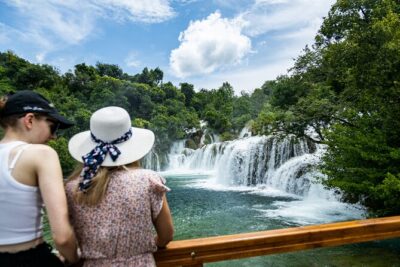 ★ 5.0Krka Waterfalls tour with Trogir Walking tour and Krka panoramic boat cruiseFrom $481,659 reviews
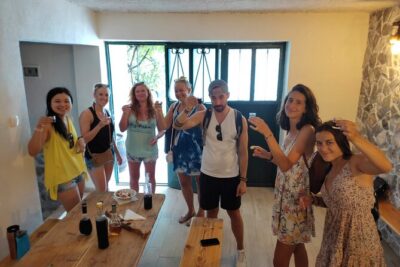 ★ 5.0Krka National Park Tour with tour Guide & Wine tasting from Split & TrogirFrom $501,625 reviews
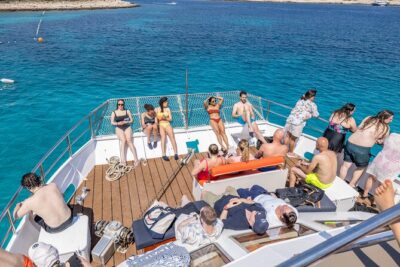 ★ 4.5Hvar, Brač & Pakleni islands cruise with lunch & drinks from Split & TrogirFrom $951,452 reviews
 ★ 4.7Split/Trogir: Krka National Park Day Trip with Wine TastingFrom $49925 reviews
 ★ 4.8From Trogir: Three Islands Half-Day Speedboat TourFrom $67804 reviews
Browse the lists this tour appears in