
REVIEW · PULA ARENA & ROMAN ISTRIA TOURS
Discover the Essence of Pula: Private Tour with a Local Pro
Roman Pula in two hours.
I love how this private walking tour strings together the city’s Roman highlights and lesser-seen stops fast, with a history-teacher style guide who explains the why behind the stone. The drawback to plan for: a couple of the biggest sights (like the Arena and Augustus Temple) may require paid admission tickets on top of the tour price.
This is the kind of tour that works well when you want a solid orientation without feeling rushed. You’ll get an English guide, a mobile ticket, and only your group on the route, from the meeting area by Park NimfejaArena through to the Forum area.
Expect good shoes and a steady walking pace. It’s best with moderate physical fitness, it runs in about two hours total (walking time included), and it does require good weather, since it’s outdoors for most of the experience.
In This Review
- Key highlights to look forward to
- A two-hour plan that gives you bearings fast
- Meet at Park NimfejaArena, end at the Forum Square
- Stop 1: Pula Arena, the Roman amphitheater you can read like a story
- Stop 2: Tito’s Park miniature Pula for a quick reset
- Stop 3: The Twin Gates, where your eyes learn a pattern
- Stop 4: Zerostrasse, a World War I shelter under your feet
- Stop 5: Gate of Hercules, a symbolic entryway
- Stop 6: The Forum, Pula’s public center where Rome mattered
- Stop 7: Tempio di Augusto, one of Croatia’s best-preserved Roman temples
- What this tour costs, and why it can still be great value
- The guide style is the secret ingredient
- How to get the most from each stop
- Who should book this private Pula walk
- Should you book this tour of Pula with a local pro?
- FAQ
- How long is the Pula private walking tour?
- Is this a private tour or a group tour?
- What language is the tour offered in?
- Where does the tour start and end?
- Are admission tickets included for all stops?
- What sights are included in the route?
- Do I need a certain fitness level?
- Is the tour dependent on weather?
- Can I cancel for a refund?
- Is the experience accessible for everyone?
Key highlights to look forward to
- A history-teacher approach that turns “old buildings” into stories you can repeat later
- Fast coverage of major Pula sights without the stress of mapping everything yourself
- Small stops with big context, like Tito’s Park and the WWII-era adjacent layers you’ll spot in the route
- Zerostrasse tunnel time, a World War I shelter that breaks up the walk in a memorable way
- Roman landmarks plus free viewpoints, so you can control your budget at your own pace
- Guide names come up again and again, including Halan and Dalen, both praised for humor and making Pula feel personal
Other Roman-Istria stops we have covered
- Medulin -Kamenjak 5h boat trip with lunch & drinks on Sandra Boat★ 5.0 · 1,621 reviews
- Full-Day Boat Tour of the Medulin Archipelago from Medulin★ 5.0 · 1,389 reviews
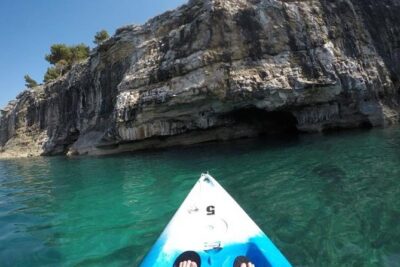
- Pula: Kayaking,Snorkeling, Cliff jumping Tour with Wetsuit★ 4.8 · 861 reviews
- Pula: National Park Brijuni Island Visit & Dolphin Cruise★ 4.5 · 788 reviews
A two-hour plan that gives you bearings fast
If Pula is new to you, the hardest part is usually this: knowing where to start, and what you’re actually looking at. This tour is built to solve that. In two hours, you move through the city’s most important pieces, then you add a few turns that help you notice things you’d likely walk past later on your own.
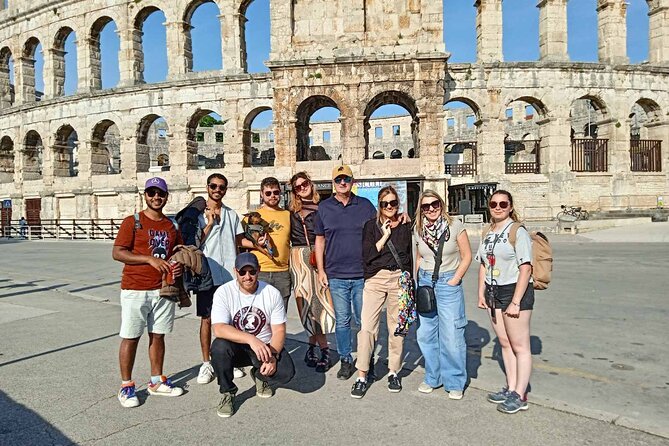
The private format matters. With only your group, you can ask questions as they come up. I also like that the tour is timed so you spend your energy looking at buildings and streets, not waiting around.
And yes, you still get the wow factor. The Pula Arena is a major Roman monument. The Forum and Augustus Temple give you the political center view. Between those, the route includes quieter diversions that add texture, not just a checklist.
Meet at Park NimfejaArena, end at the Forum Square
This walk starts at the area near Park NimfejaArena (52100 Pula) and finishes at Forum Square (Forum 3 area). That end point is a smart choice. By the time you’re done, you’re dropped into the heart of the old city’s public space, which makes it easier to continue your day with coffee, a meal, or just another round of wandering.
The tour is in English, and it’s set up with a mobile ticket. It’s also near public transportation, which can help if you’re arriving from somewhere else in Istria or timing your day tightly.
One more practical note: the itinerary includes “walking time” as part of the total experience. So even though some stops are short, you’re not losing the clock to logistics. You’re moving, stopping, and learning as you go.
Stop 1: Pula Arena, the Roman amphitheater you can read like a story
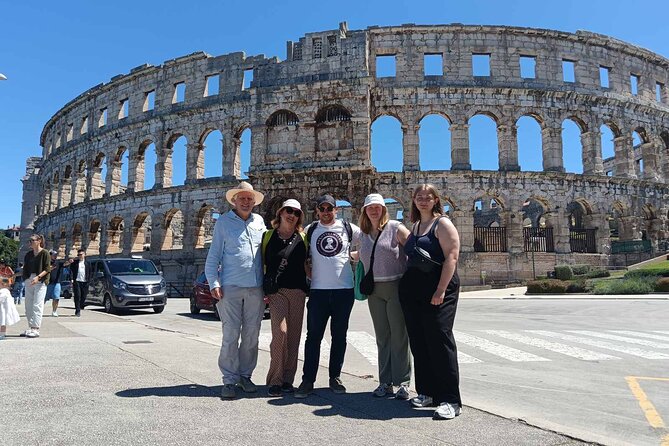
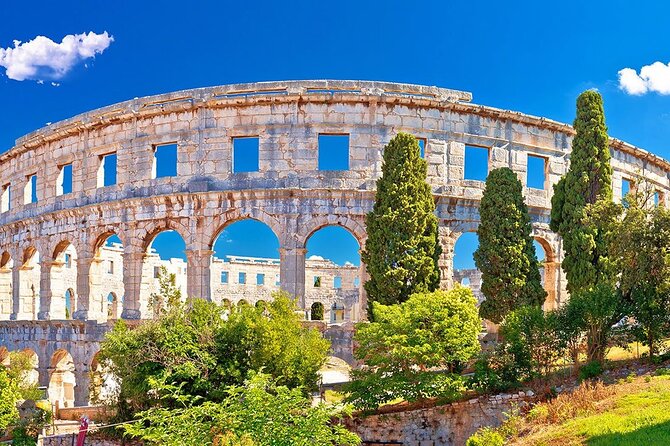
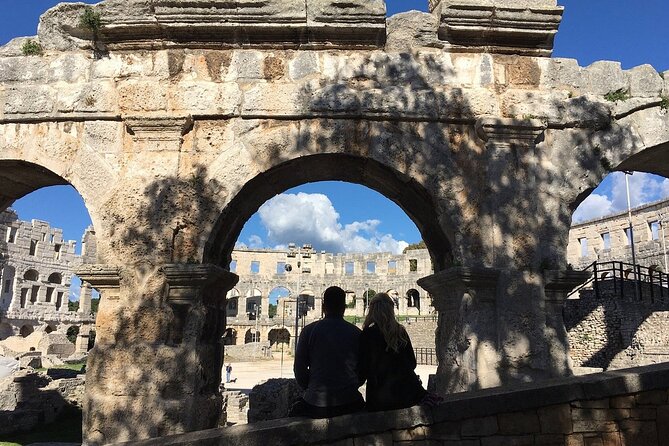
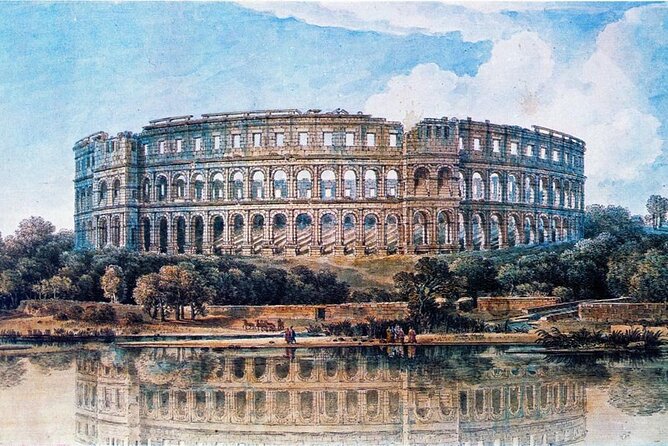
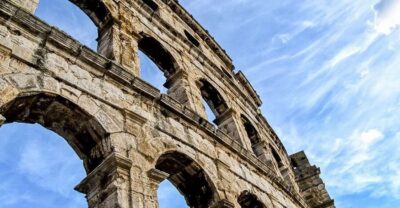
Your biggest first stop is the Pula Arena. This is one of the most well-preserved Roman amphitheaters, built in the first century AD. It could hold more than 20,000 spectators, and in ancient times it was used for gladiatorial contests, battles, and other public spectacles.
What I like about starting here is that it gives your brain a reference point. Once you stand near an arena like this, you can better understand the scale of Roman public entertainment and the engineering behind it. It’s not just impressive, it’s legible. Even if you’re not a Rome expert, you’ll catch the main ideas quickly.
The modern use is also part of the charm. The arena hosts events such as concerts, film festivals, and theatrical performances. That mix helps you feel the space isn’t frozen in time.
Practical detail to plan for: admission is not included for this stop. If you want to explore the underground passages and chambers, you’ll likely need an additional ticket. Timewise, expect about 30 minutes here, which is enough to get the big picture and take in key features without turning it into a half-day project.
Stop 2: Tito’s Park miniature Pula for a quick reset
After the Arena’s stone power, Tito’s Park is a welcome pause. It’s a scenic green space near the city center, and it’s named for Josip Broz Tito. The main attraction is a detailed miniature model of Pula, showing the city layout, landmarks, and topography.
This stop is small, but it helps your navigation a lot. When you’ve just seen one major monument, the miniature model gives you a sense of where everything sits relative to everything else. It also turns the walk from pure sight-seeing into “learning how the city fits together.”
This stop is free, and it’s only about 10 minutes, so it works like a reset button. Even if you skip a slow look, the model still gives you that mental map.
- Medulin -Kamenjak 5h boat trip with lunch & drinks on Sandra Boat
★ 5.0 · 1,621 reviews - Full-Day Boat Tour of the Medulin Archipelago from Medulin
★ 5.0 · 1,389 reviews - 3hours all inclusive Sunset&Dolphin Tour from Medulin on Sandra
★ 5.0 · 1,130 reviews - Dolphin Watching & Sunset Boat Tour With Dinner and Drinks
★ 5.0 · 1,075 reviews - Pula: National Park Brijuni Island Visit & Dolphin Cruise
★ 4.5 · 788 reviews
Stop 3: The Twin Gates, where your eyes learn a pattern
Next are the Twin Gates. They’re an imposing structure and once served as a crucial entrance to the city. Even though you’re only here briefly, gates like this matter because they teach you how ancient cities guided movement and controlled access.
This is one of those stops where a good guide makes a difference. Instead of treating it like a photo-op, your guide can point out what the gates meant in the larger urban plan. That quick context helps the rest of the route click into place.
Admission is free here, and the time slot is about 10 minutes. It’s short, but it has a job: get you ready to interpret the next symbols and stonework.
Stop 4: Zerostrasse, a World War I shelter under your feet

Then comes the switch in tone: Zerostrasse. This is an underground tunnel system built during World War I as a shelter. It’s not the typical Roman-only stop, and that variety is part of why this tour feels good.
It gives you a physical sense of how the city layered itself through different eras. You’re still in Pula, but the story is no longer only about ancient spectacle and power. It becomes about protection and survival, and that changes your perspective.
Admission is not included for this stop. It’s also about 10 minutes, so you’re not going to spend all day underground. Still, even a short tunnel visit can be memorable because it’s a different environment from the streets and squares you’ll be walking.
Stop 5: Gate of Hercules, a symbolic entryway
The Gate of Hercules is another free stop, and it’s hard to miss once you’re close. It has a depiction of Hercules’ head, making it a symbolic entrance to the city.
I like gates like this because they combine function and mythology. In Roman and Roman-influenced spaces, symbols often carried meaning beyond decoration. With a guide who explains the angle, you’ll likely understand how Hercules fits the idea of protection, strength, or identity.
Timewise, plan on about 10 minutes. It’s quick, but it adds variety after the underground stop. It also helps keep your eyes active, instead of zoning out between longer monuments.
Stop 6: The Forum, Pula’s public center where Rome mattered
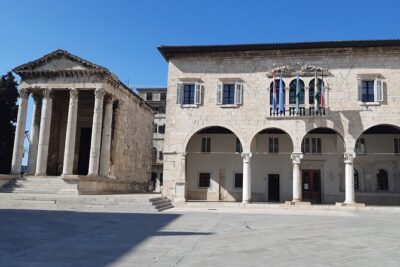
Now you land in the Forum, the main square in Pula’s old town area on the western side of the center. This is where the city’s political, administrative, and religious life once centered in ancient times.
The Forum is also connected to major monuments. You’ll hear about the Temple of Augustus, and you’ll see references to the Town Hall built on the site of the former Roman Capitolium. Even if you’re only standing in a modern square, the guide’s explanations should help you picture what it used to be.
This stop lasts about 20 minutes, so you’ll have time to slow down. It’s the kind of place where you can look around and start noticing the relationship between street lines, building scale, and the sense of a civic hub.
It’s free to visit, and it’s an ideal place to ask questions. You can also use this as a mental check: if the Roman story is clicking, you’re in a good rhythm.
Stop 7: Tempio di Augusto, one of Croatia’s best-preserved Roman temples
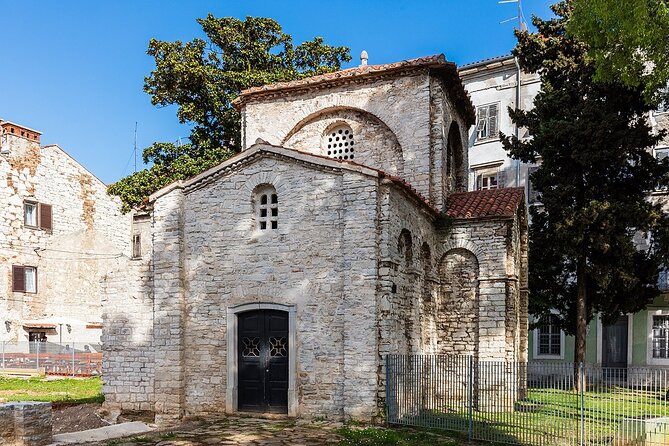
Your last stop is Tempio di Augusto, the Temple of Augustus. This is described as one of the best-preserved Roman monuments in Croatia. It was built between 2 BC and AD 14 and dedicated to Emperor Augustus.
The temple is located on the Forum and now serves as a museum. It has seen damage over time, including during World War II, and it has been successfully restored. That restoration detail matters because it gives you a sense of continuity: what you see today isn’t exactly what was there centuries ago, but it’s close enough to communicate the original ambition.
Admission is not included for this stop, and it’s about 10 minutes. That makes it a “taste” rather than a deep museum session. If you’re the type who loves museums and wants to read everything, you might want to plan extra time after the tour ends to return on your own.
What this tour costs, and why it can still be great value
The price is $60.01 per person for about two hours. For a private walking tour, that’s not bad at all, especially in a compact city where one great guide can save you time and confusion.
Here’s the honest value breakdown:
- You’re paying for the guide, the route planning, and the interpretation. The best-rated part of the experience centers on the guide style, including humor and personal teaching that brings Pula to life.
- You’ll hit multiple major sites in a short span, including the Arena, Forum, and Augustus Temple. That kind of concentrated route is hard to replicate without spending time researching.
- Some of the biggest stops do not have admission included. So budget for optional extra tickets, especially at the Arena and Tempio di Augusto.
If you’re on a tight schedule and you want the city to click quickly, private guiding often becomes the better deal than piecing things together with solo tickets and apps. If you plan to skip paid interior access and focus on exterior views, you can keep costs more predictable.
The guide style is the secret ingredient
In the best tours, you don’t just learn facts. You learn how to look. This one leans hard into that, thanks to guides described as both enthusiastic and funny.
Two names show up strongly: Halan and Dalen. Both are praised for a teaching style that turns connections into something you can remember, not something you forget on the walk back to your hotel. You’ll also pick up practical suggestions, like places to eat and even spots to sample free brandy or gin, depending on what’s available locally.
If you care about history but also like the human side, that matters. It makes the route feel like a conversation, not a lecture.
How to get the most from each stop
This tour is timed. That’s good. It means you don’t drift into low-energy wandering.
To make it work:
- Wear shoes you’re comfortable in for a city walk. The tour is short enough that you might keep going after, but you still need comfort for the full loop.
- Bring water if it’s warm. Nothing in the tour notes says it includes refreshments.
- Have your questions ready. The guide’s teaching style is part of the appeal, and the private format means you’re not stuck waiting for a group moment.
Also, since the tour requires good weather, try to schedule it when the forecast looks most trustworthy. Rain and cold can change what you want from a walking plan, especially for tunnel time underground.
Who should book this private Pula walk
I think this is an excellent fit if:
- You’re visiting Pula for the first time and want a quick orientation that also teaches you what you’re seeing
- You like Roman sites but want more than just the biggest monument photos
- You prefer a private guide who can answer questions and tailor explanations as you walk
- You enjoy a guide who adds humor and personal touches to make the city feel lived-in
It’s less ideal if:
- You want all museum and monument admissions included in the ticket price
- You cannot do moderate walking or prefer to avoid outdoor time in uncertain weather
Should you book this tour of Pula with a local pro?
Yes, if your goal is to understand Pula quickly, in plain language, with a guide who makes the connections fun. The route is efficient, the sight mix is balanced between major Roman landmarks and practical detours, and the guide style is consistently described as energetic and entertaining.
Book it especially if you value orientation and you want to return later to sights with better context. And if you decide to go, keep a little money aside for the paid-entry stops, then let the free parts of the walk stretch your budget further.
FAQ
How long is the Pula private walking tour?
The tour runs for about 2 hours.
Is this a private tour or a group tour?
This is a private tour/activity. Only your group participates.
What language is the tour offered in?
The tour is offered in English.
Where does the tour start and end?
It starts near Park NimfejaArena and ends at Forum Square (Forum 3 area).
Are admission tickets included for all stops?
No. Admission tickets are not included for some stops, including the Pula Arena and Tempio di Augusto, and also for Zerostrasse. Tito’s Park, the Twin Gates, the Gate of Hercules, and the Forum are listed as free.
What sights are included in the route?
The tour includes the Pula Arena, Tito’s Park, the Twin Gates, Zerostrasse, the Gate of Hercules, the Forum, and Tempio di Augusto.
Do I need a certain fitness level?
Travelers should have a moderate physical fitness level.
Is the tour dependent on weather?
Yes. It requires good weather. If it is canceled due to poor weather, you will be offered a different date or a full refund.
Can I cancel for a refund?
Free cancellation is available. You can cancel up to 24 hours in advance for a full refund.
Is the experience accessible for everyone?
The tour notes that service animals are allowed and that it is near public transportation. Beyond that, it specifies moderate physical fitness.
Roman Istria, Continued



Freshly written up around Pula


Pula Arena & Roman Istria Tours, top to bottom.
 ★ 4.3Pula: Arena Entrance TicketFrom $112,590 reviews
 ★ 5.0Medulin -Kamenjak 5h boat trip with lunch & drinks on Sandra BoatFrom $541,621 reviews
 ★ 5.0Full-Day Boat Tour of the Medulin Archipelago from MedulinFrom $541,389 reviews
 ★ 5.03hours all inclusive Sunset&Dolphin Tour from Medulin on SandraFrom $541,130 reviews
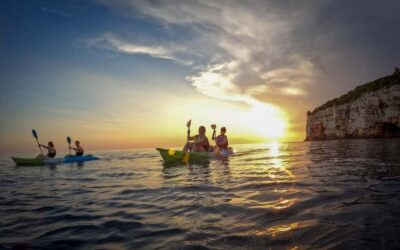 ★ 4.8Pula: Kayaking,Snorkeling, Cliff jumping Tour with WetsuitFrom $57861 reviews
 ★ 4.5Pula: National Park Brijuni Island Visit & Dolphin CruiseFrom $76788 reviews
 ★ 4.5Pula: Brijuni Sunset Dolphin Cruise with Dinner & DrinksFrom $62764 reviews
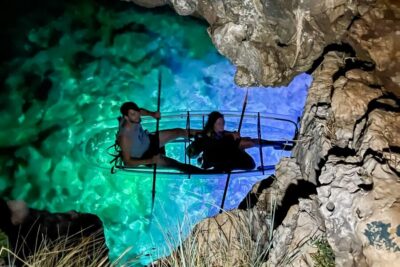 ★ 4.9Pula: Night-Time Sea Kayaking Tour in Transparent KayakFrom $69628 reviews
Browse the lists this tour appears in