
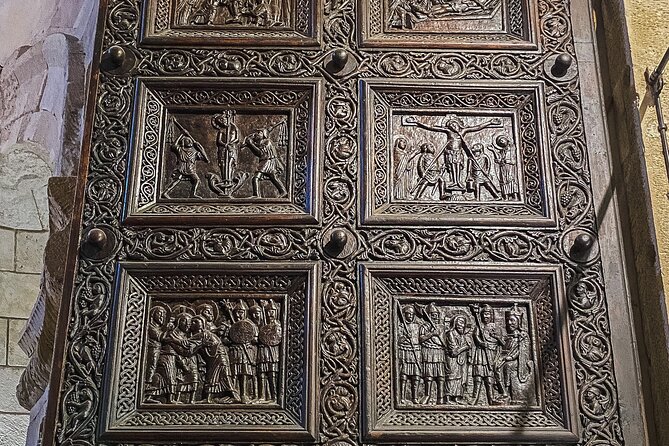
REVIEW · WALKING TOURS
Split Palace & Old Town -Private walking tour- Entrance included
Split’s palace tells a story. On this private walking tour with entrance tickets included, you get a clear timeline from the Riva into the heart of Diocletian’s complex.
I especially like the stop mix, it is not just outside views. You get indoor moments too, including the Cathedral of Saint Domnius and the Temple of Jupiter, plus the palace cellars and basement areas.
One possible drawback is access: if events or church services interfere, some sights may be skipped or the route may shift a bit.
In This Review
- Key highlights you will actually feel on the walk
- Enter Diocletian’s Palace with a guide, not just a map
- Riva to the palace core: setting the context before the stone overload
- Diocletian’s Palace interiors: Cathedral, Jupiter, and the palace basement
- Cathedral of Saint Domnius, from imperial mausoleum to cathedral
- Temple of Jupiter, now a baptistery with a special ceiling
- Basement and interior areas you would otherwise miss
- The cellars through the South Gate: size, preservation, and scale
- Peristyle and the palace’s private world: what Diocletian displayed
- North Gate to Old Split: Golden Gate, then Pjaca and Voćni trg
- Golden Gate: the North Gate and the road to Salona
- Walking the palace walls into Narodni Trg and beyond
- Pjaca (People’s Square): Venetian palaces and a neo-Gothic city hall
- Voćni trg (Fruit’s Square) and Marko Marulić
- Fish Market, sulfur baths, Marmontova street, and the end at Procurative
- Split Fish Market: why there are no flies
- Marmontova ulica: French design under Napoleon
- Prokurative: a Venetian-feeling square for a relaxed finish
- Price and time: is this good value at $203.95 per person?
- Who this tour suits best, and when you might choose differently
- Practical tips so you enjoy every stop
- Should you book this Split Palace and Old Town private tour?
- FAQ
- FAQ
- How long is the Split Palace and Old Town private walking tour?
- Is this tour private?
- Is the tour offered in English?
- Are entrance tickets included?
- What if a sight is closed due to events or church services?
- What should I know about weather and cancellation?
Key highlights you will actually feel on the walk
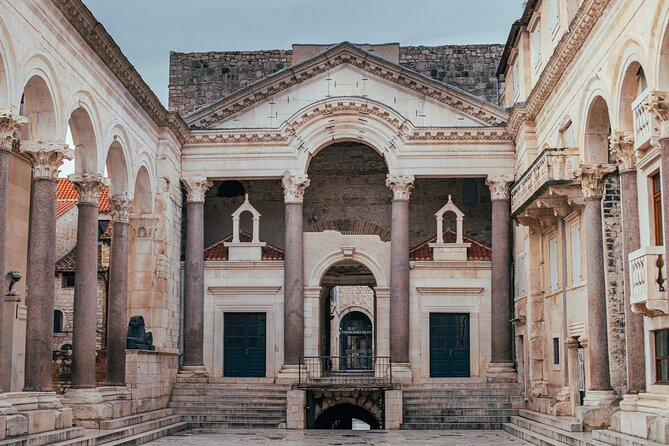
Private pace, only your group, so you can ask questions without feeling rushed
Included admissions for key Diocletian interiors, including the cellars, Cathedral of Saint Domnius, and Temple of Jupiter
A guide who makes the palace readable, with Dana and Jana specifically praised for clear history and helpful directions afterward
Roman gates to medieval squares, walking from Diocletian’s North Gate into Old Split’s Pjaca and Voćni trg
A natural ending spot at Procurative, where you can drop into cafes and restaurants right after the tour
More Split covered at walking pace
- Split: Old Town and Diocletian Palace Walking Tour★ 4.9 · 4,727 reviews
- Walking Tour of Split and Diocletian’s Palace★ 5.0 · 2,588 reviews
- Krka Waterfalls tour with Trogir Walking tour and Krka panoramic boat cruise★ 5.0 · 1,659 reviews
- Split & Diocletian’s Palace Walking Tour★ 5.0 · 1,125 reviews
Enter Diocletian’s Palace with a guide, not just a map
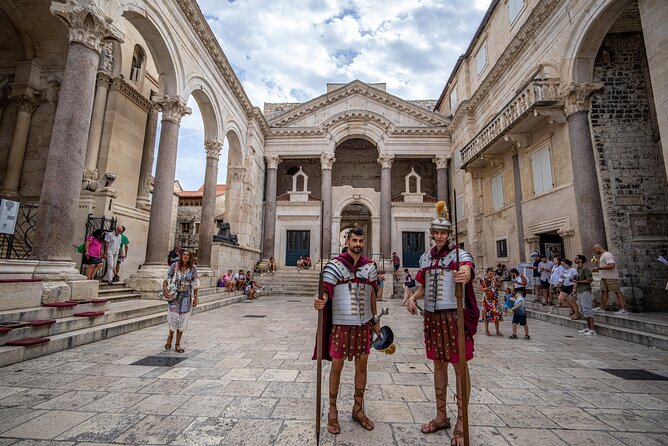
Split’s Old Town can feel like you are walking through one big stone puzzle. This is the kind of place where a quick brochure glance helps, but a good guide helps more. The value of a private walking tour is simple: you move at a comfortable pace, and the person leading you can point out what matters without turning it into a lecture.
You start at the Riva, the promenade of Split. Even before you hit the palace walls, that first stretch matters because it helps you get bearings fast. You also get the basic city framing you need, so later stops make more sense when you are surrounded by Roman foundations and later medieval additions.
For me, the standout feature is how the tour balances big “wow” architecture with practical, inside access. You are not stuck guessing what you are looking at, and you are not paying extra at several stops because admission is included for multiple major sites.
Riva to the palace core: setting the context before the stone overload
The tour begins at a clear landmark area near the “model of the historical core of the city of Split.” That is a nice touch because it gives you a mental picture before you start moving through the real streets.
From there, you head toward Diocletian’s Palace, the massive Roman complex that still shapes Split’s layout. At this point, the guide’s job is crucial: they translate what you see into something logical.
If you have ever visited ruins and felt like you were staring at details with no story, this part helps prevent that. Instead of wandering, you are guided through the “what” and “why,” so each gate, corridor, and courtyard becomes part of a timeline rather than a random landmark.
And yes, the walk covers a lot of ground in a short time, but the private format helps you slow down when something grabs your attention. That is often the difference between seeing a place and understanding it.
Diocletian’s Palace interiors: Cathedral, Jupiter, and the palace basement
The tour’s center of gravity is the palace complex itself, and that is where the included tickets pay off. You move from the general palace look into the interior spaces that help you understand how this place worked.
Cathedral of Saint Domnius, from imperial mausoleum to cathedral
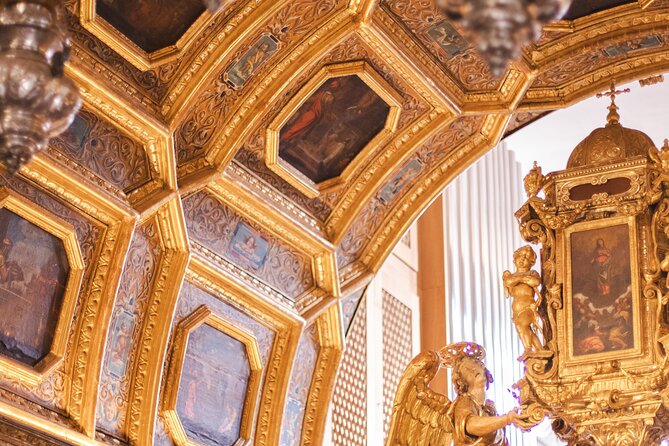
One of the strongest stops is the Cathedral of Saint Domnius. This church began as the mausoleum of late Emperor Diocletian. Over time, as Christianity spread, the emperor’s remains and coffin disappeared, and the pagan mausoleum became a Christian cathedral.
That conversion is not just a historical footnote. It is visible in how you experience the building today. You get a sense of how reused space can carry layers of meaning, from imperial authority to religious identity.
- Split: Krka Waterfalls Trip with Boat Cruise and Swimming
★ 4.8 · 10,519 reviews - From Split: Krka Waterfalls, Food & Wine Tasting Tour
★ 5.0 · 9,326 reviews - Blue cave, Mamma Mia and Hvar, 5 islands speedboat tour
★ 5.0 · 7,150 reviews - From Split: Krka Waterfalls, Food & Wine Tasting Tour
★ 4.9 · 6,598 reviews - Split/Trogir: Blue Cave, Mamma Mia, Hvar and 5 Island Tour
★ 4.6 · 6,320 reviews
Temple of Jupiter, now a baptistery with a special ceiling
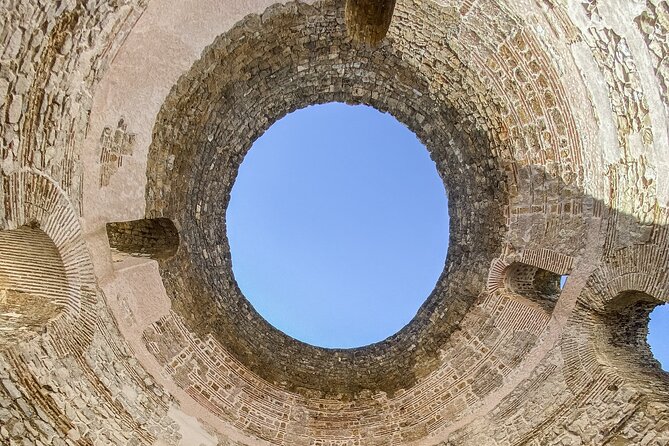
Next is the Temple of Jupiter, which today functions as a baptistery. The tour highlights a ceiling casket design, and the important part for you is context: it influenced architects in Renaissance Dalmatia. That is exactly the kind of connection that makes a stop feel more than scenic. You are not just looking, you are learning why the style mattered later.
Basement and interior areas you would otherwise miss
A lot of people see the outside walls and courtyards, then leave with only half the story. This tour goes further. If attractions are open and there are no worship or event conflicts, you also visit areas like the palace basement and other interior spaces tied to the complex.
The practical benefit is huge: you get a fuller understanding of the palace scale and layout. Even if you consider yourself a casual history fan, these interior moments tend to “click” in a way street-level sightseeing often does not.
The cellars through the South Gate: size, preservation, and scale
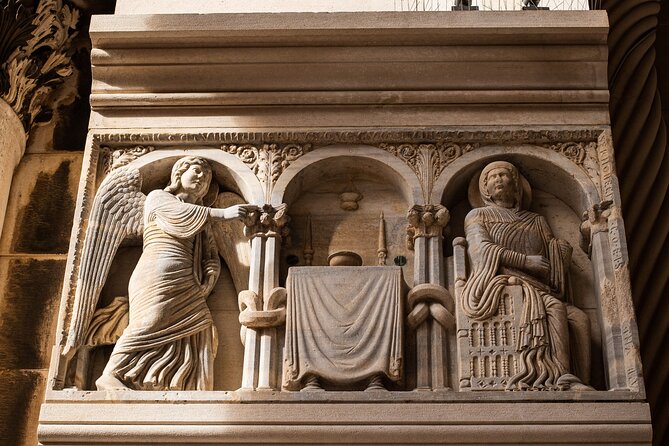
After the main palace interiors, you go toward Diocletian’s Cellars. The experience here is about scale and preservation. The cellars are over 1700 years old and are described as very well preserved, and the tour uses that fact to help you picture how enormous the palace complex truly was.
Walking through spaces built that long ago can be surprisingly grounding. You start thinking in dimensions instead of just silhouettes. The guide’s framing matters here, because it turns “old underground rooms” into a clearer sense of structure and purpose.
And since entrance to the cellars is included, you avoid the common problem on self-guided visits: you might want to go inside, but you end up skipping because of time or ticket friction. Here, those decisions are made for you.
Peristyle and the palace’s private world: what Diocletian displayed
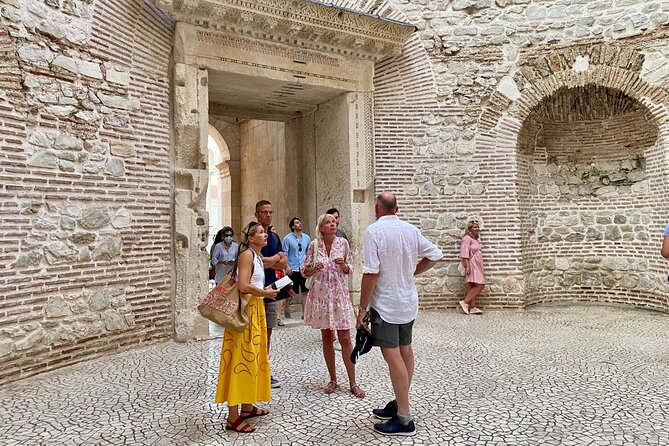
The tour also stops at the Peristyle of Diocletian’s Palace. This area is described as the sacral meeting place in Diocletian’s time, where he appeared to his subjects and was worshipped as the son of Jupiter.
That detail changes how you read the space. You start to notice the theatrical nature of authority in Roman city planning. The Peristyle is not random beauty, it is a stage.
From there, you move into the Vestibulum, the entrance area to Diocletian’s private chambers. Even if you only get a short look, the idea is powerful: you are shifting from public display zones to controlled private access. That movement helps you understand how this palace was built for different roles, not one single function.
North Gate to Old Split: Golden Gate, then Pjaca and Voćni trg
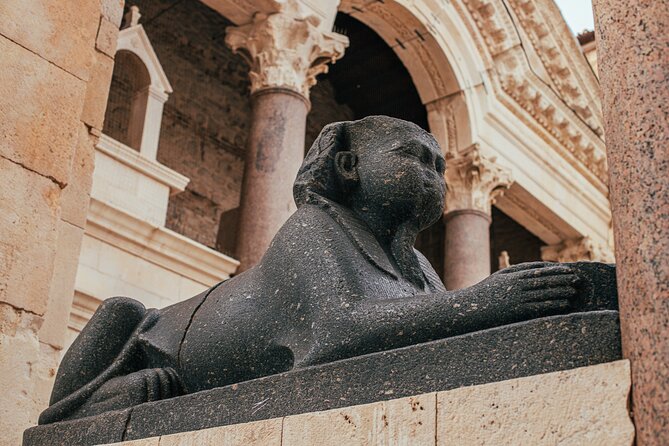
Once you move from the inner palace into Old Split, the tour becomes a walk through layers of time.
Golden Gate: the North Gate and the road to Salona
A key stop is the Golden Gate, the North Gate of the palace. In Roman times, this was the most important gate, and from here the road led to Salona, the capital of the Roman province.
If you have ever wondered why gates were named and positioned the way they were, this stop answers it. You are seeing a junction between the palace world and the wider Roman region, not just a dead-end wall.
Walking the palace walls into Narodni Trg and beyond
From the North Gate, the route continues along the palace walls toward Narodni Trg and further to Voćni Trg. This part of the city developed west of the palace since the Middle Ages, which gives you a reason why the street plan feels different as you move away from the Roman core.
You also get the sense that Split’s “oldness” is not uniform. Roman foundations anchor the city, and later centuries built their own centers around those foundations.
Pjaca (People’s Square): Venetian palaces and a neo-Gothic city hall
Next up is Pjaca, the city center since the Middle Ages. The tour points out old Venetian palaces and the old city hall in a neo-Gothic style.
This is one of those stops where the guide’s job is interpretation. If you are just looking at facades, you may miss what changed and why. With a guide, you notice the mix of eras in a way that makes the square feel like a living timeline rather than a photo stop.
Voćni trg (Fruit’s Square) and Marko Marulić
At Voćni trg, which used to be the market place for fruit, there is a monument to Marko Marulić, one of Split’s important Renaissance authors. This is a quieter stop, but it can be a satisfying one because it ties daily life, trade, and local identity to a specific person.
If you like learning how a city remembers its writers, artists, and thinkers, this is worth your attention.
Fish Market, sulfur baths, Marmontova street, and the end at Procurative
After the palace and square circuit, the tour shifts into street-level Split, with a couple stops that are both practical and sensory.
Split Fish Market: why there are no flies
The tour includes the fish market, and it comes with a fun, specific explanation: the smell of sulfur is the reason there are no flies in the market.
Next door are the sulfur baths, and the guide also notes that even Diocletian knew sulfur baths could provide relief for rheumatism and other diseases. Whether you believe every wellness claim, the connection to place is still useful. It tells you the market area was not just trade, it was tied to health and daily routines.
Marmontova ulica: French design under Napoleon
Then you hit Marmontova ulica, a busy pedestrian zone and shopping street. The tour attributes its build to the French under Napoleon’s rule at the beginning of the 19th century.
This stop works well because it reminds you that Split kept changing after the Romans. It also gives you a natural place to slow down if you want to browse shops or pick up snacks.
Prokurative: a Venetian-feeling square for a relaxed finish
The tour ends at Procurative (Prokurative) at Republic Square. The square is compared to St. Mark’s Square in Venice, and the reason you will like ending here is practical: there are cafes and restaurants where you can keep the story going at your own pace.
You finish at a spot designed for lingering, so you are not stuck hunting for food right after walking for two and a half hours.
Price and time: is this good value at $203.95 per person?
At $203.95 per person for about 2 hours 30 minutes, this is not a budget add-on. But private, entrance-included palace access in a high-demand historic core is rarely cheap, and this tour has clear value built in.
Here is what you are paying for beyond basic sightseeing:
Private format so you get focused guidance instead of crowd management
Included admissions for major interior components tied to Diocletian’s Palace, including the Cathedral of Saint Domnius and the Temple of Jupiter, plus the cellars and palace basement areas when open
A route that combines Roman palace structure with Old Town squares, so you do not have to connect the dots yourself
Also, the tour is designed for English speakers and uses a mobile ticket, which makes it easier to handle your day without extra paperwork.
Another small value point: the tour has an average booking window of 73 days in advance. That does not mean you must book early, but it is a hint that getting a time slot is often smoother when you plan ahead.
Who this tour suits best, and when you might choose differently
This tour is a great fit if you want a structured route through Split’s most important spaces but do not want to pay for multiple separate tickets or waste time figuring out which entrances are worth your effort.
It also suits you if you care about interpretation. The palace is huge, and without guidance it is easy to miss the connections, like how the mausoleum became a cathedral, or how Roman design influenced later architecture.
A private format is also ideal if you like asking follow-up questions. The guides you might see in practice, like Dana and Jana, are praised for strong history explanations and for helping with directions for what to do next.
If you want total freedom to wander at your own speed and you enjoy reading on your own, you can do Split without a guide. But if you want the story organized and tied to specific interiors, this is the more efficient way to get there.
Practical tips so you enjoy every stop
A couple things will help you get the most out of the 2.5-hour route.
Wear comfortable shoes. This is a lot of old-stone walking plus stairs and indoor-outdoor transitions.
Keep an eye on access. The tour notes that some sights might not be visited due to events or church services, and the program can be adjusted.
Plan for the final square. Ending at Prokurative is convenient for a meal, so you can treat the last leg as your transition into lunch or an evening plan.
Should you book this Split Palace and Old Town private tour?
If you are coming to Split for the first time and want to understand why the city feels the way it does, I think this is a smart booking. The combination of palace interiors plus Old Town squares, with included entrances, is exactly the sort of structure that saves time and reduces decision fatigue.
Book it if:
You want Diocletian’s Palace inside access, not just the outside walls
You prefer a guided route that connects Roman, Christian, and medieval layers
You like the idea of finishing in a practical cafe square at Prokurative
Skip or consider a different approach if:
You are fine with mostly outside sightseeing and do not care about interior entrances
You are traveling on a day when you expect major closures due to events, since the tour may shift stops when access is limited
FAQ
FAQ
How long is the Split Palace and Old Town private walking tour?
It runs about 2 hours 30 minutes.
Is this tour private?
Yes. It is a private tour/activity, and only your group participates.
Is the tour offered in English?
Yes, the tour is offered in English.
Are entrance tickets included?
Yes. Entrance fees are included for multiple sites, including Diocletian’s Palace areas such as the basement, the Cathedral of Saint Domnius interior, the Temple of Jupiter, and Diocletian’s Cellars.
What if a sight is closed due to events or church services?
The tour may change slightly. If worship or events prevent visiting certain attractions, the guide adjusts the program.
What should I know about weather and cancellation?
The experience requires good weather. If it is canceled due to poor weather, you will be offered a different date or a full refund. You can cancel for a full refund up to 24 hours in advance.
Walk It: More of Split at Ground Level

Freshly written up around Split



Walking Tours, top to bottom.
 ★ 4.8Dubrovnik: Old Town Walking TourFrom $235,174 reviews
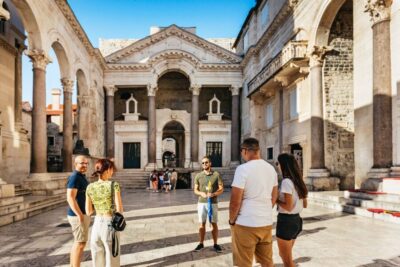 ★ 4.9Split: Old Town and Diocletian Palace Walking TourFrom $174,727 reviews
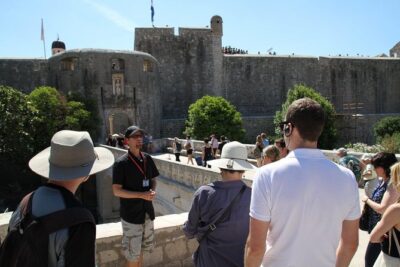 ★ 5.0Dubrovnik Discovery Old Town Walking TourFrom $244,458 reviews
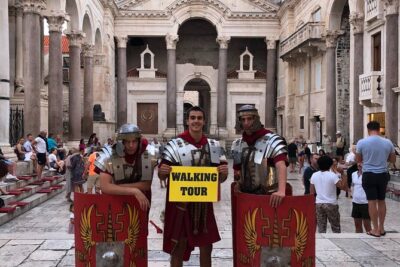 ★ 5.0Walking Tour of Split and Diocletian’s PalaceFrom $482,588 reviews
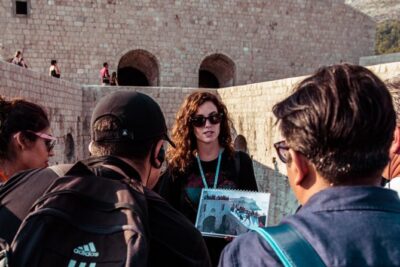 ★ 5.0Dubrovnik: Game of Thrones Walking TourFrom $301,732 reviews
 ★ 5.0Dubrovnik Old Town History Walking TourFrom $241,684 reviews
 ★ 5.0Krka Waterfalls tour with Trogir Walking tour and Krka panoramic boat cruiseFrom $481,659 reviews
 ★ 4.8Dubrovnik: City Walls Early Morning or Sunset Walking TourFrom $291,523 reviews
Browse the lists this tour appears in