
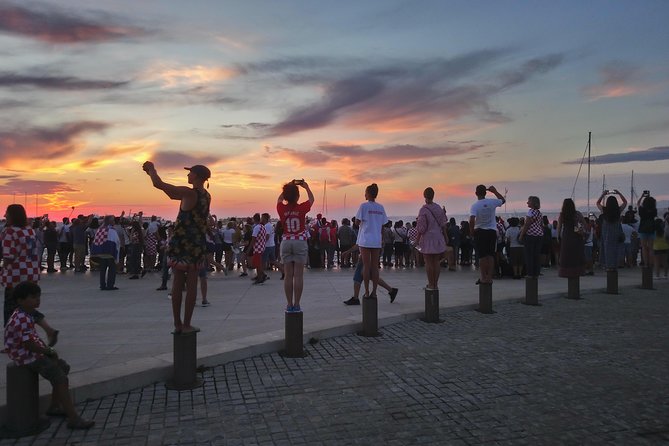
REVIEW · ZADAR OLD TOWN & SEA ORGAN TOURS
Zadar City Tour 90min Walk
Zadar hits different in 90 minutes. This is a small-group walking tour that strings together Roman, early Christian, and Venetian-era landmarks into a tight route you can actually finish without rushing your feet to death.
I especially love how it blends major sights with quick context, so spots like the Sea Organ and the Cathedral of St. Anastasia feel more than just postcard stops. You also get optional extras on the way, like free tastings or a chance to enter a medieval church.
One thing to consider: the tour is packed, and several churches are viewed from outside with no entry, so if you want lots of inside time, this may feel too exterior-focused. Also, it is not recommended for people with mobility issues, and there are no toilet breaks included.
In This Review
- Key Things You’ll Notice on This Zadar Walk
- Zadar in 90 Minutes: Why This Route Works
- Price and Value: What You’re Paying For
- The Small-Group Feel and the Guides People Mention
- Morning vs 18:30: Choose Your Starting Line
- Stop 1: Greeting to the Sun (Morning Only)
- Stop 2: Sea Organ (Morning Only)
- Cathedral of Saint Anastasia: Big Romanesque Exterior Look
- The Roman Forum: The Ancient City Under Your Feet
- Stup srama (Pillar of Shame): A Darker Medieval Survival
- Church of St. Donatus: The Rotunda You See Everywhere
- Benedictine Monastery of St. Maria: Outside Views, Big Time Layers
- People’s Square (Narodni trg): Where the City Passes Through
- Kalelarga and the New Gate: Roman Street to Modern Entrance
- Five Wells: Included in One Format, Quick Stop in the Other
- What You Might Enter or Taste: The Extras That Make It Feel Local
- Timing, Pace, and Weather Reality
- How to Use This Tour After It Ends
- Who This Tour Is For (and Who Should Rethink It)
- Should You Book This Zadar City Tour?
- FAQ
- How long is the Zadar city tour?
- What language is the tour offered in?
- Is the tour price $26.43 per person?
- What is included during the tour?
- Which landmarks are excluded on the morning versus evening tours?
- Are there toilet breaks and is it suitable for mobility issues?
Key Things You’ll Notice on This Zadar Walk
- Small group format with a maximum of 15 people, so it stays personal.
- Two different start-and-see formats depending on whether you go in the morning or at 18:30.
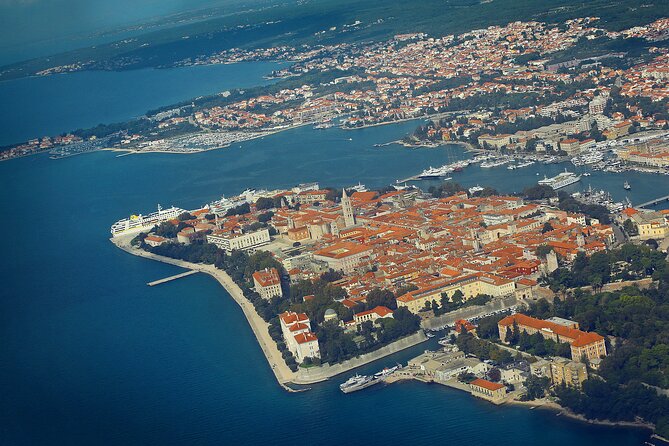
- Modern Zadar meets ancient Zadar, with installations like the Greeting to the Sun and Sea Organ alongside Roman remains.
- Most stops are quick look-and-learn, including Cathedral of St. Anastasia and Church of St. Donatus from the outside.
- Venetian-era Zadar is everywhere, especially around People’s Square and the city hall and guard structures.
- Optional tastings or free church entry may pop up along the route.
Other Zadar outings we thought were worth a look
- Zadar: Plitvice Lakes Guided Day Tour with Tickets★ 4.9 · 3,148 reviews
- Zadar: Kornati Boat Trip with Lunch and Swim Stops★ 4.5 · 1,498 reviews
- Zadar: Plitvice Lakes with Boat Ride and Zadar Old Town Tour★ 4.9 · 1,368 reviews
- From Zadar: Plitvice Lakes with Boat Ride & Zadar Old town tour★ 5.0 · 1,129 reviews
Zadar in 90 Minutes: Why This Route Works
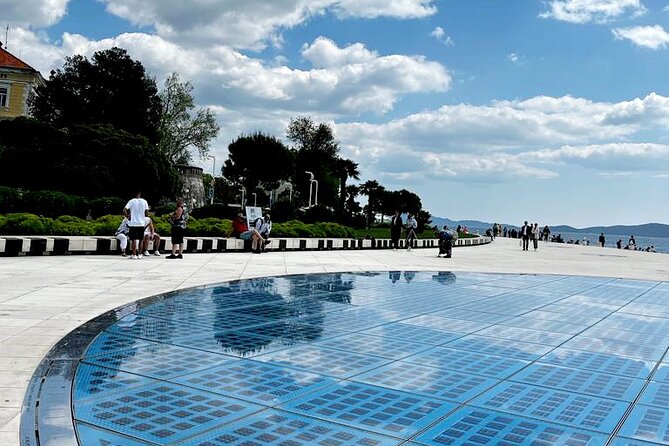
Zadar’s old town is compact, and this walk is designed for that reality. In about 1 hour 30 minutes, you get a sequence of landmarks that show how the city layered cultures over centuries, instead of making you jump across town with tired legs.
I like that the tour keeps moving, with frequent short pauses. Think five to ten minutes at a time, enough to reset your eyes, catch details, and get the story without turning the day into a sit-down lecture.
And Zadar has a rare mix of “new” and “ancient” in the same streets. You can go from sound-and-light coastal installations to Roman forums and medieval columns without feeling like you are cramming unrelated stops.
Price and Value: What You’re Paying For
At $26.43 per person for roughly 90 minutes, this tour is priced like a practical old town overview. You are not paying for admission fees to most monuments, since many listed stops are free to view and the tour is mainly about guided interpretation on foot.
The value part is the combination of:
- a guided route through the most central historic areas
- small-group attention (max 15 people)
- optional extras, such as possible free entrance to a medieval church or Maraskino/cheese tastings
You should also know what is not included. There are no transfer services, toilet breaks are not part of the package, and a lot of the churches are outside viewing only.
If you have limited time in Zadar, this kind of ticket can be a smart move. It helps you prioritize what to return to on your own later, especially if you want to photograph, wander, or grab food after the tour ends.
The Small-Group Feel and the Guides People Mention
This is offered in English and runs with a maximum of 15 participants. That matters because the guide can actually point, explain, and respond without the tour turning into a slow-moving conga line.
The feedback names guides like Dorja and Danja, and the consistent theme is strong city background and clear communication. Dorja, in particular, is described as professional and strongly invested in sharing what Zadar has meant over time, from Roman-era remains to later conflicts and modern identity.
Do keep one caution in mind. In one instance, an alternate guide stepped in and was described as quieter, which can be tricky on busy streets. If you know you have trouble hearing on outdoor tours, position yourself closer to the guide early.
Morning vs 18:30: Choose Your Starting Line

This tour has real differences depending on the time you book.
Morning format (11 AM):
- includes the Greeting to the Sun and Sea Organ
- excludes the Land Gate
18:30 format (evening):
- includes the Land Gate start and focuses on the old town core from there
- excludes the Sea Organ
- starts in English from Zadar Land City Gates, with the guide waiting in front of the gates beside the bikes
So if you care most about the sea-inspired installation, go morning. If you want the Venice Republic Land Gate experience and the evening atmosphere, go 18:30.
Either way, the overall tempo stays similar: short stops, quick context, and a guided walk that keeps you oriented through Zadar’s old center.
More Zadar covered at walking pace
- Zadar: Guided Walking Tour
★ 4.8 · 445 reviews - Zadar City Tour 120min Walk
★ 5.0 · 203 reviews - Zadar Walking Tour sponsored by Gligora Cheese and deli.
★ 5.0 · 119 reviews - Zadar: Virtual Reality Guided History Walking Tour
★ 4.4 · 86 reviews - Zadar: Private Walking Tour Through 3,000 Years of History
★ 4.7 · 71 reviews
Stop 1: Greeting to the Sun (Morning Only)
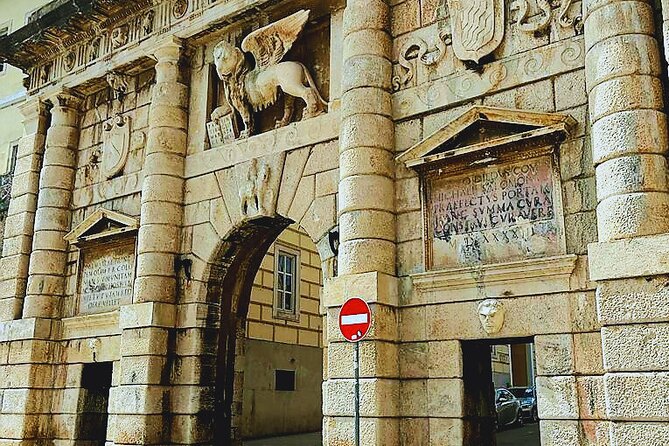
The Greeting to the Sun is one of the most talked-about public installations in the world. It is a solar-panel artwork on the floor, created to represent our solar system, and it has been around since 2008.
Why it works on a walking tour: it sets a modern tone without leaving the old town behind. You get a quick “how Zadar thinks today” moment before the city history gears up.
A practical note: it is not included on the evening tour. If you want this specific stop, book the morning slot.
Stop 2: Sea Organ (Morning Only)
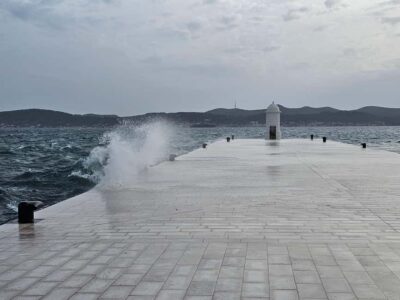
Next up is the Sea Organ, launched in 2005, also one of Zadar’s signature installations. It sits along the promenade like a piano keyboard, and the idea is that the sea helps create the instrument-like sound.
This stop is short by design. You do not need a long stay to get the point, and the guide can explain the concept quickly so you understand what you are seeing and hearing.
Again, it is not included on the evening format. If you want the full “Zadar modern waterfront” arc, morning is your best bet.
Cathedral of Saint Anastasia: Big Romanesque Exterior Look
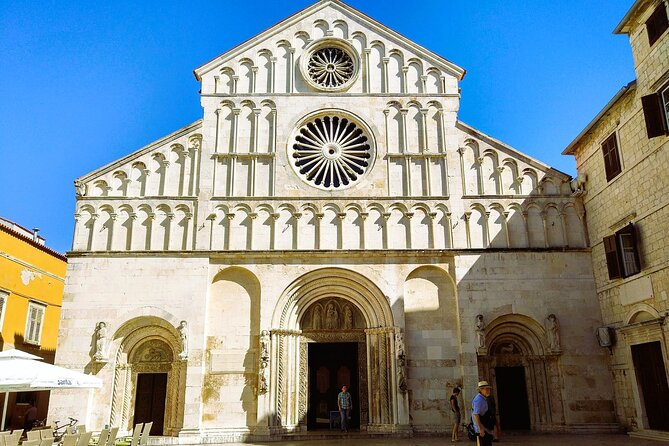
The Cathedral of St. Anastasia is described as Zadar’s biggest Romanesque church. The tour stop includes time to see it, but there is no entrance.
That might sound limiting, but it can still be useful. When a guide calls out the Romanesque style details and explains the cathedral’s role, you can still make a good decision about whether you want to come back later for an inside visit on your own time.
If you are hoping for a long church interior experience, this may not satisfy that desire. This tour is structured for quick exterior viewing at major religious landmarks.
The Roman Forum: The Ancient City Under Your Feet
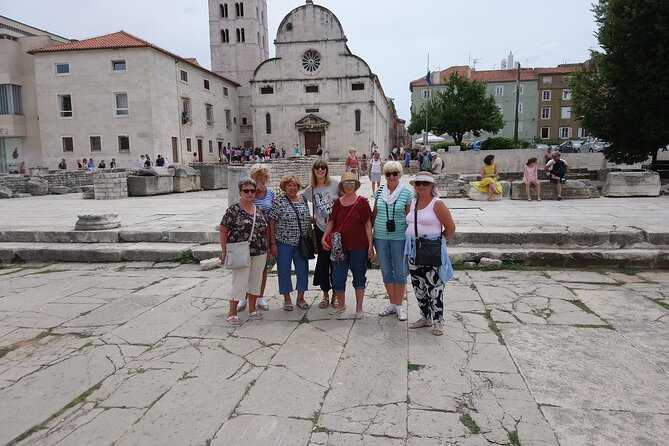
The Forum stop focuses on an ancient Roman Forum from the 1st century BC. This is one of those moments where the scale of time suddenly feels real.
Because the tour is on foot, you naturally connect the dots between different layers of Zadar. The guide’s role here is to help you picture what this area would have looked like when Roman public life was happening here, not just to point at ruins.
This stop is free to view, and the “short but meaningful” timing keeps it from eating your whole tour.
Stup srama (Pillar of Shame): A Darker Medieval Survival
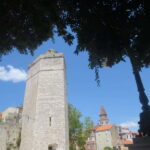
Stup srama is one of two biggest Roman columns that survived and later became associated with medieval punishment culture, sometimes known as the pillar of shame. The tour gives you a chance to see it, with no entrance.
The value here is context. If you treat it as just a column, you miss why it matters. With the explanation, it becomes a marker of how later societies reused older structures and turned them into symbols.
This is a short stop, but it can be one of the most memorable if you like history that includes uncomfortable parts.
Church of St. Donatus: The Rotunda You See Everywhere
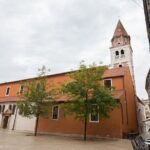
Church of St. Donatus is a desacralized church with roots in the 9th century, built as a huge rotunda in a pre-Romanesque style. Like several other religious sites on this route, there is no entrance.
The benefit of seeing it on a guided walk is that you get a sense of why this shape is unusual and how it reflects the era. If you are the type who likes architecture, this stop can “click” more when you hear it explained out loud while standing in front of it.
It is not an inside visit, so plan to take photos and move on.
Benedictine Monastery of St. Maria: Outside Views, Big Time Layers
The Benedictine Monastery of St. Maria is a feminine Benedictine convent from the 11th century, with a Renaissance church inside the complex. The tour stop does not include an entrance.
Because you are not going in, you should treat this stop as an orientation point. Your guide can help you notice what survived, what changed over time, and how monastic life fits into Zadar’s story.
If you want more time inside religious sites, this is one reason to consider pairing the tour with your own later exploration.
People’s Square (Narodni trg): Where the City Passes Through
People’s Square is the kind of place you will likely walk through anyway, but the tour helps you see the details you might miss. You get a quick look at the surrounding City Loggia and City Guard from the Middle Ages.
Then the route adds short stops at:
- a 16th-century City Guard building during the Venice Republic period (no entrance)
- Gradska loža, the 16th-century city hall from the same Venetian Republic period (no entrance)
These stops are brief, but they are valuable because they explain how Zadar functioned under Venetian rule and why the square looks the way it does.
Kalelarga and the New Gate: Roman Street to Modern Entrance
Kalelarga is described as the biggest street on the peninsula and it used to be the main Roman Decumanus. That is a fun line to hear while walking, because it turns “just a main street” into an artery that connected older city life.
The tour also references the New Gate visible from People’s Square, noted as the last gate built in 1931. Even if you are not going to it directly, hearing the timeline helps you understand why you see certain entrances and not others.
This section is where you feel the walk turn from monuments to flow. You start to understand how people actually move through this part of Zadar.
Five Wells: Included in One Format, Quick Stop in the Other
Five Wells is a free stop, but it depends on your tour time. It is noted as not included on the morning tour, meaning you will only see it on the format that includes it.
Because it is short, you probably will not spend a long time photographing. Still, it is a great example of how old infrastructure can become a recognizable city character.
If your schedule makes the morning your only option, you will trade this stop for the sea installations.
What You Might Enter or Taste: The Extras That Make It Feel Local
The tour includes possible free entrance to a medieval church or Maraskino/cheese tastings on the way. In practice, the experience can include stops into local shops for samples, with mention of Maraska liquor and cheese tasting.
This is the part I would not skip if food and local specialties are part of how you travel. It is not a huge “meal,” but it helps you connect names on a menu to a place with real roots.
Two practical thoughts:
- Because it is described as possible, do not build your plan around it happening every time.
- If you have dietary needs, ask at the start so you are not stuck guessing later.
Timing, Pace, and Weather Reality
The walk is about 1 hour 30 minutes, with quick stops. That pace is perfect for first-time orientation, but it also means you should arrive ready to walk and look, not to take long detours.
There are no toilet breaks included, so plan accordingly. And the experience requires good weather, meaning if conditions are poor, you may be offered a different date or a full refund.
If you want photos, bring a little patience. Outdoor streets can be crowded, and hearing can be harder in noisy intersections. Position yourself well near the guide at the start, then stay there when the group stops.
How to Use This Tour After It Ends
After a tour like this, I like to do two things:
1) Return on my own to one stop that really hooked me, like Church of St. Donatus or the Roman Forum area.
2) Walk the streets again, but slower, using what the guide pointed out as my checklist.
You will likely leave with a mental map of where the historic centers are, and which areas are worth a second pass. That is the real value of a 90-minute guided walk, you get enough structure to wander intelligently after.
If you still have energy, People’s Square and Kalelarga are easy places to keep exploring because they are naturally “walkable” no matter what else you do.
Who This Tour Is For (and Who Should Rethink It)
This fits best if you want:
- a focused old town orientation in about 90 minutes
- a guide to explain why key landmarks matter
- a route that mixes major monuments with modern Zadar installations
It may not fit as well if you:
- want many church entrances and long interior time
- need frequent breaks, since toilet breaks are not included
- have mobility constraints, since it is not recommended for travelers with mobility issues
It also suits couples and small groups well because the maximum size stays under 15.
Finally, be aware the style can lean more toward guided explanation than casual conversation. If you prefer an interactive back-and-forth, tell your guide early what you care about most.
Should You Book This Zadar City Tour?
I think you should book this tour if you have limited time and you want your first look at Zadar to come with context. For the price, you get a tight route through the city’s most recognizable Roman, Venetian, and medieval touchpoints, plus possible local tastings that make it feel grounded.
Choose morning if the Sea Organ and Greeting to the Sun are high on your list. Choose 18:30 if you want the Land Gate start and you would rather focus on the inland old town core.
Skip this tour or pair it differently if you need lots of inside church time, or if mobility and breaks are major constraints. In those cases, a different format might serve you better.
FAQ
How long is the Zadar city tour?
It lasts about 1 hour 30 minutes.
What language is the tour offered in?
The tour is offered in English.
Is the tour price $26.43 per person?
Yes, the price is listed as $26.43 per person.
What is included during the tour?
The tour includes possible free entrance to a medieval church or Maraskino/cheese tastings that may happen on the way.
Which landmarks are excluded on the morning versus evening tours?
The 11 AM tour excludes the Land Gate, and the 18:30 PM tour excludes the Sea Organ.
Are there toilet breaks and is it suitable for mobility issues?
Toilet breaks are not included. It is not recommended for travelers with mobility issues.
City-Scale Tours in Zadar



Walk It: More of Zadar at Ground Level

Zadar, A Few More Outings




Freshly written up around Zadar
Zadar Old Town & Sea Organ Tours, top to bottom.
 ★ 4.9Zadar: Plitvice Lakes Guided Day Tour with TicketsFrom $883,148 reviews
 ★ 4.8Zrmanja River: Half-Day Guided Kayaking Tour Near ZadarFrom $641,817 reviews
 ★ 4.5Zadar: Kornati Boat Trip with Lunch and Swim StopsFrom $641,498 reviews
 ★ 4.9Zadar: Plitvice Lakes with Boat Ride and Zadar Old Town TourFrom $531,368 reviews
 ★ 4.9From Zadar: Island-Hopping Speedboat Tour with DrinksFrom $381,247 reviews
 ★ 4.1Zadar: Kornati and Telašćica Full-Day Boat Trip with LunchFrom $511,193 reviews
 ★ 4.7Zadar: Plitvice Lakes Full-Day Guided Tour with a Boat RideFrom $58807 reviews
 ★ 3.8From Zadar: Kornati National Park and Telascica Boat TripFrom $64788 reviews
Browse the lists this tour appears in