
REVIEW · SPLIT OLD TOWN & PALACE WALKS
Private Split Walking tour with a Photo session
Split is all stones and stories. This private walking tour is a smooth way to see the key sights of Split while getting a real lifestyle photo session built in. I like that it is private and paced for your group, and I also like that you have a professional photographer (Ivan Gudić) guiding the photo moments as you walk.
The route is very practical too, with an easy-to-find start on the Riva and stops that are close together. The main consideration is the cost, it runs $300.73 per person, so it is best when you really want the photo work and a guide rather than just ticking off monuments quickly.
In This Review
- Key highlights to watch for
- Riva promenade to Diocletian Palace, a walk with real momentum
- Riva Harbor stop: the easiest way to get your bearings
- Diocletian’s Palace: seeing the Emperor’s world without getting lost
- The Vestibule: when old stone does the work for you
- Cathedral of Saint Domnius: one ticket, multiple sacred stops
- Gregory of Nin at the Golden Gate: local language and a lucky toe
- Pjaca and Fruit’s Square: squares where Split lives
- Prokurative: the Italian-style square feel, with a Split agenda
- How the private pace and the photo session work together
- Price and value: what $300.73 per person buys you in Split
- Who this tour fits best, and who should choose something else
- Practical tips before you go (so the day stays smooth)
- Should you book this Split private photo walking tour?
- FAQ
- Where does the tour start, and where does it end?
- How long is the walking tour?
- Is this tour private?
- What language is the tour offered in?
- Is admission to the Cathedral of Saint Domnius included?
- What is the cancellation policy?
Key highlights to watch for
- Riva promenade start: A clear meeting area that locals treat like a year-round living room
- Diocletian Palace in focused bites: Big Roman scale explained without dragging you around all day
- Vestibule acoustics: A spot where you can appreciate how sound works in old imperial spaces
- Cathedral ticket includes extras: Your Cathedral entry also covers the Temple of Jupiter and the Crypt of St. Lucy
- Photo session that follows the sightseeing: Ivan Gudić helps you turn locations into keepers, not just snapshots
- Free time after 2.5 hours: You get the “core loop” done early, then the rest of your day is yours
Other walks through the palace quarter and the alleys behind it
- Split: Old Town and Diocletian Palace Walking Tour★ 4.9 · 4,727 reviews
- Walking Tour of Split and Diocletian’s Palace★ 5.0 · 2,588 reviews
- Split & Diocletian’s Palace Walking Tour★ 5.0 · 1,125 reviews
- Walking Tour of Split with a ‘Magister’ of History★ 5.0 · 1,122 reviews
Riva promenade to Diocletian Palace, a walk with real momentum
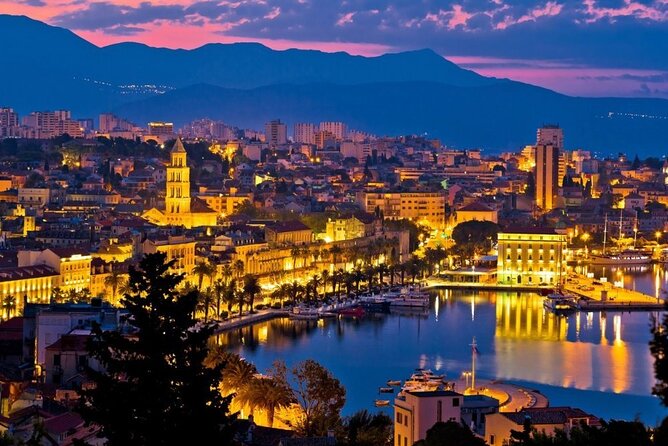
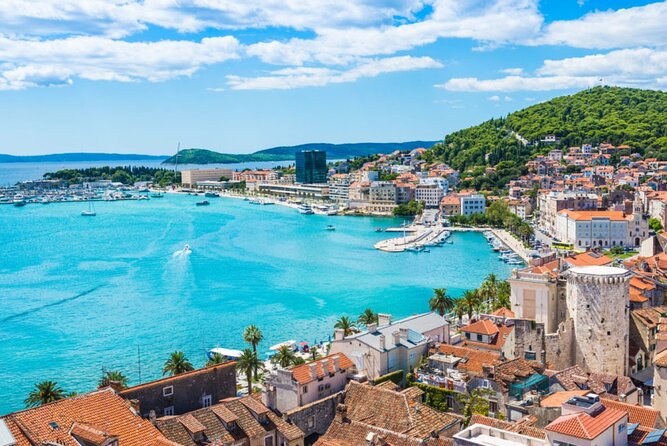
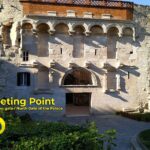
Your tour starts at Obala Hrvatskog narodnog preporoda, 21000, Split. The meeting point is on the Riva promenade, the seaside strip that matters far beyond pretty views. This is where Split’s public life happens. In the year, the waterfront becomes a stage for celebrations from major holidays through the city’s own days.
The nice part for you is the flow. You do not have to fight traffic or guess where to go first. The Riva is also highly photo-friendly because it gives you that “Split waterfront” context quickly, before you move into the dense Roman core.
You also get a feel for the walking style of this tour: short stops, clear explanations, then back on your feet. Even though the main sites are big, you are not stuck for hours in one place. That matters in Split, where the weather can flip fast and shade can be limited.
Riva Harbor stop: the easiest way to get your bearings
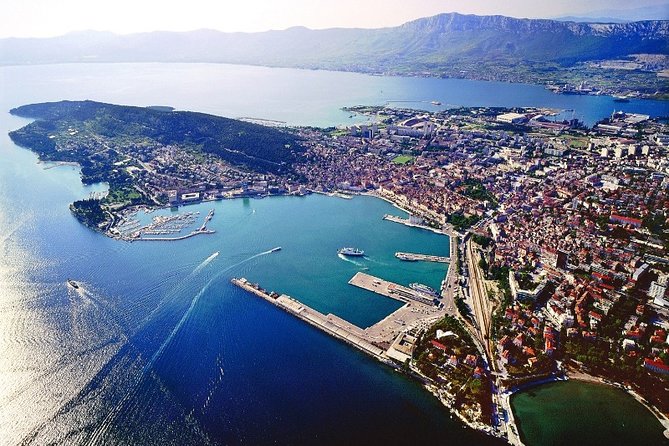
Stop 1 is at the start of the Riva near a bronze model of Split. The promenade is about 250 meters long and 55 meters wide, lined with coffee shops and restaurants where you can pause and reset.
This stop is more than a warm-up. It is a good “story starter” because it explains how locals use the space, including the way the waterfront turns into an event hub across the calendar. If you plan to wander on your own later, this first segment helps you understand where you are and why people hang out here.
Time on the stop: about 10 minutes. Admission ticket: free.
Practical tip: wear shoes that can handle uneven old-stone sections ahead. Riva itself is more forgiving, but the tour quickly shifts into historic surfaces.
Diocletian’s Palace: seeing the Emperor’s world without getting lost
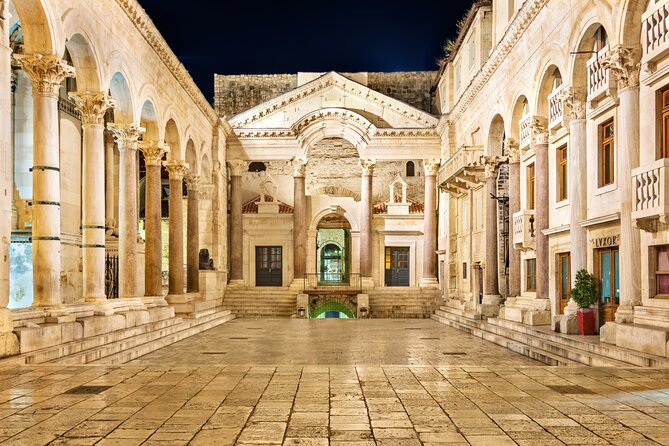
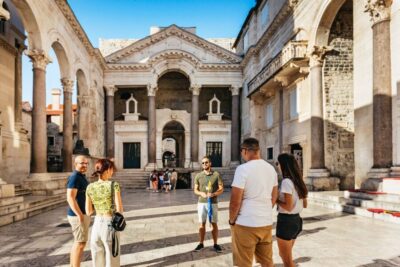
Stop 2 is the Palazzo di Diocleziano, one of the best-preserved Roman monuments of its kind. You spend about 30 minutes here, which is the right length for a private format. It gives you enough time to absorb the layout and scale without turning the palace into a long endurance test.
Here is what makes this stop worth your time: it is not treated like a random pile of ruins. You get the palace described as a combination of luxury villa and military camp, divided into four parts. The Emperor’s side is linked to ceremonial space, while the north side fits the needs of guards, servants, and storage.
The palace is rectangular, roughly 215 by 180 meters, with four big towers at the corners. Doors face each side, and there are smaller towers on the walls. Even if you never memorize dimensions, this kind of framing helps you read what you are looking at. You can start noticing “why this is here” instead of just “what this looks like.”
Admission ticket: free.
The Vestibule: when old stone does the work for you
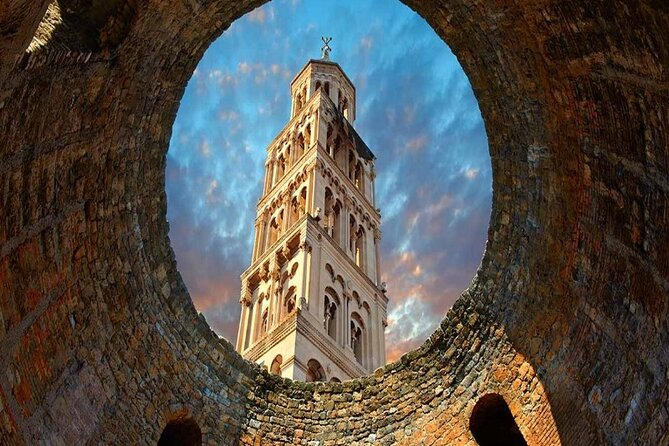
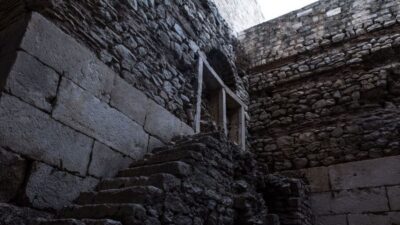
Stop 3 is the Vestibulum of Diocletian’s Palace, a space with a monumental impression both from the outside rectangular plan and the inside circular plan. The design is doing a lot for you here: semicircular niches with statues, a cupola with colorful mosaic, and the bright whiteness of the round wall.
The most interesting part is how the space has been reused. Not long ago in the broader timeline, it was used by residents for living functions, including poultry and small cultivated gardens. That detail alone helps you stop thinking of it as museum-grade only.
For your senses, though, the standout is acoustics. This is presented as a place where you can be amazed by group singing, including traditional dalmatian a capella songs. In other words, you are not only learning with your eyes. You are learning with sound.
Time on the stop: about 10 minutes. Admission ticket: free.
Practical tip: if you can, stand still where the guide points out. Acoustics are picky. Move too much and you lose what the space is trying to show you.
More Split covered at walking pace
- Krka Waterfalls tour with Trogir Walking tour and Krka panoramic boat cruise
★ 5.0 · 1,659 reviews - Split Walking Tour with Professor of History
★ 5.0 · 926 reviews - Split: Diocletian Palace & Old Town Guided Walking Tour
★ 4.7 · 882 reviews - From Split: Krka Waterfalls Cruise & Trogir Walking Tour
★ 4.7 · 681 reviews - Split: History and Heritage Walking Tour
★ 4.9 · 650 reviews
Cathedral of Saint Domnius: one ticket, multiple sacred stops

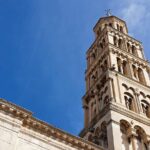
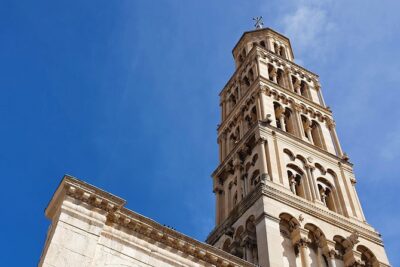
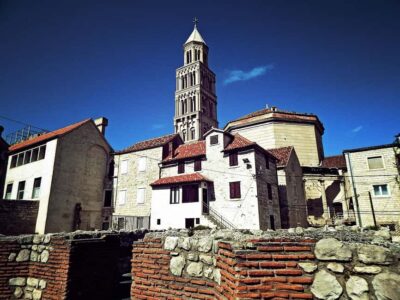
Stop 4 is the Cathedral of Saint Domnius. This is the oldest building element in Split’s major sacred sites, originally the Mausoleum of Roman Emperor Diocletian. Later, it becomes a cathedral, and the story is framed as ancient pagan, Christian medieval, and modern heritage meeting in one place.
What you should expect inside is continuity. Cathedral today is primarily a place of liturgy, with a long lineage that shows up during Sunday mass and on St. Domnius day, Split’s patron saint day.
You also get specific things to look for, like the carved walnut gates by Andrija Buvina from Split. That kind of detail is useful because it gives you a visual anchor when you are moving between old stone and newer worship spaces.
Admission cost: 25 Croatian kuna (around 3.5 euros). The ticket also includes the Temple of Jupiter and the Crypt of St. Lucy. Admission ticket: included for this tour’s segment, meaning the tour includes the Cathedral entry as part of the stop plan, but you should still be ready for the separate price at the time of entry as noted above.
Time on the stop: about 15 minutes.
Consideration: this part is ticketed, so it can add a small friction point if you are short on cash or not expecting to pay on-site. If you prefer everything included up front, plan around that cost.
Gregory of Nin at the Golden Gate: local language and a lucky toe
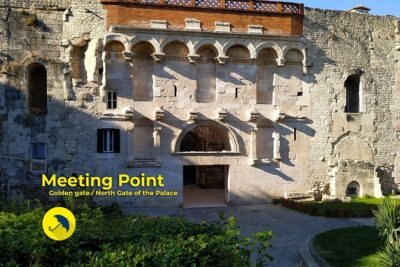
Stop 5 is the Grgur Ninski statue, just outside the Golden Gate, one of the four principal Roman gates into Diocletian’s Palace. The statue is Gregory of Nin, a medieval bishop famous for pushing back against the Catholic church structure in Rome and insisting on using the national Croatian language in Catholic services.
The tour ties that to a bigger cultural idea: when people can understand, faith and practice spread more easily. It is a political story, but delivered in a way that connects to everyday identity.
The statue is by Croatian sculptor Ivan Meštrović, created in 1929 to commemorate one thousand years since Gregory of Nin defended Croatian culture historically. And yes, there is the famous practical folk detail: it is said that rubbing his big toe will grant your wish.
Time on the stop: about 10 minutes. Admission ticket: free.
Quick tip: if you want your photo without elbow-to-elbow crowds, take your shot slightly off the main line and then let space open up again. A private tour still benefits from good timing.
Pjaca and Fruit’s Square: squares where Split lives

Stop 6 is Narodni Trg, also known locally as Pjaca, the People’s Square. It is first mentioned in the 13th century and was called St. Lawrence’s Square earlier. It becomes important as the first inhabited area outside the Diocletian Palace on the western wall.
This stop is where you start seeing Split not just as Roman heritage, but as lived city life. The square is tied to civic authority, including the Old Town Hall building, now an exhibition center. You also get the sense of how palaces around the square kept noble families close.
In today’s reality, Pjaca is a central stage for bars, restaurants, and shops. The key is that this is still a working square, not only a tourist stop.
Time on the stop: about 15 minutes. Admission ticket: free.
Stop 7 is Fruit’s Square, Trg Brace Radic. This smaller square still has landmarks worth stopping for. You have an octagonal Venetian tower, left over from a former fortress built in the 15th century for defending a small town. Across from it is the Palace of the old family Milesi from the 17th century, known for a Baroque facade, one of the best examples in Dalmatia.
Right near it stands the monument to Marko Marulić, a major figure in Croatian literature. The sculptor reference points you to a broader split-thread in the city, since Ivan Meštrović appears elsewhere too.
Time on the stop: about 10 minutes. Admission ticket: free.
Practical tip: these squares are where you can decide your next move. After the tour, you will probably want to linger nearby for coffee or a slow browse. This route gives you exactly that choice.
Prokurative: the Italian-style square feel, with a Split agenda

Stop 8 is Prokurative, officially Republic Square. It gets compared in feel to Venice’s St. Marks Square, and the layout reflects that Italian influence. The arches on neo-Renaissance buildings around the square help create that open, formal edge.
The square’s name connects to the arches and to the 19th century influence of Antonio Bajamonti, a mayor who wanted Split to support Italian tradition strongly. There was also a theatre on the square, but it was destroyed by fire, so what you see now is shaped by changes over time.
You should enjoy this stop if you like atmosphere. It is where cultural events happen, and bars and restaurants pull local life into the open. Even if you do not sit for a long drink, just watching the space helps you understand the city’s rhythm.
Time on the stop: about 10 minutes. Admission ticket: free.
How the private pace and the photo session work together
This tour is private, meaning it is just your group, not a shared cattle-car setup. That matters on a walking route through historic Split. A guide can slow down or speed up based on how you walk and what you stop for.
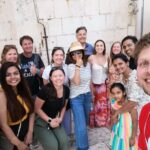
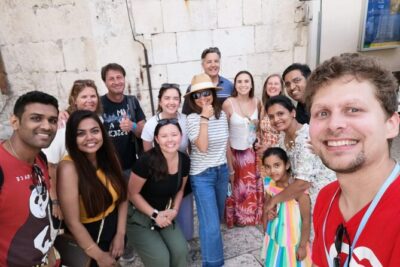
The photo session is the other big reason this feels different from a basic highlights tour. You have a private professional lifestyle photographer included, Ivan Gudić. The idea is not only to show you where to stand, but to help you get photos that match the locations you just learned about.
How I’d think about the photo part if you are booking:
- You are walking from waterfront to Roman architecture to sacred landmarks to city squares. That variety gives the photographer real material.
- A lifestyle photographer is likely thinking about angles and movement, not just posing in front of one wall.
- You may get help creating a mini story arc with your images, matching the tour’s progression.
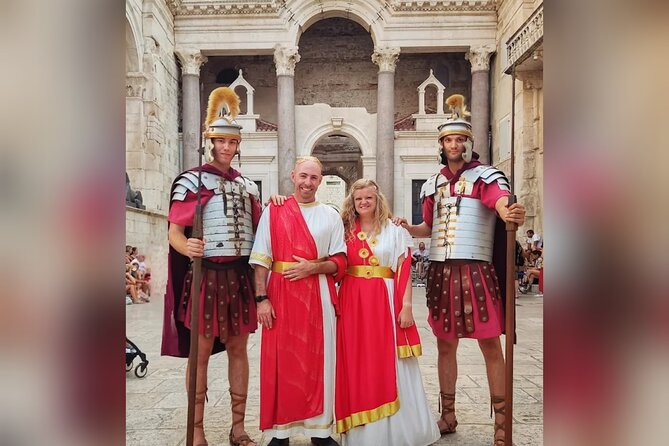
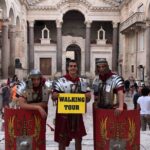
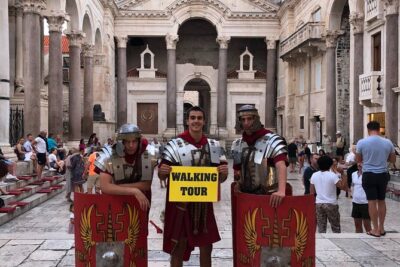
One extra note from how this experience can play out: the guide and photographer can add fun touches, including Roman-themed costume shots at the end of the session. If you like playful photo moments, this is a reason to consider doing the tour earlier in the day, when you have energy and time for extra stops.
Price and value: what $300.73 per person buys you in Split
At $300.73 per person for a tour around 2.5 hours, you are paying for more than narration. You are paying for three things:
- A live guide who helps you connect the sites into a story.
- A private walking format, meaning you get attention and flexibility.
- A professional lifestyle photographer (Ivan Gudić), plus a photo session that adds output beyond standard sightseeing photos.
If you are the kind of traveler who likes to post a few good images and also wants to understand what you are seeing, this price can make sense. If you only want to take phone snapshots and keep costs low, a standard group tour might be cheaper.
The value sweet spot is when your group wants both learning and photos, and you will not just treat this as a quick checklist. Split’s historic center can feel overwhelming fast, so the guide time is doing real work.
Who this tour fits best, and who should choose something else
This tour fits best if you want:
- A private guide for a calm pace through Diocletian’s Palace area
- Photo results you can feel good about, with help from a professional
- A route that ends back at the meeting point, so you can keep your day flexible
It might not fit you as well if:
- You want a longer, deep dive into museums and galleries. This is about highlights plus photos, then free time.
- You dislike ticket add-ons, since the Cathedral of Saint Domnius has an entry cost you need to handle.
Good to know for practical comfort: service animals are allowed, and it is described as suitable for most travelers. The tour is also near public transportation, so you should find it easy to reach without special planning.
Practical tips before you go (so the day stays smooth)
- Plan on good walking shoes. The palace and old-town areas mean uneven surfaces.
- Bring an expectation that you will pay the Cathedral related admission (25 kuna, plus the ticket covers Temple of Jupiter and the Crypt of St. Lucy).
- If you are arriving on a cruise day, double-check your confirmation and confirm the meeting point. One past issue was a no-show when confirmation details did not go through, so be proactive.
- Bring a phone with enough battery for photos, since the tour’s theme is photo capture plus story.
Also, this experience requires good weather. If the weather is poor, you are offered a different date or a full refund.
Should you book this Split private photo walking tour?
I think this is a strong pick if you want the Roman core of Split explained and you also want a photo session that feels intentional, not random. The combination of Riva orientation, focused Diocletian’s Palace time, and the Cathedral stop makes the route efficient. The pro photo angle, with Ivan Gudić included, is what pushes it into value territory for the right traveler.
If you are budget-first, a $300.73 per person price tag will feel steep. But if you want to trade a few hours of your trip for clear guidance and better photos, this tour does exactly what you hope: it gives you a guided backbone and then hands the rest of your day back to you.
FAQ
Where does the tour start, and where does it end?
The tour starts at Obala Hrvatskog narodnog preporoda, 21000, Split, Croatia. It ends back at the same meeting point.
How long is the walking tour?
The tour duration is approximately 2 hours 30 minutes.
Is this tour private?
Yes. It is a private tour/activity, and only your group participates.
What language is the tour offered in?
The tour is offered in English.
Is admission to the Cathedral of Saint Domnius included?
The Cathedral entry is 25 Croatian kuna (about 3.5 euros). That admission also includes entry to the Temple of Jupiter and the Crypt of St. Lucy.
What is the cancellation policy?
You can cancel for free up to 24 hours in advance for a full refund. If you cancel less than 24 hours before the experience starts, the amount paid is not refunded. The experience can also be rescheduled or refunded if canceled due to poor weather.
Where to Point a Camera in Split

Walk It: More of Split at Ground Level
Inside the Palace Walls
Freshly written up around Split
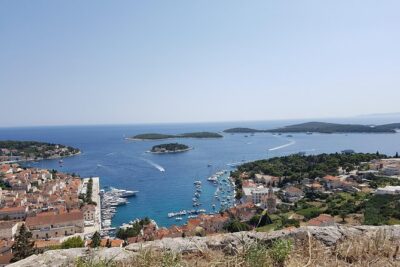

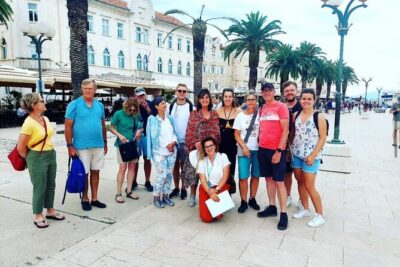
Split Old Town & Palace Walks, top to bottom.
 ★ 4.9Split: Old Town and Diocletian Palace Walking TourFrom $174,727 reviews
 ★ 5.0Walking Tour of Split and Diocletian’s PalaceFrom $482,588 reviews
 ★ 5.0Split & Diocletian’s Palace Walking TourFrom $211,125 reviews
 ★ 5.0Walking Tour of Split with a ‘Magister’ of HistoryFrom $341,122 reviews
 ★ 5.0Split Walking Tour with Professor of HistoryFrom $24926 reviews
 ★ 4.7Split: Diocletian Palace & Old Town Guided Walking TourFrom $17882 reviews
 ★ 4.8Split: Game of Thrones Tour with Diocletian’s Palace CellarFrom $41545 reviews
 ★ 5.0Diocletian’s Palace and Old Town SMALL GROUP Walking TourFrom $16502 reviews
Browse the lists this tour appears in