
REVIEW · SPLIT OLD TOWN & PALACE WALKS
Split Old Town History Walking Tour
Split’s Roman bones are right under your feet. This 90-minute Old Town history walk threads sea views, emperor-scale architecture, and street-level local life into one easy route. You get a licensed English-speaking guide and a mobile ticket, plus a route paced for real questions.
I particularly like how the walk centers on Diocletian’s Palace details you usually miss if you wander solo. You also get practical guidance on where to eat, drink, and explore, which helps your first day in Split feel less like guesswork. In small groups (up to 20), that advice actually lands.
One thing to consider: the focus is heavily inside and around the palace complex, so if you want more of Split spread out, this may feel a bit concentrated. Add in the classic Old Town mix of stone steps and uneven surfaces, and it helps to wear shoes with good grip and go slowly.
In This Review
- Key points to know before you go
- Why Diocletian’s Palace is the heart of Split
- Riva promenade start: get your bearings with sea views
- Under the palace: Diocletian’s cellars and Roman life
- St. Domnius Cathedral: where Roman columns meet a later faith
- The palace’s circular acoustics, plus a possible klapa moment
- Temple of Jupiter, sarcophagus, and the Roman-to-church timeline
- Triklinij banquets: seeing imperial luxury in one small room
- Golden Gate exit and the Gregory of Nin toe-rub ritual
- Narodni trg and Fruit’s Square: where local life now happens
- Price and value: what $30.23 buys in 90 minutes
- How to make the most of this walk (without rushing)
- Should you book the Split Old Town History Walking Tour?
- FAQ
- What is the duration of the Split Old Town History Walking Tour?
- How much does the tour cost?
- Is food or drinks included?
- Is the tour in English?
- Where do I meet the guide, and where does it end?
- How many people are in the group?
- Does it include entry fees to the stops?
- What about weather, cancellations, and refunds?
- Are pets and children allowed?
Key points to know before you go
- Diocletian’s Palace focus: you see the palace substructures, cathedral, and key palace landmarks in a tight loop.
- Free entry at every stop: the sites on the route list admission ticket as free.
- Roman-to-local story flow: you connect Roman rules of life to today’s cafés and squares.
- Guides bring the city to life: names like Anita, Toni, Petra, Katarina, Iva, and Rocco show up in standout feedback.
- Two departure options: pick the time that best fits your day.
- Small group size: a maximum of 20 travelers makes it easier to hear answers to questions.
Other walks through the palace quarter and the alleys behind it
- Split: Old Town and Diocletian Palace Walking Tour★ 4.9 · 4,727 reviews
- Walking Tour of Split and Diocletian’s Palace★ 5.0 · 2,588 reviews
- Split & Diocletian’s Palace Walking Tour★ 5.0 · 1,125 reviews
- Walking Tour of Split with a ‘Magister’ of History★ 5.0 · 1,122 reviews
Why Diocletian’s Palace is the heart of Split
Split feels like a city built in layers. The easy way to understand those layers is to start at the source, which is Diocletian’s Palace. On this walk, that palace is not just a backdrop. It is the main storyline, from Roman power belowground to the cathedral that shaped the site above.
Why this matters for you: if you only see a few photos of Split, you miss the logic of the place. Once you learn how the emperor’s residence and circulation worked, the rest of the Old Town starts making sense fast. You stop seeing random alleys and start spotting why streets bend the way they do.
Also, the time is short on purpose. In about 90 minutes, you get the big highlights and enough context to explore on your own afterward without feeling lost.
Riva promenade start: get your bearings with sea views
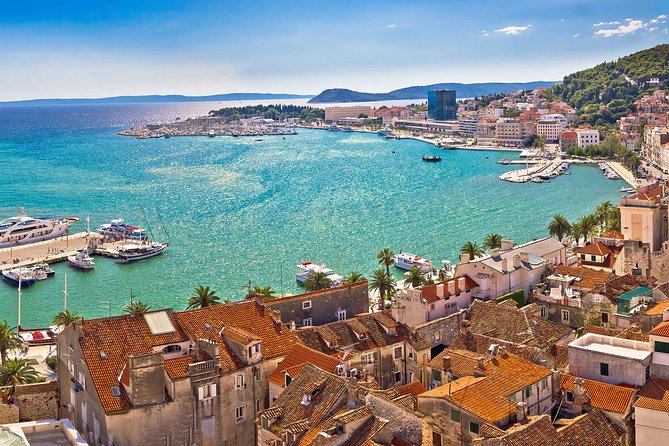
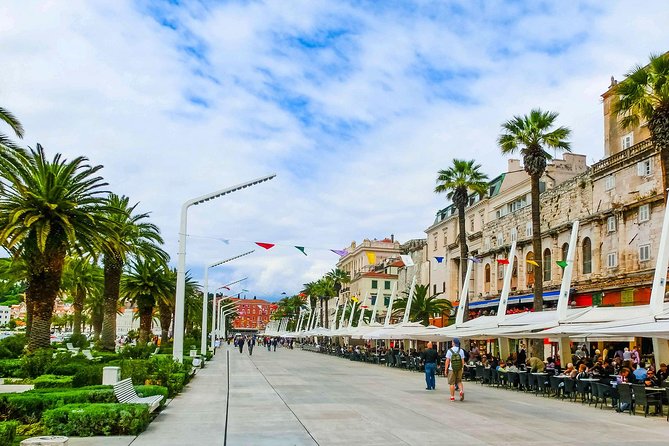
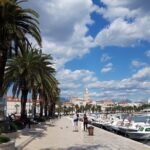
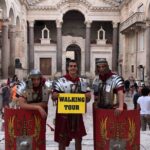
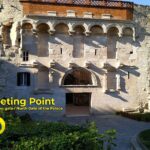
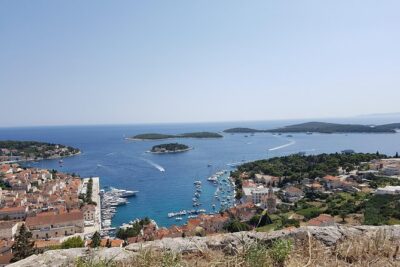
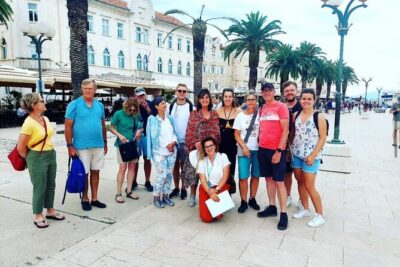
The tour meets at Obala Hrvatskog narodnog preporoda 21, on the waterfront promenade, right by the sea. This is a smart opening. You get a quick introduction to how the city is laid out while your eyes are on the water and the skyline moves around you.
At this first stop, the guide sets the tone: what you will see, why it mattered to different eras, and what to watch for as you walk. You also start with the most calming setting of the route, which helps when the palace becomes more enclosed and stone-heavy.
Practical tip: take a moment at the start to notice directions and landmarks. When the tour later funnels you into the palace complex, you will feel less like you are being rushed through a maze.
Under the palace: Diocletian’s cellars and Roman life
One of the most memorable parts is the entry into the well-preserved Diocletian’s Palace cellars. These are the substructures beneath the emperor’s world. The guide explains how these underground chambers supported the residence above, which is a mind-bender if you are not expecting architecture to have a second job.
Why it is valuable: cellars and corridors are not typically where tourists spend their time. But here, they explain the structure of power. You start to understand that the palace was a system, not just a single monument.
A small time investment makes a big difference. The stop runs about 15 minutes. That is enough time to see the space, hear the story, and feel the scale without it dragging.
St. Domnius Cathedral: where Roman columns meet a later faith
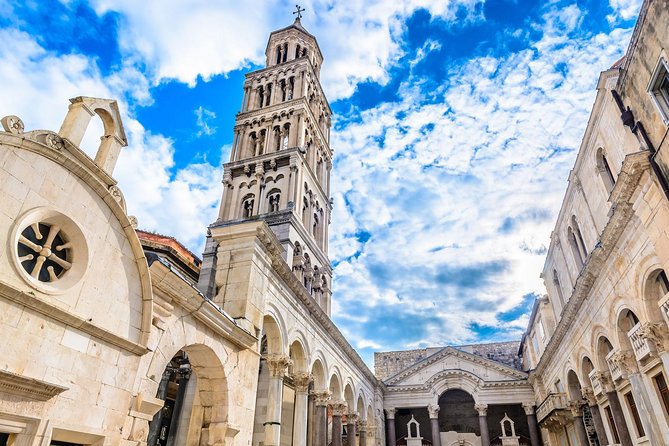
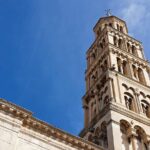
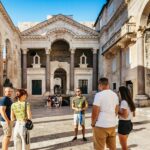
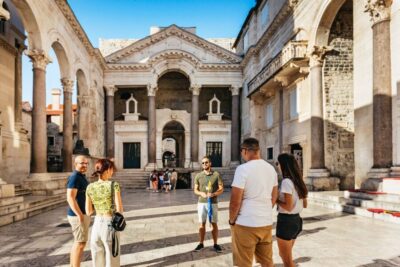
Next you step into the core of the palace story at the Peristyle and Cathedral of St. Domnius. You will see Roman columns and the cathedral connected to the emperor’s mausoleum. In plain terms, this is where the old Roman site kept living, even as faith and society changed.
This stop hits the sweet spot for many people: it is visually impressive, but the guide’s job is to make it understandable. Instead of just naming features, the explanation helps you connect what you see to why it became important later.
One practical note: this is a stop where you may spend a bit more time if you are the type who likes to look up at details. The tour gives you about 10 minutes here, so if you want photos, position yourself early and keep moving.
More Split covered at walking pace
- Krka Waterfalls tour with Trogir Walking tour and Krka panoramic boat cruise
★ 5.0 · 1,659 reviews - Split Walking Tour with Professor of History
★ 5.0 · 926 reviews - Split: Diocletian Palace & Old Town Guided Walking Tour
★ 4.7 · 882 reviews - From Split: Krka Waterfalls Cruise & Trogir Walking Tour
★ 4.7 · 681 reviews - Split: History and Heritage Walking Tour
★ 4.9 · 650 reviews
The palace’s circular acoustics, plus a possible klapa moment
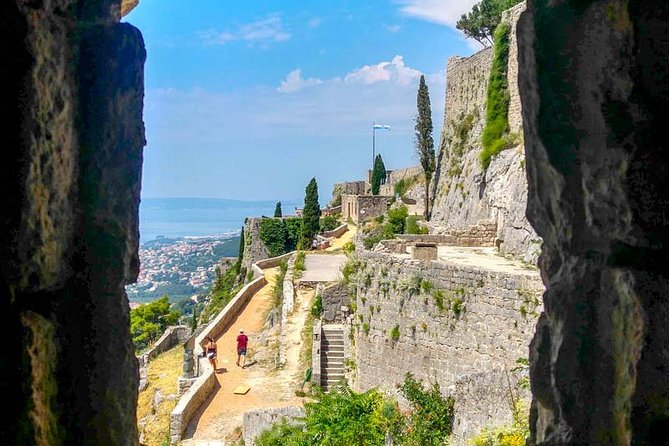
The tour then moves to the Vestibulum of Diocletian’s Palace, where you stand beneath the circular open dome. The design is known for acoustics, and the guide may mention how sound behaves in this space.
If you are lucky, you might catch a live performance from traditional klapa singers. Even when there is no performance, the acoustics idea is fun. It makes the architecture feel alive, like the stone is still part of daily culture.
Timing here is short, around 5 minutes. Treat it like a quick reset before the next Roman relic stop.
Temple of Jupiter, sarcophagus, and the Roman-to-church timeline
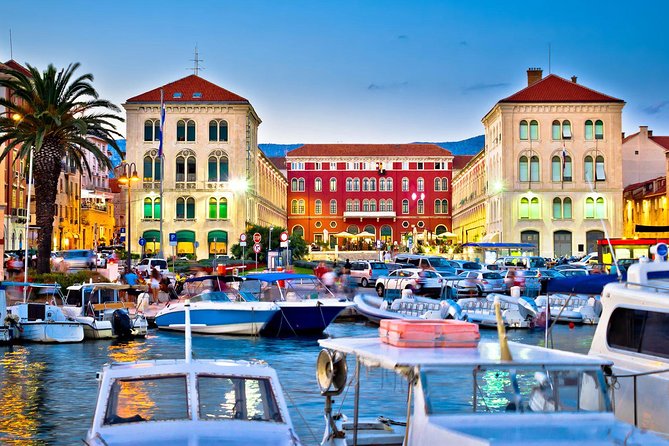
At the Temple of Jupiter, the setting is especially interesting because it became a baptistery. That transformation is a clear example of how historical sites in Split were reused, not erased.
You will also see ancient sculptures and a preserved sarcophagus. This is the kind of stop where the guide’s explanations matter. Without context, you might recognize it as a temple. With context, you understand the changes in how the space was used and valued.
Expect about 5 minutes here. It is short, but the story is the point.
Triklinij banquets: seeing imperial luxury in one small room
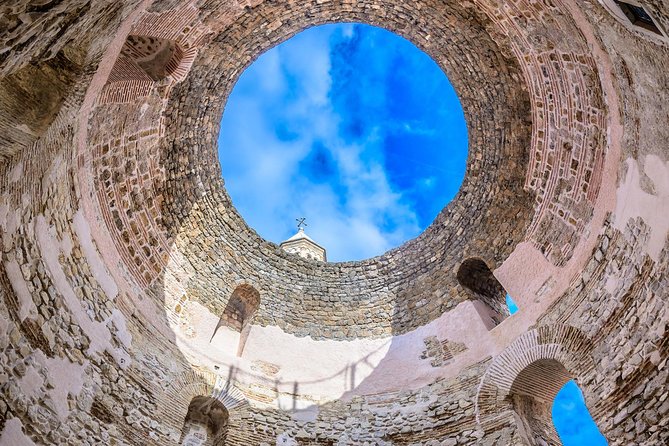
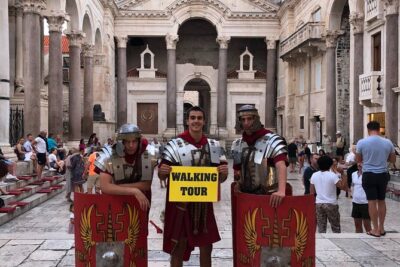
Then comes the Triklinij, the area where Diocletian hosted lavish banquets. The guide explains Roman dining culture and imperial luxury, which sounds abstract until you stand in the space and imagine the flow of conversation, food, and status.
Why you will probably enjoy it: dining is one of the easiest entry points into history. Everyone can picture a meal, even if you cannot picture imperial Rome. This stop turns the palace from architecture into everyday human behavior, just with bigger stakes.
Another 5-minute stop, so keep your attention on the guide’s story and let the room do the rest.
Golden Gate exit and the Gregory of Nin toe-rub ritual
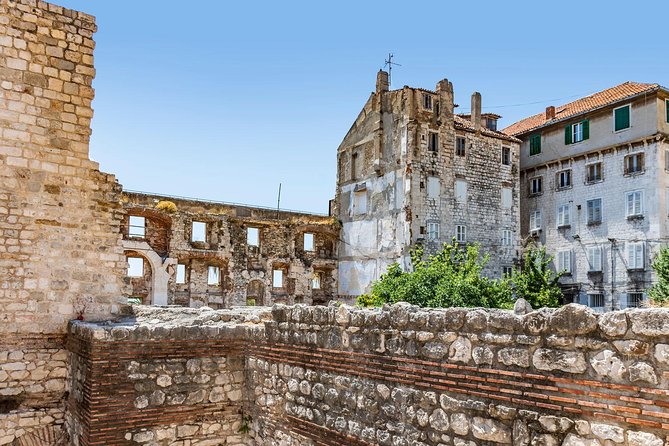
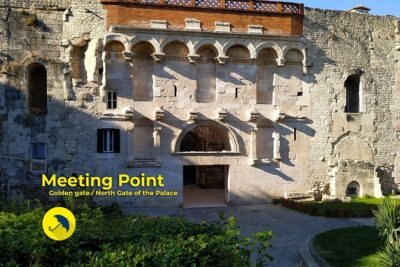
At the Golden Gate, you exit through the grandest of the four palace gates. This is a satisfying moment because the tour shifts from enclosed palace spaces back into the wider city.
Outside, you stop at the towering statue of Gregory of Nin, and there is a local tradition: rub his toe for good luck. It is a small ritual, but it is also a nice reminder that Split’s history is not only about Romans. It is also about later local identities that people keep alive with everyday customs.
Timing is about 10 minutes. Use it to stretch your legs before the final Old Town squares.
Narodni trg and Fruit’s Square: where local life now happens
The last stretch is about connecting the palace past to present-day street life.
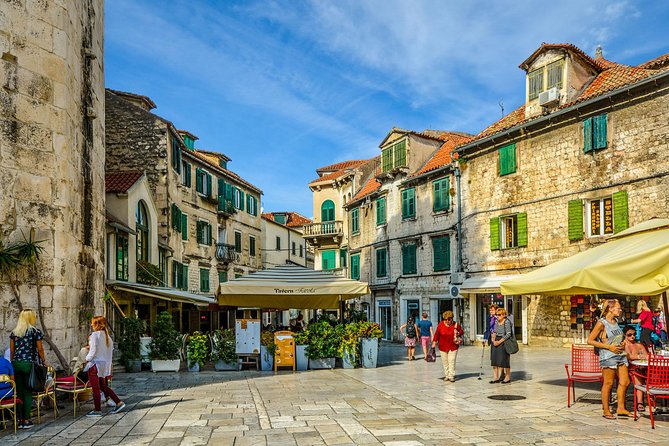
At Narodni trg (Pjaca), you stroll through a historic square surrounded by Venetian-era buildings and an old city clock. It is a good place to look around and see how the Old Town energy works in real time, especially if you plan to return later for a café or people-watching.
Then you reach Fruit’s Square (Trg Brace Radic), named for the fruit markets that used to happen there. Now it is framed by baroque palaces and everyday café life. The guide’s job here is to help you notice the contrast: trade and markets then, social life now.
These are short stops (about 10 minutes and 5 minutes). Think of them as your transition from guided storytelling to independent exploration.
The tour ends where it started, back at Obala Hrvatskog narodnog preporoda 21, so you do not have to figure out how to get back.
Price and value: what $30.23 buys in 90 minutes
At $30.23 per person for about 1 hour 30 minutes, the value comes from what you are getting, not from the length.
First, the guide is a professional licensed local guide. That matters here because the palace is full of spaces that can look confusing if you only have signage and a phone. When the guide connects the cellars, the cathedral, and the banqueting area into one story, you walk away with mental maps.
Second, the important stops list admission ticket free. So you are not paying extra at each site just to access the sights the tour is built around.
Third, you are traveling with a group capped at 20. That size usually keeps things lively, but still allows room for questions. Names like Anita and Toni stand out in positive feedback for passion and clear explanations, and that matches what you want in a short tour.
Fourth, the format is practical: an English tour with a mobile ticket, and two departure times so you can fit it around beach time and dinner plans.
What you do not get is food and drinks, which is totally normal for a short history walk. Plan a meal before or after, not during.
How to make the most of this walk (without rushing)
This is a walking tour through stone corridors and open plazas. A few practical choices make a big difference:
Wear non-slip shoes. One piece of feedback notes that the route is not designed for wheelchairs, so good grip and careful footing are important.
Bring water if you tend to get warm. The tour runs year-round, and while it operates in all weather conditions, you will still feel the sun or chill in open squares.
If this is your first day, do it early. You will learn how Split is arranged, then you can explore the rest of the Old Town with fewer wrong turns.
Come with questions. The best moments are usually the ones where the guide explains a detail you did not notice yet, like how spaces were used.
Should you book the Split Old Town History Walking Tour?
If you want a focused first introduction to Split, this is a very reasonable pick. In 90 minutes you get palace architecture (including cellars), a major cathedral stop, key Roman spaces, and then two squares to ground the history in today’s street life. The free admission listed for each stop also helps the value.
I would particularly book this if:
- you like getting context quickly before exploring on your own
- you enjoy Roman history but want it explained in everyday terms like banquets and how spaces function
- you want local advice on where to eat and what to see next
I would think twice if:
- you want a wide cross-section of modern Split beyond the palace area
- you are sensitive to walking on uneven stone, since the route is not aimed at wheelchair access
One caution from feedback: there have been a couple of serious issues tied to cancellations or missing tour records on arrival when booked through third-party platforms. To reduce risk, keep your confirmation details handy and double-check the meeting time the day before.
If you go in with the right expectations, this walk is a smart way to understand why Split looks the way it does, and it gives you enough fuel to explore the rest of the city independently.
FAQ
What is the duration of the Split Old Town History Walking Tour?
It runs for about 1 hour 30 minutes.
How much does the tour cost?
The price is $30.23 per person.
Is food or drinks included?
No. Food and drinks are not included.
Is the tour in English?
Yes, the tour is offered in English.
Where do I meet the guide, and where does it end?
You meet at Obala Hrvatskog narodnog preporoda 21, 21000, Split, Croatia, and the tour ends back at the meeting point.
How many people are in the group?
The tour has a maximum of 20 travelers.
Does it include entry fees to the stops?
The listed stops show admission tickets as free.
What about weather, cancellations, and refunds?
The tour operates in all weather conditions, and you should dress appropriately. If it is canceled due to poor weather, you will be offered a different date or a full refund. There is free cancellation up to 24 hours in advance for a full refund.
Are pets and children allowed?
Pets are not allowed. Children must be accompanied by an adult.
Split, the Longer Story


Walk It: More of Split at Ground Level

Inside the Palace Walls
Freshly written up around Split



Split Old Town & Palace Walks, top to bottom.
 ★ 4.9Split: Old Town and Diocletian Palace Walking TourFrom $174,727 reviews
 ★ 5.0Walking Tour of Split and Diocletian’s PalaceFrom $482,588 reviews
 ★ 5.0Split & Diocletian’s Palace Walking TourFrom $211,125 reviews
 ★ 5.0Walking Tour of Split with a ‘Magister’ of HistoryFrom $341,122 reviews
 ★ 5.0Split Walking Tour with Professor of HistoryFrom $24926 reviews
 ★ 4.7Split: Diocletian Palace & Old Town Guided Walking TourFrom $17882 reviews
 ★ 4.8Split: Game of Thrones Tour with Diocletian’s Palace CellarFrom $41545 reviews
 ★ 5.0Diocletian’s Palace and Old Town SMALL GROUP Walking TourFrom $16502 reviews
Browse the lists this tour appears in