
REVIEW · HISTORICAL TOURS
Split: Private Walking Tour in the Historical Town Center
Split clicks on foot. This private 105-minute walk links Diocletian’s Palace to the streets around it, so you get the story and the layout in one smooth loop. You start on the Riva promenade, then step through Roman, medieval, and Venetian-era life without feeling rushed.
I especially like how the guide explains the mix of eras where you can literally see the change in stone and street patterns. I also love the focus on orientation, from the Peristil and major gates down to squares like Pjaca and Prokurative, so you know what to seek out after the tour. One key consideration: it is not suitable for wheelchair users, because you are walking the old town streets and through historic areas.
In This Review
- Key highlights you will actually feel
- Why Split’s Palace and medieval squares make sense fast
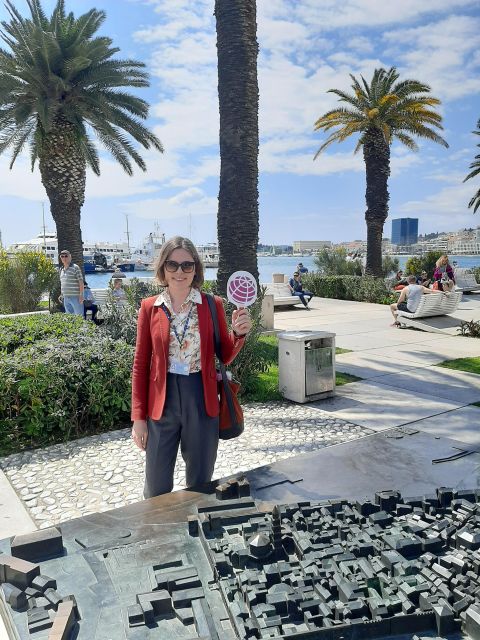
- Getting there at Riva: the bronze model meeting point
- Diocletian’s Palace: the Roman core plus the lived-in medieval layer
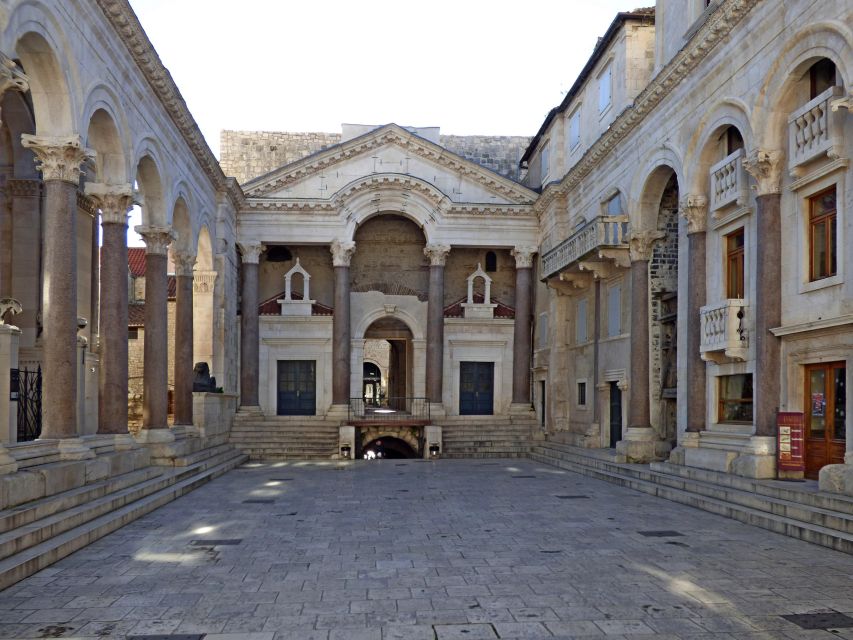
- Peristil courtyard: where daily life becomes obvious
- St Domnius and Jupiter’s Temple: two faith stories, one city map
- Down to the Substructures: the basement level worth the ticket
- The palace neighborhoods and the former Jewish ghetto area
- Leaving the Palace: Venetian, French, Austro-Hungarian, Yugoslavian rule
- Pjaca, Fruit Square, and Prokurative: squares that tell you how the city functioned
- Ending on the Riva promenade by the sea
- Price and value: $153 per group up to 15
- Pacing, comfort, and what to bring
- Who this private tour is best for
- Should you book this private Split walking tour with Sanja?
- FAQ
- How long is the Split private walking tour?
- Where do we meet for the tour?
- Is this tour private, and what is the group size limit?
- What languages are available for the live guide?
- What major sights are included in the tour?
- Is the entrance fee to the Diocletian’s Palace Substructures included?
- Do we need an entrance ticket for Jupiter’s Temple?
- Is cancellation free, and how late can I cancel?
- Is the tour suitable for wheelchair users?
Key highlights you will actually feel
- Private format, best use of time with your own group and a clear speaking style that makes it easy to follow
- Diocletian’s Palace, the oldest core plus the medieval neighborhood that grew inside it
- Substructures visit option (the basement level) with a separate entrance fee
- Iconic landmarks in context: Peristil, St Domnius, and the Golden Gate area
- Medieval squares outside the Palace like Pjaca, Fruit Square, and Prokurative
- Big-period timeline in plain language under Venetian, French, Austro-Hungarian, and Yugoslavian rule
More Split covered at walking pace
- Split: Old Town and Diocletian Palace Walking Tour★ 4.9 · 4,727 reviews
- Walking Tour of Split and Diocletian’s Palace★ 5.0 · 2,588 reviews
- Krka Waterfalls tour with Trogir Walking tour and Krka panoramic boat cruise★ 5.0 · 1,659 reviews
- Split & Diocletian’s Palace Walking Tour★ 5.0 · 1,125 reviews
Why Split’s Palace and medieval squares make sense fast

Split can feel like a pile of cool stops. This kind of tour turns that pile into a map in your head. You start inside the oldest part of town, the 4th-century palace complex of Roman emperor Diocletian, and then you expand outward into the medieval city that formed around it.
What makes this work well is the pacing. You are not sprinting for photo ops. You get enough time at the main spaces to understand what you are looking at: courtyard life in the Peristil, the way the palace walls and gates shaped movement, and how later rulers left their fingerprints on the city’s public spaces.
I also like that the route ends back near the sea, on the Riva promenade. That matters. It helps you re-anchor yourself after the stone-and-stairs part of the day. You leave with bearings, not just facts.
Getting there at Riva: the bronze model meeting point
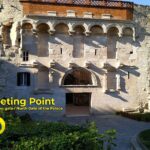
Meet at the Riva promenade by the bronze model of the historical core of Split. It is located in front of the south entrance to Diocletian’s Palace. That is a smart meeting spot for two reasons.
First, it sets you up immediately. You can visually connect the bronze model with what you will walk into. Second, you avoid wandering around trying to find the right entrance. Split’s old town has multiple “almost right” corners. This meeting point keeps things simple.
Plan to arrive a few minutes early. It is a walking tour, and the whole idea is to start on time while you are fresh and ready to move through the palace and squares.
Diocletian’s Palace: the Roman core plus the lived-in medieval layer
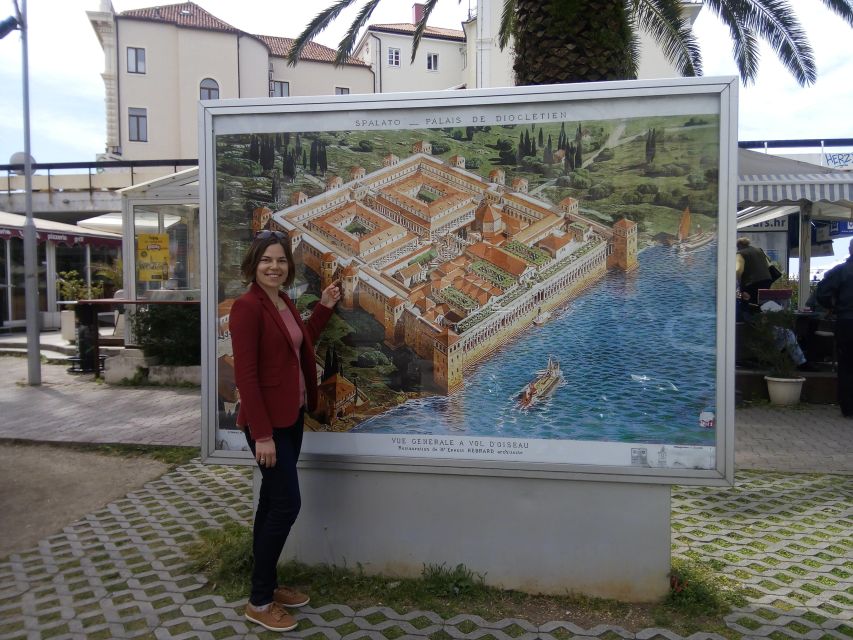
The heart of the tour is Diocletian’s Palace, and you get about half an hour for the main orientation walk here. You will see the palace area and then the smaller medieval neighborhood that developed inside it. That inside-out mix is the whole point of Split’s magic.
A Roman palace was built for one kind of life. Then centuries happened. People moved in, adapted spaces, and layered new functions into older structures. So you are not just staring at ancient ruins. You are watching a city grow up inside a building that was not originally meant to be a town.
You will also cover the palace walls and the palace gates, with a specific stop at the Golden Gate area. Gates are useful on a tour like this because they explain how people entered, exited, and organized daily life. When you understand the gates, you stop feeling like you are wandering randomly once the tour ends.
Peristil courtyard: where daily life becomes obvious
From the palace overview, you move to the Peristil for a guided look that lasts about 10 minutes. The Peristil is the palace’s central courtyard space, the kind of place where you can almost imagine the rhythm of movement and gathering.
This stop is short by design. It is meant to give you the visual anchor, not bury you in details. If you look up and around, you start to notice how architecture channels sight lines and movement.
Other history-led routes through Split
- Walking Tour of Split with a ‘Magister’ of History
★ 5.0 · 1,122 reviews - Split Walking Tour with Professor of History
★ 5.0 · 926 reviews - Split: History and Heritage Walking Tour
★ 4.9 · 650 reviews - Split History and Gastro Small-Group Tour with Food and Drinks
★ 5.0 · 375 reviews - Split: Local History and Culture 90-Minute Walking Tour
★ 5.0 · 194 reviews
St Domnius and Jupiter’s Temple: two faith stories, one city map
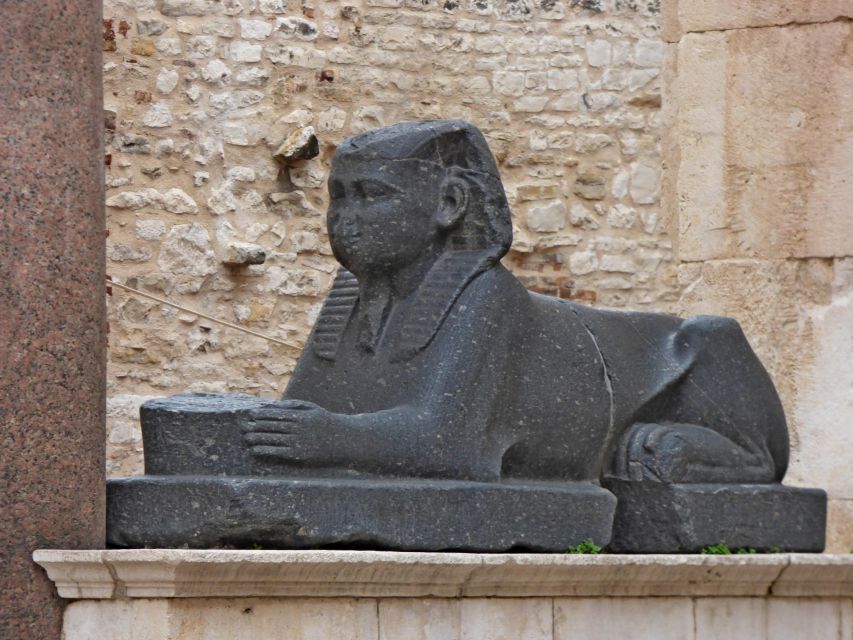
Next comes the Mausoleum of Roman emperor Diocletian turned into St Domnius Cathedral. You spend around 10 minutes here for guided viewing and passing through key areas. This is not just a church stop. It’s a “this is how buildings get reused” stop.
What I like about including it is that it bridges time quickly. You can connect the Roman-era setting to the later religious center without needing a lecture. You just stand where history changed function.
Then you pass by Jupiter’s Temple / Baptistery. This one is an external visit with no entrance fee, so it works as a quick stop between larger spaces. Even as a pass-by, it gives you a sense of how the palace complex held different types of sacred spaces over time.
Down to the Substructures: the basement level worth the ticket
One of the most practical advantages of this tour is how it includes the basement level of the Palace, often called the Substructures. This part is not free, since entrance fees are not included in the tour price. Still, it is one of the best ways to make the palace feel real.
Basements change how you understand the palace above. Suddenly you see storage, service spaces, and the physical logic of the complex. It adds a vertical dimension to your mental map. Without it, the palace can feel like a set of surfaces. With it, you get structure.
If you want the maximum value from the experience, plan for that extra entrance fee so the day stays smooth. It is the kind of cost that buys understanding, not just another room.
The palace neighborhoods and the former Jewish ghetto area
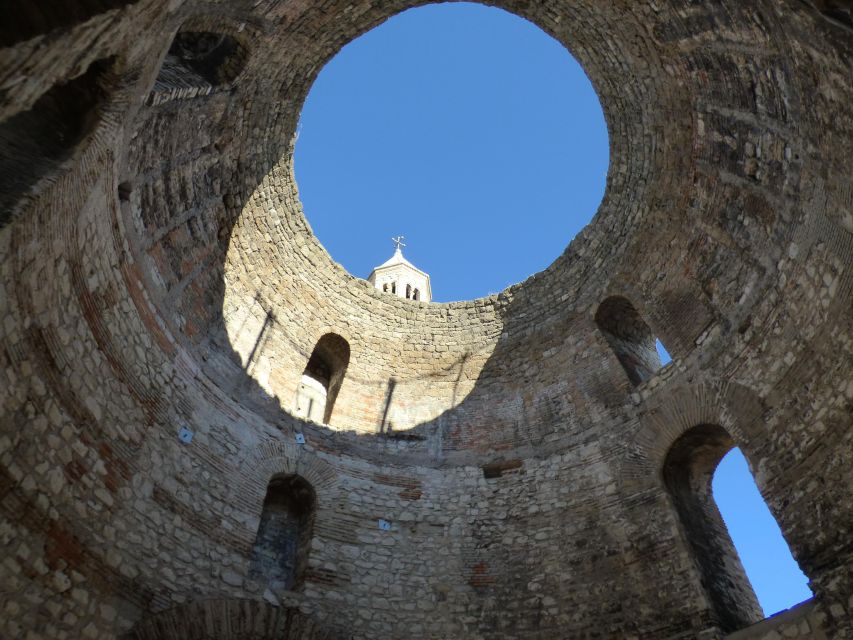
Split’s story is not one straight line, it is mixing. Inside the palace complex, you also pass medieval houses of noble families. That helps explain who lived where, and why certain corners look more “residential” than “monumental.”
You will also visit a small former Jewish ghetto area, including a synagogue that is still active. This is handled as part of the tour’s broader story about how the city’s community life changed across eras. It is meaningful because it shows continuity, not just conversion.
I like that the tour treats this as part of the city’s layout and timeline, not as a quick checklist stop. You come away with a sense of how minority communities were built into the city fabric, even as power shifted.
Leaving the Palace: Venetian, French, Austro-Hungarian, Yugoslavian rule
The second part of the tour moves to the medieval neighborhood built outside the palace. This is where the city starts to feel like a normal town, with squares, daily movement, and public gathering points shaped by rulers and politics.
The guided explanation here focuses on how socio-political life worked under Venetian, French, Austro-Hungarian, and Yugoslavian control. You are not hearing history trivia for its own sake. The point is to connect rule changes to what you see in front of you, especially in the public squares.
Pjaca, Fruit Square, and Prokurative: squares that tell you how the city functioned
You will visit and walk through these famous squares in the outer medieval area:
- Pjaca (People’s Square), where you connect civic space to everyday life
- Fruit Square, which gives you a sense of trade and local rhythms
- Prokurative, a grander-feeling square that helps explain the city’s more official side
These are short stops, but they are timed to build a coherent walk. You learn how to read a city square as a social machine: where people gathered, traded, and performed civic life.
Ending on the Riva promenade by the sea
You finish back on the Riva promenade by the sea, returning near the bronze model area. That ending matters more than you might think. Old towns can blur together when you are surrounded by stone, archways, and narrow lanes.
Riva is your reset button. It gives you a wide view and a calmer pace right after the palace and squares. If you plan to keep exploring later, ending by the sea helps you pick directions more confidently.
Price and value: $153 per group up to 15
The price is $153 per group, good for groups up to 15 people. That’s an important detail, because for families and friend groups, this format can work out well compared with per-person tours.
You also get a professional licensed local guide with a Master’s degree. That tends to show in how information is structured. The standout from guide-focused feedback is clarity, especially for French-speaking visitors, and the ability to answer questions comfortably.
Is it cheap? Not really. There is a note that it can feel a bit pricey. But the value case is stronger if you do two things:
1) You book early so the tour sets your bearings for the rest of your Split days.
2) Your group size makes private sense.
If you are traveling solo, you may want to price-check against other walking options. Still, private tours can be worth it when you care about understanding, not just seeing.
Pacing, comfort, and what to bring
This is a walking tour, about 105 minutes. Expect cobblestones, historic uneven ground, and some stairs or tight passageways inside old structures. That is why it is not suitable for wheelchair users.
For most people, the pace is steady rather than frantic. It is long enough to cover the main sights that help you understand Split, but short enough that you still have energy for the rest of the day.
Bring comfortable shoes and water. Also, if you know you want to use the Substructures entrance, be ready with cash or card for the separate ticket fee since it is not included.
Who this private tour is best for
This works especially well if you:
- want the big highlights without turning it into a scavenger hunt
- care about how political control changes city space over time
- like asking questions and hearing answers in your preferred language
- are coming to Split for a first look and want a reliable map afterward
It may be less ideal if mobility is limited, since it is not wheelchair accessible.
Should you book this private Split walking tour with Sanja?
If you want Split to make sense quickly, I think this is a strong choice. The mix of Diocletian’s Palace, the Peristil, St Domnius Cathedral, the Substructures, and then the medieval squares outside the palace creates a full city loop that feels logical.
It is also a comfort choice. The guide, Sanja, comes through as fluent and adaptable. People specifically highlight how her French explanations are clear, and how she answers questions. Others emphasize that the tour, done early, helps the rest of their stay click, especially when they want to explore the old town with confidence.
Book it if your priorities are understanding the layout and the layers of history you can see with your own eyes. Consider not booking if you need wheelchair access or if you want a purely outside-only, no-ticket visit, because the Substructures have an extra entrance fee.
Overall, it is the kind of tour that turns Split from a collection of sights into a place with structure, story, and direction.
FAQ
How long is the Split private walking tour?
It lasts 105 minutes, about 1:45 hours total.
Where do we meet for the tour?
Meet by the bronze model of the historical core of Split on the Riva promenade by the sea, in front of the south entrance to Diocletian’s Palace.
Is this tour private, and what is the group size limit?
Yes, it is a private group tour. The price is listed per group up to 15 people.
What languages are available for the live guide?
The live guide is available in English, Italian, French, and Spanish.
What major sights are included in the tour?
You will see Diocletian’s Palace (including areas inside the palace), the Peristil, St Domnius Cathedral, Jupiter’s Temple (external visit), the palace walls and gates (including the Golden Gate area), People’s Square, Fruit Square, Pjaca, and Prokurative, and you end back on the Riva promenade.
Is the entrance fee to the Diocletian’s Palace Substructures included?
No. Entrance fees to the Diocletian’s Palace Substructures (basement level) are not included.
Do we need an entrance ticket for Jupiter’s Temple?
No. Jupiter’s Temple / Baptistery is visited externally, and there is no entrance fee for that stop.
Is cancellation free, and how late can I cancel?
Yes, free cancellation is available up to 24 hours in advance for a full refund.
Is the tour suitable for wheelchair users?
No, it is not suitable for wheelchair users.
Split, the Longer Story



Walk It: More of Split at Ground Level

Freshly written up around Split



Historical Tours, top to bottom.
 ★ 5.0Dubrovnik Old Town History Walking TourFrom $241,684 reviews
 ★ 5.0Walking Tour of Split with a ‘Magister’ of HistoryFrom $341,122 reviews
 ★ 5.0Split Walking Tour with Professor of HistoryFrom $24926 reviews
 ★ 4.9Split: History and Heritage Walking TourFrom $18650 reviews
 ★ 5.0Game of Thrones & History of Dubrovnik TourFrom $30628 reviews
★ 4.9Dubrovnik: Old Town History Walking TourFrom $20474 reviews
★ 5.0Game of Thrones & History of Dubrovnik TourFrom $30628 reviews
★ 4.9Dubrovnik: Old Town History Walking TourFrom $20474 reviews
 ★ 5.0Split History and Gastro Small-Group Tour with Food and DrinksFrom $139375 reviews
 ★ 5.0SPLIT-PREMIUM Emperor’s Walking Tour for History Lovers + MuseumFrom $30333 reviews
Browse the lists this tour appears in