
REVIEW · SPLIT OLD TOWN & PALACE WALKS
Split: Private Walking Tour with Diocletian’s Palace
A Roman palace maze, minus the crowd. This private walk through Split lets you connect the dots between the city’s Roman core and the medieval and Renaissance streets layered on top. You get to slow down, ask questions, and actually understand why this place looks the way it does.
What I love most is the private, personalized pacing. With a guide like Slavko (raised in Split) or Antonia (who patiently answered every question), the tour feels tailored instead of rushed. I also like the focus on signature sights, from the Golden Gate to the Cathedral of Saint Domnius, with plenty of context so it all clicks fast.
One consideration: this is a walking tour and it is not suitable for wheelchair users. Also, the experience depends on your chosen length since it runs from about 90 minutes up to 5 hours, so wear proper shoes and plan for walking.
In This Review
- Key highlights and why they matter
- Golden Gate, your shortcut to understanding Split
- From Roman ruins to medieval streets, walking your way through layers
- Game of Thrones Museum stop, quick and optional-feeling
- Squares and Riva Harbor, where local life still makes sense
- Diocletian’s Cellars, Peristil, and the Vestibul
- Cathedral of Saint Domnius (St Duje): the story under the stone
- The return to Golden Gate and how to leave with a plan
- Price and value: $117 for up to 2 people
- Guides make the difference: personal, professional, and built for questions
- What to bring and how to make it comfortable
- Who should book this private Split walk, and who should skip it
- Should you book it?
- FAQ
- How long is the Split private walking tour?
- Where do I meet the guide?
- Is this tour private?
- What sights are covered during the walk?
- What language options are available?
- What should I bring for the walking tour?
- Is the tour wheelchair accessible?
Key highlights and why they matter
- Private guide, real local storytelling that helps you see more than just photo spots
- Diocletian’s Palace sections like the Cellars, Peristil, and the Vestibul
- Fast city orientation starting at Golden Gate and moving through the Roman core
- Family-friendly pacing that can work even when teenagers get bored
- A quick Game of Thrones Museum stop if you want pop-culture context, without taking over
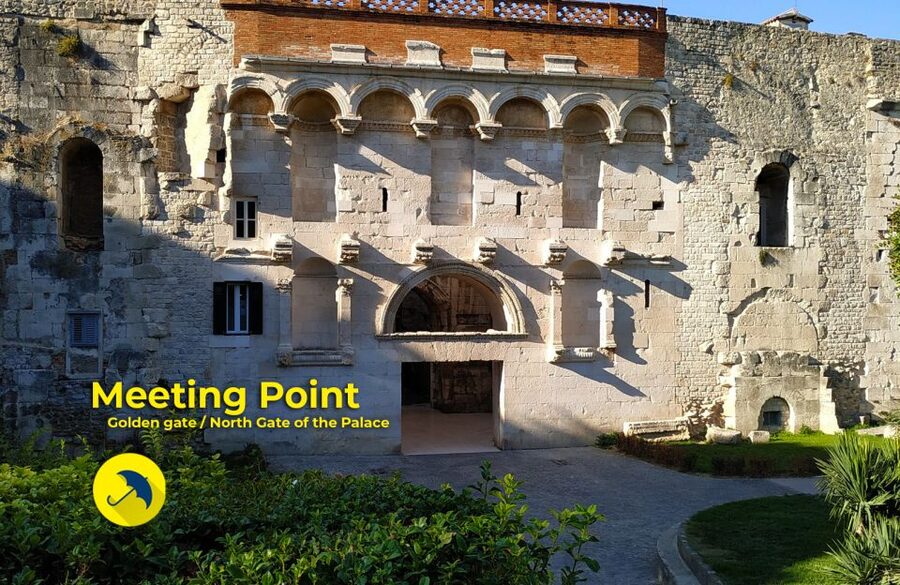
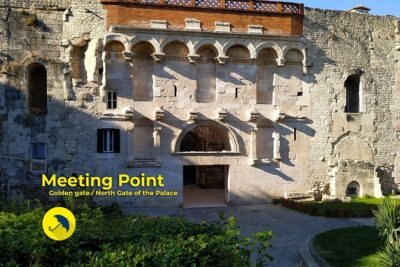
- Meeting at Golden Gate with a blue umbrella, easy to find
Other walks through the palace quarter and the alleys behind it
- Split: Old Town and Diocletian Palace Walking Tour★ 4.9 · 4,727 reviews
- Walking Tour of Split and Diocletian’s Palace★ 5.0 · 2,588 reviews
- Split & Diocletian’s Palace Walking Tour★ 5.0 · 1,125 reviews
- Walking Tour of Split with a ‘Magister’ of History★ 5.0 · 1,122 reviews
Golden Gate, your shortcut to understanding Split
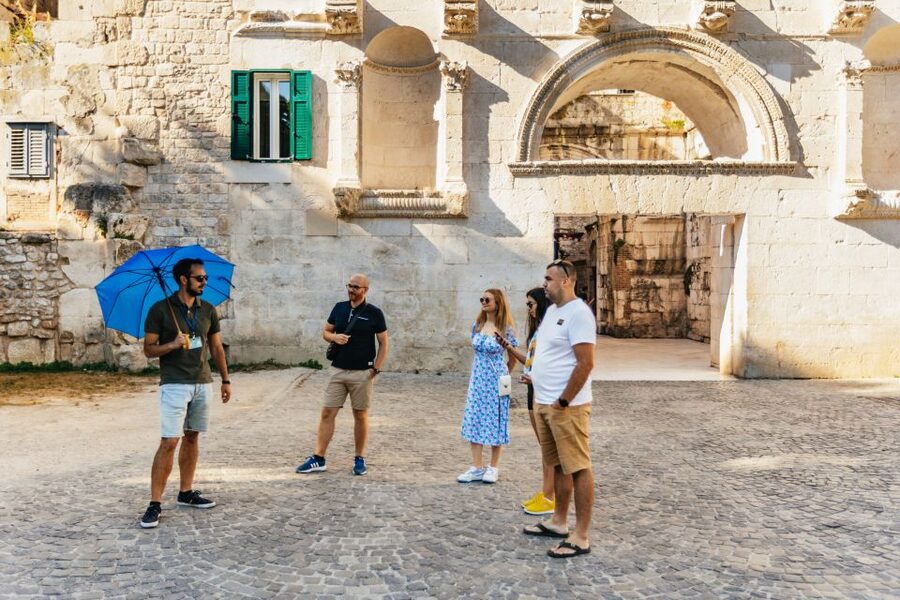
Split can feel like a maze at first. The good news is that this tour begins at Golden Gate, the north gate of Diocletian Palace, which is a natural place to orient your brain. From here, you get an instant sense of how the city was shaped by Roman planning, then rebuilt and reinterpreted over centuries.
You’ll also pick up small details that make Split easier to navigate. The tower-clock nearby has kept time in Split since the 15th century, and you’ll see how the medieval city kept using, repurposing, and referencing the Roman footprint. Even the statue of Gregory of Nin, the medieval Croatian bishop, helps you understand how local identity is carved into the streets.
And if you are the type who worries about missing something, this start helps. A guide can point out what matters first, so you are not left guessing which corners are worth lingering in. You’ll love that this is a private tour, so the pace matches you, not a big group schedule.
From Roman ruins to medieval streets, walking your way through layers
Once you leave the gate area, your route moves through the parts of Split that show different time periods side by side. You’ll pass by Roman portion ruins scattered through the city fabric, then shift into the medieval and later eras. That mix is the whole point of Split.
Your guide will walk you through things like Romanesque churches from the 12th and 13th centuries, medieval fortifications, and palaces in styles you can spot with your eyes. You’ll see 15th-century Gothic influence, then Renaissance and Baroque flourishes as you move through different neighborhoods. It sounds like a lot, but on foot it becomes simple. Each stop is a “label” for what you are looking at.
This is one of the best values of a private tour. When you only have a day, you need more than a list of sights. You need the why. A guide gives you that context so you can tell the difference between a building that is impressive because it is old and a building that is important because of what it represents.
Game of Thrones Museum stop, quick and optional-feeling
Yes, there is a stop at the Game of Thrones Museum. It’s a short one, so think of it as a detour for the curious rather than the main event. If you or your group likes pop-culture hooks, it can be a fun bridge into the city’s role in modern storytelling and tourism.
But because it is only briefly included, you are not stuck “doing museum time” for the whole tour. You keep moving, and the rest of the walk remains rooted in Split’s actual architecture and landmarks. This balance is ideal if you have a mixed group, like parents who want history and teens who want relevance.
Squares and Riva Harbor, where local life still makes sense
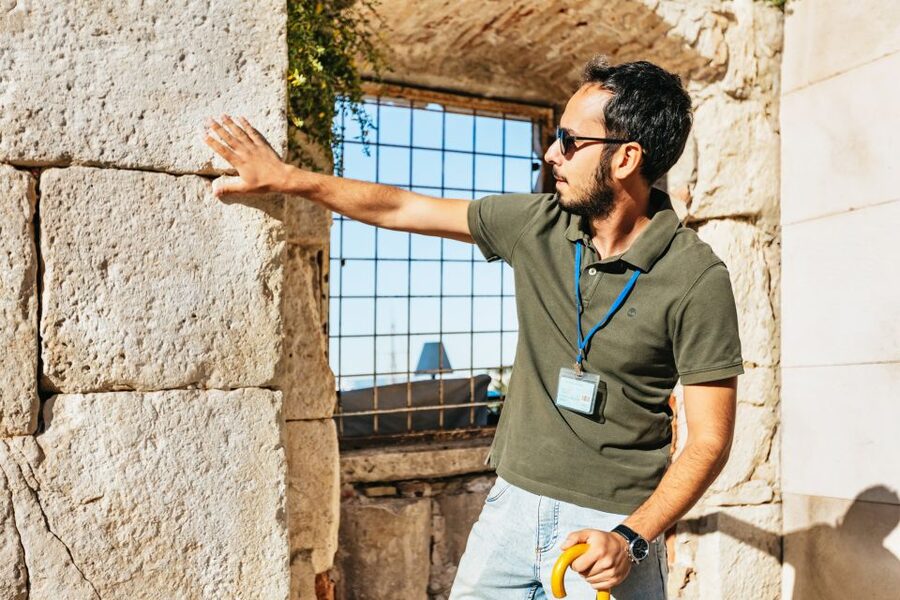
Split’s squares and harbor edges are not just pretty backdrops. They are where everyday rhythm happens, which makes them the perfect places to pause and reset your understanding.
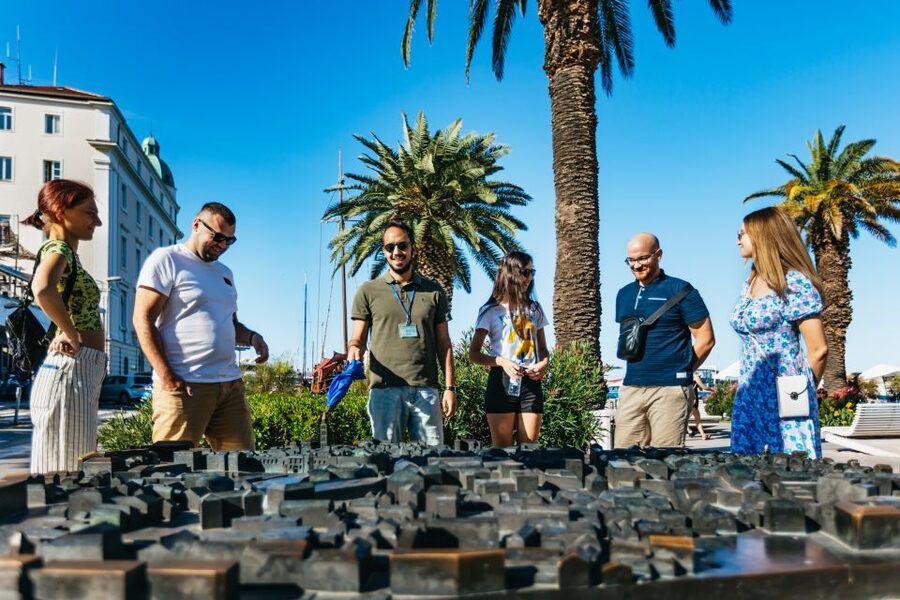
You’ll pass People’s Square and Fruit Square, then head toward Riva, the harbor promenade. Along the way, your guide points out how the city’s public spaces link the old Roman core to later city planning. You’ll also get insight into City Hall and the Fish Market, a focal point of life in Split.
Here’s why I think these stops are a smart use of time. After walking through heavy history, you need a human scale moment. A square, a market area, and a promenade give you that. You can look around and see how people actually use the space today, which helps the story feel real instead of like a lecture.
Practical tip: this is where sunglasses and sun hat start earning their keep. The tour keeps you outside, and Split sun can be serious even when the air feels mild.
More Split covered at walking pace
- Krka Waterfalls tour with Trogir Walking tour and Krka panoramic boat cruise
★ 5.0 · 1,659 reviews - Split Walking Tour with Professor of History
★ 5.0 · 926 reviews - Split: Diocletian Palace & Old Town Guided Walking Tour
★ 4.7 · 882 reviews - From Split: Krka Waterfalls Cruise & Trogir Walking Tour
★ 4.7 · 681 reviews - Split: History and Heritage Walking Tour
★ 4.9 · 650 reviews
Diocletian’s Cellars, Peristil, and the Vestibul
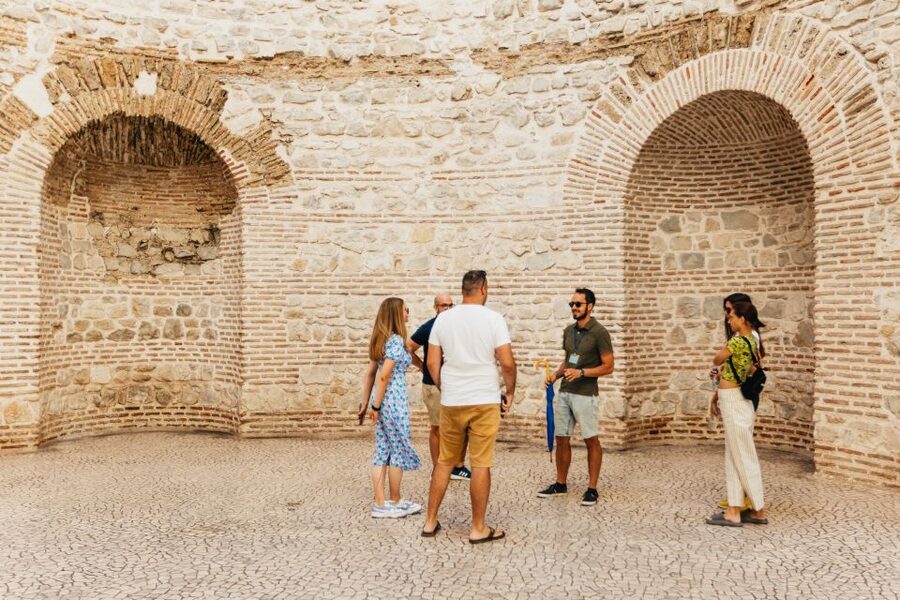
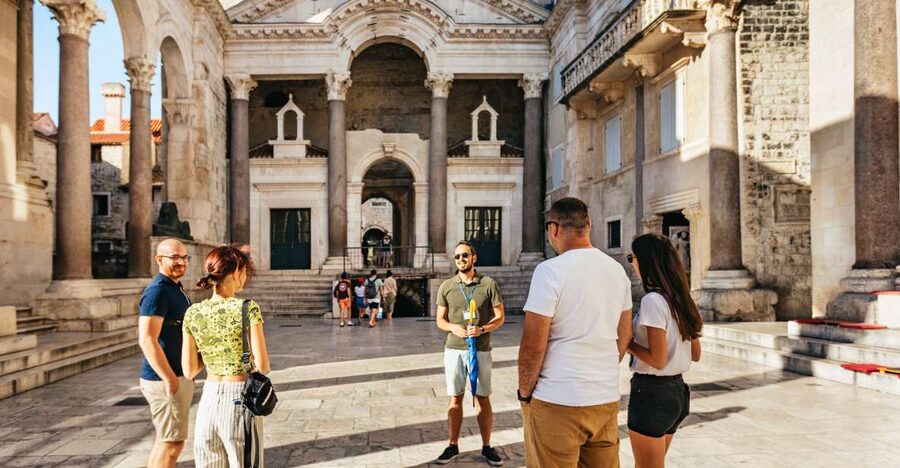
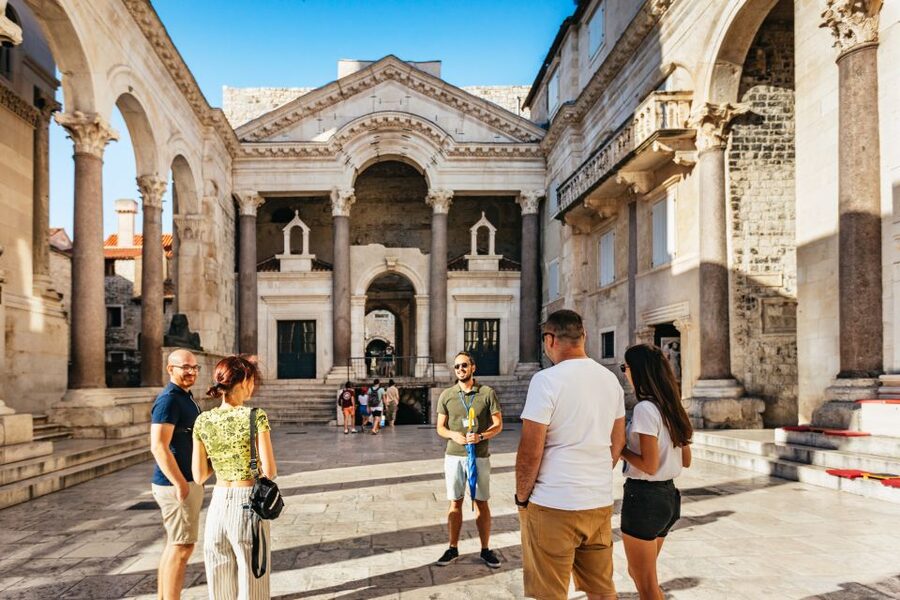
This is the core of the experience. You are exploring the 1700-year-old palace complex as it appears in Split today, not as a distant concept. Your guide takes you through Diocletian’s Cellars and the Peristil, then ends up at the Vestibul area, all while explaining what you are seeing.
If you’ve ever wondered why Diocletian’s Palace looks like it was built and then absorbed by the city around it, this part answers that. You see how Roman construction holds its shape for centuries, while surrounding streets and buildings evolve alongside it. On a private walking tour, you can slow down at the moments that spark your questions instead of trying to keep up with a group.
One benefit of this format is that it makes the palace feel structured. Instead of wandering, you follow a guided path that ties together the relationship between spaces. The result is that you finish with mental maps, not just photos.
Drawback to know: these palace areas can feel intense if you are not interested in architecture. If you want only beaches and views, you might find this heavy on stone and layout. Still, even then, the scale and survival of the palace is hard to ignore.
Cathedral of Saint Domnius (St Duje): the story under the stone

The Cathedral of Saint Domnius, locally known as St Duje, is one of the most important stops on this walk. Your guide connects the cathedral’s significance to the palace world around it, which is key for understanding why this area matters so much.
Here’s the standout detail: the cathedral was built in the 5th century on the site where Diocletian, the last famous persecutor of the Christians, was interred in 311 AD. That single thread turns the cathedral into more than a church. It becomes a marker of how religious and political power shifted over time in the same physical space.
Your guide will point out the building character you should notice, and you’ll learn what makes it one of the best-preserved ancient Roman buildings still standing today. That phrase is important. It means you are not just seeing a reconstruction or a style imitation. You are looking at something that has endured.
This stop is also a great moment for questions. If you want to understand how one empire leaves behind a footprint that later generations reinterpret, you’ll get a straightforward explanation here. You can ask about what survived, what changed, and why.
The return to Golden Gate and how to leave with a plan
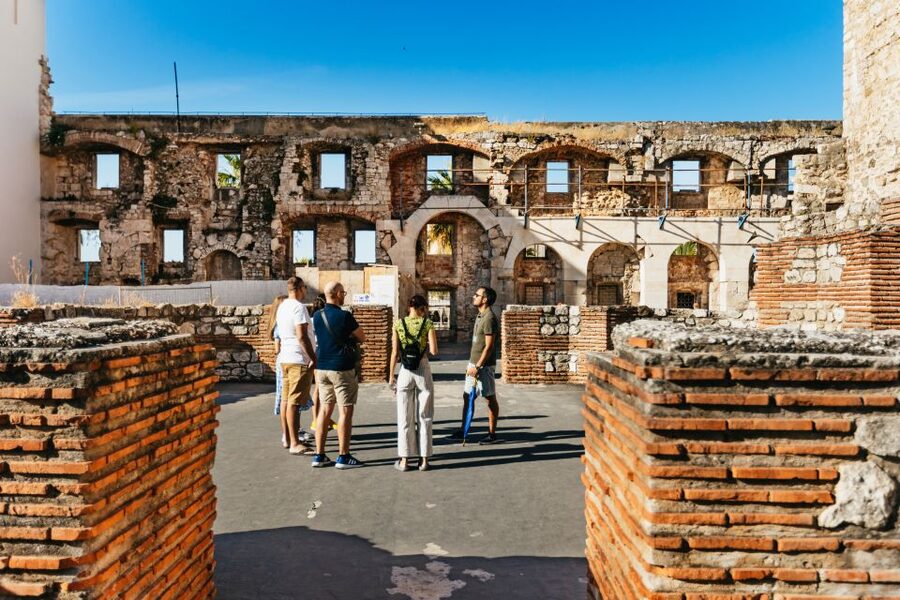
The tour loops back to Golden Gate, which is smart. Returning to your start point helps you lock in direction and timing. You can look at the route in your head and feel confident about where you are in Split.
Just as important, this is where your guide’s local tips can shine. In the reviews you’ll find a theme: guides like Vinka and Antonia are passionate and careful about answering questions, even when it takes extra time. That matters because it lets you move from “what did I see” to “what should I do next.”
If you’ve got limited energy after the tour, you can use your new map to pick an easy next step. Maybe you want another look at the harbor promenade. Maybe you want to explore one square a bit longer. Maybe you want to chase a viewpoint you can now locate without stress.
Price and value: $117 for up to 2 people
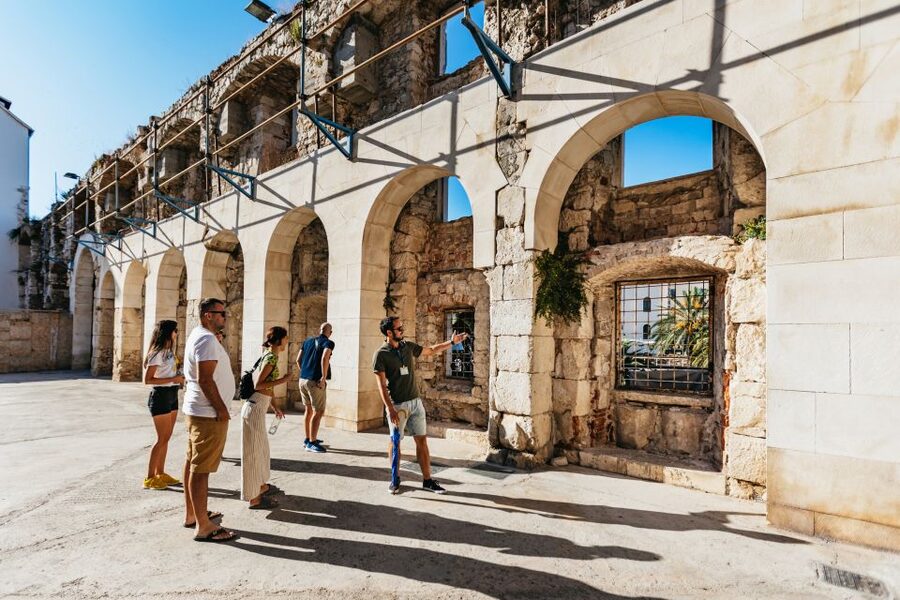
At $117 per group for up to 2 people, the value depends on how you travel. If you are used to paying for private tours, it lands in the reasonable range because you are paying for your own guide and your own pace.
Here’s what makes it feel fair. You are getting:
- A professional local guide
- A private group format (no loud speed-walking, no getting separated)
- Time in standout palace areas plus the cathedral and central squares
- Flexibility in duration, from 90 minutes up to 5 hours depending on your timing and interest
In practical terms, this can save you money if it replaces a day of figuring things out on your own. And it can be worth it even for a short visit because a private guide can help you avoid common mistakes, like wasting time on spots that do not match your interests.
One more thought: if your group includes a teenager or two, this kind of tour can prevent the usual history fatigue. The guide can adapt, keeping the story in reach without turning it into a kids-only show.
Guides make the difference: personal, professional, and built for questions
This tour wins because of the guide, not because of a scripted route. A private walking tour works only if your guide can read the room and adjust. From the names you might meet, you’ll likely get that local perspective.
Guides such as Slavko, Antonia, and Vinka are described as professional and enthusiastic, and they focus on giving individual tips. One of the biggest practical advantages is that a good guide can help you avoid big tour crowds by choosing a rhythm that keeps you from being stuck in the same bottleneck as everyone else. That means you can actually hear the story instead of shouting over backpacks.
Also, this is not just one-way facts. You should feel comfortable asking questions, even if the answer takes a minute longer. That extra exchange is often what turns a standard sight visit into a memorable one.
What to bring and how to make it comfortable
This is an outdoor walking experience. Plan for walking and sun.
Bring:
- Comfortable shoes, because you will be on foot
- Sunglasses
- A sun hat
If you burn easily, pack sunscreen too. Nothing in the tour description says they provide it, and you’ll likely be outside for multiple stops.
If you are prone to getting overheated, ask your guide to tailor the timing. Because the tour is private, you can usually shift the pace so you do not feel punished for choosing a history-heavy itinerary.
Who should book this private Split walk, and who should skip it
This tour is a strong match if you want history you can actually understand and use. It works especially well for couples, small families, and groups that include teens, because the guide can keep the story engaging while still anchored to real architecture.
You might also enjoy it if you want orientation fast. You start at a key landmark, then cover palace areas and central squares, so you leave with a clear sense of how Split is laid out.
Skip it or consider alternatives if:
- You use a wheelchair or need step-free access, since it is not suitable for wheelchair users
- You only want beach time and minimal walking, because the format is designed around monuments and stone streets
- You dislike structured walking tours, because this experience is built around guided stops
Should you book it?
If you like your sightseeing with context and your days with flexibility, I’d book this. The private pacing, the expert local guidance, and the mix of Diocletian’s Palace spaces plus St Duje make it a high-value way to understand Split in a single outing.
If you are short on time, consider booking this early in your stay. You’ll get your bearings fast, and that helps everything else you do afterward.
FAQ
How long is the Split private walking tour?
The duration can be flexible, ranging from about 90 minutes up to 5 hours. Starting times depend on availability.
Where do I meet the guide?
Meet at Golden Gate, the North Gate of Diocletian Palace in Split. Look for your guide holding a blue umbrella.
Is this tour private?
Yes. It is a private sightseeing tour for a private group.
What sights are covered during the walk?
You’ll visit key areas such as Golden Gate, Diocletian’s Cellars, Peristil, the Cathedral of Saint Domnius, and the Vestibul, plus stops through the city center including places like People’s Square, Fruit Square, and Riva.
What language options are available?
The live guide is available in English, German, Spanish, and French.
What should I bring for the walking tour?
Wear comfortable shoes. Bring sunglasses and a sun hat as well.
Is the tour wheelchair accessible?
No, it is not suitable for wheelchair users.
Walk It: More of Split at Ground Level



Inside the Palace Walls

Freshly written up around Split
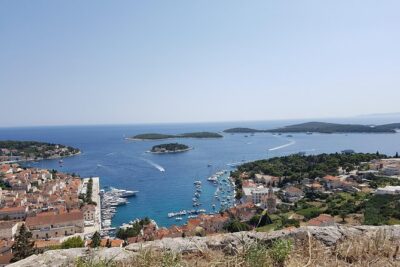


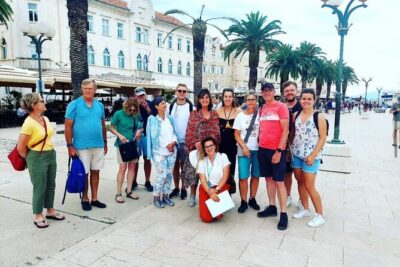

Split Old Town & Palace Walks, top to bottom.
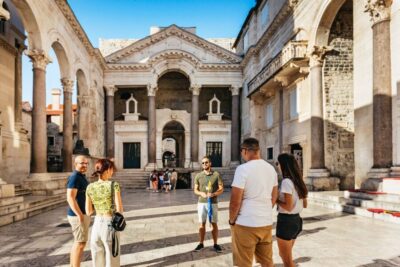 ★ 4.9Split: Old Town and Diocletian Palace Walking TourFrom $174,727 reviews
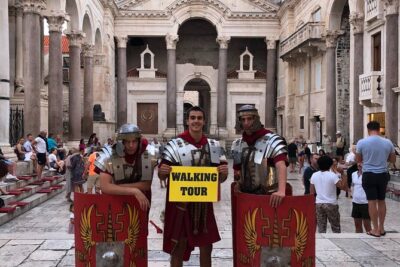 ★ 5.0Walking Tour of Split and Diocletian’s PalaceFrom $482,588 reviews
 ★ 5.0Split & Diocletian’s Palace Walking TourFrom $211,125 reviews
 ★ 5.0Walking Tour of Split with a ‘Magister’ of HistoryFrom $341,122 reviews
 ★ 5.0Split Walking Tour with Professor of HistoryFrom $24926 reviews
 ★ 4.7Split: Diocletian Palace & Old Town Guided Walking TourFrom $17882 reviews
 ★ 4.8Split: Game of Thrones Tour with Diocletian’s Palace CellarFrom $41545 reviews
 ★ 5.0Diocletian’s Palace and Old Town SMALL GROUP Walking TourFrom $16502 reviews
Browse the lists this tour appears in