
REVIEW · PULA ARENA & ROMAN ISTRIA TOURS
Pula: Historic Sites Guided Walking Tour
Pula has a lot going on for just a short stroll. I love how this 90-minute guided walk packs the big Roman landmarks into an easy route, and I also love the clear, story-driven way the guide explains what you are looking at as you move. If you want ticketed access inside monuments, plan on paying entry fees separately, since this tour does not include them.
You will meet your guide at the Pula Arena entrance with a blue card and umbrella, and you will finish near the Twin Gate. English is offered on a live guide, it runs rain or shine, and the pace is steady but walk-focused, so people with mobility impairments may struggle.
In This Review
- Key highlights you will actually feel
- Why this Pula walk works so well (and for whom)
- Meeting at the Pula Arena, then getting your bearings in minutes
- Pula Arena: more than a photo stop
- Up toward the Venetian castle for views and layered history
- Cathedral and Roman Forum: the story connects
- Arch of Sergii and Roman mosaics along the way
- Pula Market: history for real people, not just empires
- Gate of Hercules to wrap: a clear ancient finale
- Price and value: $20 for a fast, guided route
- What you learn from the guides (and why it matters)
- Practical tips so your tour feels smooth
- Should you book the Pula Amphitheater walking tour?
- FAQ
- How long is the Pula Historic Sites Guided Walking Tour?
- How much does the tour cost?
- Where do I meet the guide?
- What sites are included in the walking route?
- What is included in the ticket price?
- Are entry tickets included?
- What languages are offered?
- Is the tour canceled for bad weather?
- Is video recording allowed?
- Is the tour suitable for people with mobility impairments?
Key highlights you will actually feel
- Pula Arena start, with a quick overview that helps you spot what matters fast
- Venetian-built castle stop for panoramic views and a history lesson tied to who lived there
- Roman Forum highlights, including the Augustus Temple and City Hall
- Arch of Sergii plus Roman mosaics on the route, not just the headline sites
- Pula Market history, dating to the early 1900s, for a local life angle
- Gate of Hercules as a satisfying final ancient landmark before you wrap up
Other Roman-Istria stops we have covered
- Medulin -Kamenjak 5h boat trip with lunch & drinks on Sandra Boat★ 5.0 · 1,621 reviews
- Full-Day Boat Tour of the Medulin Archipelago from Medulin★ 5.0 · 1,389 reviews
- Pula: Kayaking,Snorkeling, Cliff jumping Tour with Wetsuit★ 4.8 · 861 reviews
- Pula: National Park Brijuni Island Visit & Dolphin Cruise★ 4.5 · 788 reviews
Why this Pula walk works so well (and for whom)
Pula is the kind of city where you can go sightseeing on your own, but you might miss the “why.” This tour is built for speed with context. You get a guided route that connects the Roman monuments to the later layers of Pula, so the city stops feeling like scattered ruins.
It is a good fit if you are in Pula for a limited time, want the main sights without turning it into a full day, and like history explained in plain language. It is also a strong choice for first-timers, because the route naturally gives you orientation. I found that when the guide points out what to watch for, the buildings start to make sense, not just look old.
One practical consideration: it is not listed as suitable for people with mobility impairments. You should also expect rain or shine. Wear shoes that handle old-town walking, and bring a light layer even in nicer weather.
Meeting at the Pula Arena, then getting your bearings in minutes
The tour begins in front of the Amphitheater entrance at the meeting spot, where your guide holds a blue card and an umbrella. That detail matters more than you might think. In old towns, meeting points can get confusing fast, and this one is easy to spot.
Right at the start, you get a brief overview of Pula’s history and what you are about to see. This is one of the best parts of the experience, because it sets your “mental checklist.” You are not walking past monuments hoping something clicks later. You are being taught what to look for as you go, including the Roman influence that shows up across the center.
The tour runs for about 1.5 hours, so the guide keeps things moving. The pace feels designed to let you see a lot without sprinting, which matches the way the route is laid out in the old town.
Pula Arena: more than a photo stop
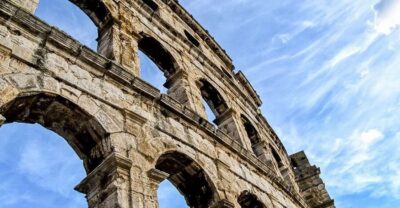
The Pula Amphitheater, often just called the Arena, is the anchor of the walk. You start here, which helps because once you understand the Arena’s role, the rest of Pula reads differently.
From here, the guide’s stories give you a framework for the Roman era. Even if the stones are what you photograph first, the explanation is what helps you understand why these structures mattered in their time. You will also see how later rulers and styles worked into the same city space.
This opening sets a tone that many people love, because it is informative without feeling like a lecture. It also gives you quick confidence for the rest of the walk, so you can enjoy the monuments instead of worrying about missing the key facts.
Up toward the Venetian castle for views and layered history
After the Arena area, you head toward Pula Castle, built by the Venetians in the 17th century. This is a smart shift in the tour because it changes the “type” of history you are seeing. You go from Roman monumental remains to a later fortress history, tied to who controlled the region and how the city defended itself.
The tour also gives you time to appreciate the panoramic views from the castle. Even if your view is partly blocked by buildings, standing higher changes how you understand Pula’s layout. You start to see how the neighborhoods and landmarks connect.
The guide explains the castle’s history and also mentions previous inhabitants. That detail matters, because it prevents the stop from feeling like a generic viewpoint. You are not just looking out, you are learning how the location repeatedly mattered over centuries.
More Pula covered at walking pace
- Pula: Historic Walking Tour with Local Guide & City Views
★ 4.8 · 143 reviews - Pula walking tour
★ 5.0 · 96 reviews - Pula: Historic Sites Guided Walking Tour
★ 4.8 · 78 reviews - Pula Essentials Walking Tour
★ 4.8 · 64 reviews - Pula Essentials Walking Tour
★ 5.0 · 62 reviews
Cathedral and Roman Forum: the story connects
From the castle area, the walk continues toward the Cathedral and into the Roman Forum zone. This sequence is effective because it keeps building your timeline. You see the medieval and later religious landmark side by side with the Roman civic core.
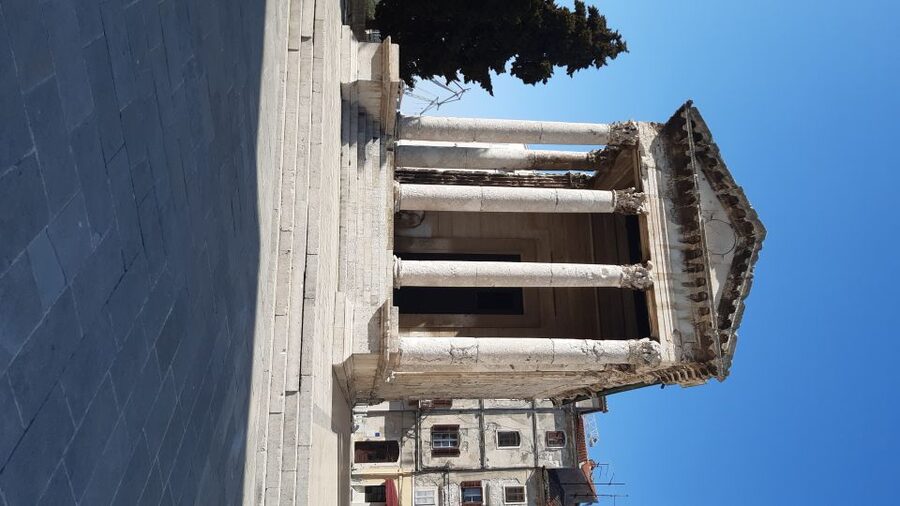
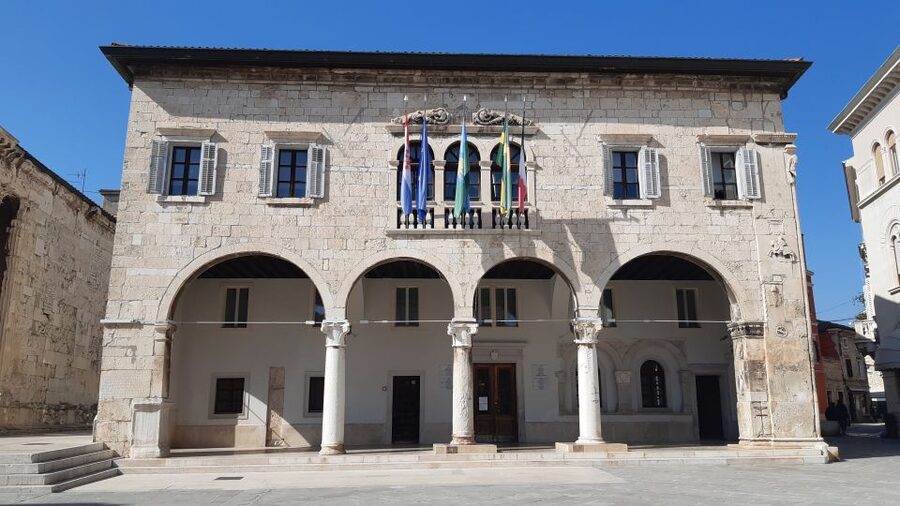
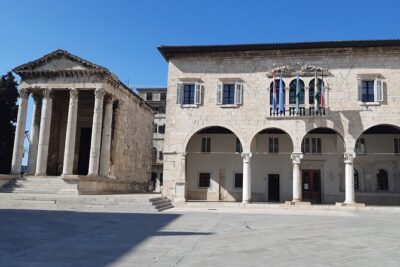
In the Roman Forum area, you focus on major named highlights: the Augustus Temple and City Hall. The Augustus Temple is described as about 2,000 years old, and it is one of those stops that feels instantly meaningful because the name is so recognizable. The guide helps you see what kind of space it was and why it fits into the bigger Roman plan for Pula.
Arch of Sergii and Roman mosaics along the way
One of the easiest mistakes in a Roman city is focusing only on the famous buildings. This tour keeps you alert to smaller survivals and details.
Along the way, you see Roman mosaics, plus the Arch of Sergii. The mosaics are the kind of thing you might overlook if you are just sightseeing quickly. With a guide pointing them out, you learn what you are looking at and why Roman decoration and art mattered, not just that the city had marble and monuments.
The Arch of Sergii adds another layer. It is a reminder that triumphal architecture is not only for big empires in big capitals. Pula had its own local expressions of Roman power and culture.
Pula Market: history for real people, not just empires
After the ancient and medieval monuments, the tour shifts toward everyday local history at the Pula Market, established in the early 1900s.
This is a great mid-to-late walk change of pace. It is not as dramatic as an amphitheater, but it is more grounded. You get a sense of how Pula kept functioning and how commerce shaped the city long after the Romans were gone.
Even if you just glance at stalls and open space, the context helps. You start to understand that Pula is not a museum. It is a working city with layers.
Gate of Hercules to wrap: a clear ancient finale
The tour ends with the ancient Gate of Hercules at the finish near the Twin Gate area. Having a final named landmark helps the experience land. Instead of ending near something generic, you close with an ancient structure that fits the Roman theme of the walk.
By this point, you have already seen the Roman Forum zone and several named Roman elements, so the gate feels less like a random stop. It becomes the last piece in a guided tour logic that ties together monuments, movement, and meaning.
Price and value: $20 for a fast, guided route
At $20 per person, this walking tour is priced for value if your main goal is to see and understand Pula quickly. You are paying for an English-speaking local guide and a structured route that connects sites, rather than paying for entry into buildings.
That also means you should budget for entry tickets separately if you want inside access at any stop. If your priority is to learn the city layout and key history without extra ticket costs, you will still likely feel satisfied. If you expect everything to be included, you might feel surprised when you see ticket lines.
For many visitors, this is a smart first stop in Pula. It gives you confidence so the rest of your time feels easier and less confusing.
What you learn from the guides (and why it matters)
This is the kind of tour where the guide makes the difference between seeing monuments and actually understanding them.
In the field, you will hear the stories in a way that feels both structured and lively. People highlight guides like Sini for excellent English and a style that keeps the group engaged, with answers to questions. Others note the guide is friendly and even funny, which helps in a 1.5-hour format where attention can wander if the narration turns dry.
You also get “insider information” that is not just dates. You hear about architecture, culture, and how Pula’s heritage evolved from Roman days into later periods like the Venetian era. That is what makes the walk feel worth it, even if you have visited a few historic sites before.
Practical tips so your tour feels smooth
- Wear walking shoes you trust on uneven old-town streets.
- Bring a light rain layer since it runs rain or shine, even if the route is short.
- Expect more looking than sitting. This is a walk that rewards paying attention.
- If you care about indoor sights, plan ahead for entry tickets since they are not included.
- If video matters to you, note that video recording is not allowed on this tour.
Should you book the Pula Amphitheater walking tour?
Book it if you want the best of Pula in a compact time window, and you like history explained while you walk. This tour is especially worth it if you are the type of person who wants to understand what you are seeing, not just collect photos.
Skip it or adjust expectations if you rely on mobility-friendly routes, since it is not suitable for people with mobility impairments based on the tour details. Also, if your plan is to enter every site you see without paying anything extra, you will need to handle entry tickets on your own.
If you are in Pula for a day or two, this is a strong way to get the city into your head fast. Then you can wander afterward with a lot more confidence and fewer guesswork moments.
FAQ
How long is the Pula Historic Sites Guided Walking Tour?
The tour lasts about 90 minutes.
How much does the tour cost?
The price is $20 per person.
Where do I meet the guide?
Meet your guide in front of the Amphitheater entrance. They will have a blue card around their neck and hold an umbrella.
What sites are included in the walking route?
You will cover Pula’s main historic highlights, including the Pula Arena, Pula Castle, the Cathedral, the Roman Forum (including Augustus Temple and City Hall), Roman mosaics along the way, the Arch of Sergii, the Pula Market, and the ancient Gate of Hercules.
What is included in the ticket price?
The tour includes a local expert guide.
Are entry tickets included?
No. Entry tickets are not included.
What languages are offered?
The live guide is available in English.
Is the tour canceled for bad weather?
No. The tour takes place rain or shine.
Is video recording allowed?
No. Video recording is not allowed.
Is the tour suitable for people with mobility impairments?
No. It is not suitable for people with mobility impairments.
Pula, the Longer Story


Walk It: More of Pula at Ground Level
Roman Istria, Continued





Freshly written up around Pula



Pula Arena & Roman Istria Tours, top to bottom.
 ★ 4.3Pula: Arena Entrance TicketFrom $112,590 reviews
 ★ 5.0Medulin -Kamenjak 5h boat trip with lunch & drinks on Sandra BoatFrom $541,621 reviews
 ★ 5.0Full-Day Boat Tour of the Medulin Archipelago from MedulinFrom $541,389 reviews
 ★ 5.03hours all inclusive Sunset&Dolphin Tour from Medulin on SandraFrom $541,130 reviews
 ★ 4.8Pula: Kayaking,Snorkeling, Cliff jumping Tour with WetsuitFrom $57861 reviews
 ★ 4.5Pula: National Park Brijuni Island Visit & Dolphin CruiseFrom $76788 reviews
 ★ 4.5Pula: Brijuni Sunset Dolphin Cruise with Dinner & DrinksFrom $62764 reviews
 ★ 4.9Pula: Night-Time Sea Kayaking Tour in Transparent KayakFrom $69628 reviews
Browse the lists this tour appears in